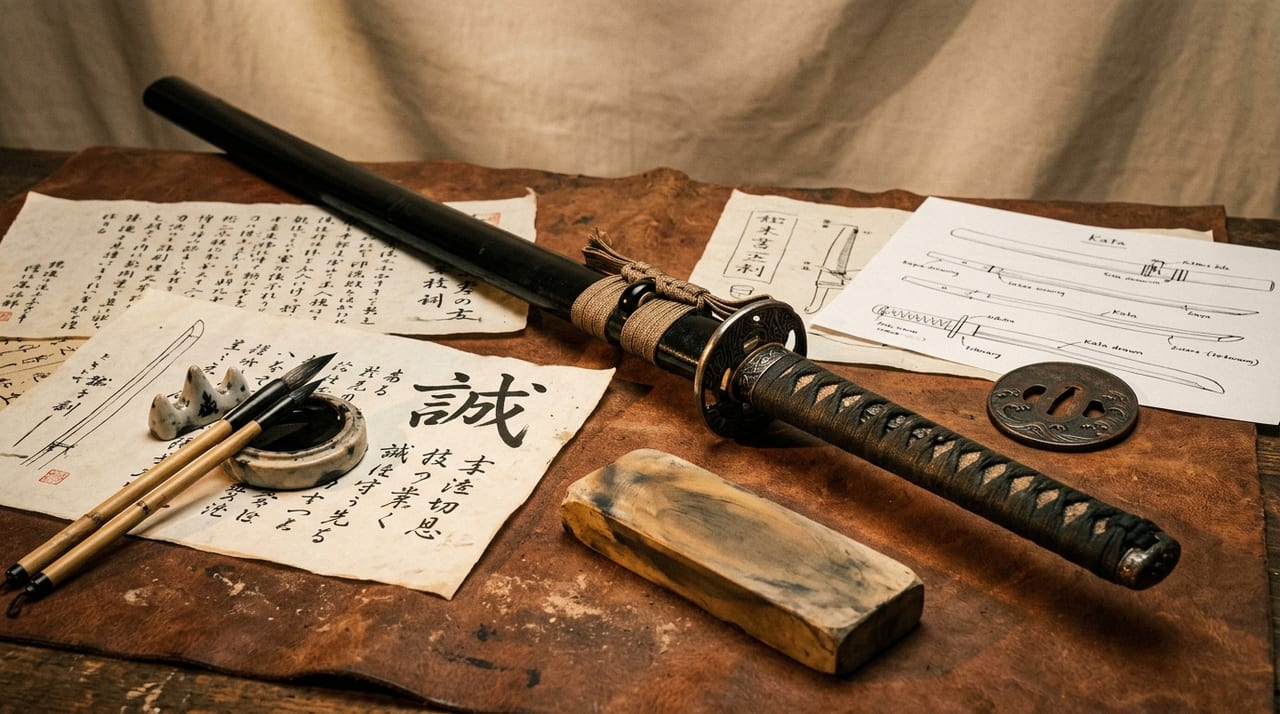
 * Image is for illustrative purposes only.
Sword for Hire
剣客商売
A towering masterpiece of historical fiction serialized by Ikenami Masatarō from 1972 onward. Centering on Akiyama Shōbei, a swordsman of Edo, and his son Dajirō, the story follows an aging master swordsman who freely makes his living by the blade while unraveling the delicate nuances of human nature. With three pillars—'sword, food, and human nature'—the work is particularly renowned among Japanese historical fiction for its meticulous depictions of swordsmanship and Japanese swords.
Description
Ikenami Masatarō and the Birth of Sword for Hire
Sword for Hire, standing alongside Onihei Hankachō and Shikakinin Fujishiro Umeyasu as one of Ikenami Masatarō's three representative masterworks, was serialized in the magazine Shōsetsu Shinchō from 1972 to 1990. The protagonist Akiyama Shōbei is a swordsman of Edo who, despite being in retirement, possesses first-rate swordsmanship. His son Dajirō is an earnest young swordsman devoted entirely to the way of the blade, and this contrasting father-son pair endows the narrative with rich human depth. Ikenami himself possessed kendo experience, and his knowledge and intuition underpin the realism of the sword technique depictions. His deep expertise in Edo's food culture and customs is equally evident, and Sword for Hire constructs a unique world built on the three pillars of 'sword, food, and human nature.'
Swordplay Schools and the World of Mugai-ryū
In Sword for Hire, both the father Shōbei and son Dajirō practice the swordsmanship of 'Mugai-ryū,' a prestigious school of the early Edo period founded by Tsuji Gettan, which became the source tradition for numerous later schools. Against this backdrop, scenes of tsujigiri (crossroads dueling) and shiai (formal bouts) using live blades are depicted with palpable tension. Particularly noteworthy is how the narrative carefully portrays the economic realities facing professional swordsmen. The hardships of operating a dojo, competition for students, and the difficulty of making one's livelihood by the sword emerge as themes running parallel to the aesthetics of the blade, undergirding the story. This is reflected in the very title 'Sword for Hire'—the work embodies a cool-headed recognition that swordplay is as much business as it is romance, a current flowing beneath the work's foundation.
Edo's Blade Culture and Townspeople Society
Set in the mid-to-late Edo period, Sword for Hire vividly depicts the atmosphere of Edo's street life, where samurai, townspeople, swordsmen, and gamblers intermingle. During this era, while the samurai class retained the obligation to bear swords, they increasingly lacked combat experience, yet a peculiar profession emerged—the 'swordsman'—consisting of individuals who made their living by the blade. Rather than serving a clan, these men earned their keep through dojo management, bodyguard work, and formal bouts. The swords that appear in the narrative need not be famous blades, but must be trustworthy weapons capable of withstanding actual combat. In Ikenami's portrayal, the sword functions as 'a tool reflecting its owner's way of life,' transcending mere prop to become a mirror reflecting the character's inner world.
Television Drama History and Cultural Contribution
Sword for Hire was adapted for film and television beginning with the 1973 Fuji Television version (starring Katō Takeshi) through the 1998 Fuji Television version (starring Fujita Makoto). The Fujita Makoto version, in particular, was serialized and broadcast over an extended period, achieving high viewership. The portrayal of Akiyama Shōbei by Fujita Makoto—at once refined yet formidable—became deeply imprinted in the minds of many viewers as the 'ideal swordsman.' The action choreography in the drama involved master choreographers, with movements researched and grounded in actual Edo-period swordsmanship. Through these adaptations, Sword for Hire made a significant contribution to shaping the image of 'authentic Edo swordplay' in Japanese popular culture.
Mugai-ryū and the History of Edo Swordplay Culture
The Edo swordplay culture that forms the backdrop of Sword for Hire exists within a historical process wherein the focus shifted from 'actual combat' to 'martial discipline and spiritual cultivation' amid the Tokugawa shogunate's peace. Schools such as Mugai-ryū completed refined systematic approaches that united technical mastery with spiritual training during the Edo period. The philosophy of swordsmanship established in this era—the notion that 'the sword is a matter of the spirit'—is inherited in contemporary kendo. Ikenami Masatarō articulated the work's rich portrayal of swordplay's spiritual dimensions alongside the worldly reality of making one's living by the sword, vividly revealing swordplay's dual nature in Japanese culture.
Implications for Japanese Sword Collectors and Tōkenza
While swords in Sword for Hire need not be famous blades, they are implicitly assumed to possess the quality of 'working blades' capable of practical use. Among the swordsmiths known as shinTo and shinshintō of the mid-to-late Edo period, many produced reliable, practical blades suited to such use. Tōkenza stocks abundantly the types of Edo-period tachi and wakizashi befitting the world of Edo swordsmen depicted in Sword for Hire. For those seeking 'a reliable blade rather than a celebrated name,' Hizen blades, Mino blades, and Izumi-no-kami Kanetada-lineage practical swords are recommended. We would be delighted if you could re-experience the world of swords and human nature brought to life through Ikenami's prose by handling an authentic blade in your hands.
Shōbei's Blade and the Ideal of the 'Aging Master'
One reason Sword for Hire stands out among Japanese historical fiction is that the protagonist Shōbei is not a 'youthful hero' but an 'aging master.' Even past sixty, his swordplay remains sharp, and enriched by life experience and insight, he becomes a swordsman of even greater formidability. This image of the 'aged swordsman' embodies the ideal long articulated in Japanese martial philosophy: 'the way of the sword is lifelong training.' In the context of authentic sword training using live blades, the concept that technique and spirit mature with age is respected as a shared value in contemporary kendo and iaido circles. Shōbei's life poses an essential question to the reader about what it means to bear a Japanese sword and walk the path of the blade—not physical prowess, but the deepening of spirit. This ethos resonates deeply with the way Tōkenza treasures its approach to Japanese swords.
Real Swords Featured
Mugai-ryū Uchigatana (Early to Mid-Edo Period)
The father and son swordmasters featured in "Kenkaku Shōbai," Akiyama Shobei and Jiro, practice the Mugai-ryū (無外流), a school founded by Tsujigetttan. Mugai-ryū is a martial arts style that emerged in the early Edo period, with a system balancing technical refinement and spiritual cultivation. The uchigatana favored by its practitioners were typically practical and easy to handle, ranging from 2.2 to 2.4 shaku in length, with Hizen and Mino blades being common—swords chosen for reliability over ornamentation in their hamon patterns. The "plain yet functional blade" wielded by Shobei exemplifies these practical Edo-period uchigatana.
Izumi-no-kami Kanetada (Tenshō to Early Edo Period)
Izumi-no-kami Kanetada (also written Shitesada), a master craftsman of Mino, was immortalized during the Sengoku period as the beloved blade of warriors like Hijikata Toshizo. His lineage continued throughout the Edo period. Mino-tradition blades that prioritized sharpness and practicality were an ideal choice for the combat-focused swordsmen depicted in "Kenkaku Shōbai," representing one of the most fitting traditions for the work's sword aesthetic. Even today, many sword enthusiasts appreciate Mino-tradition blades as "functional swords," and Tōkenjō regularly handles Edo-period Mino-school swords.
Hizen Tadahiro (Early to Mid-Edo Period)
Tadahiro, the second-generation Hizen blade maker (Hashimoto Tadahiro), son of the founder Tadayoshi, produced numerous practical blades of consistent quality. His swords are characterized by the transparency of their jigane and calm, flowing hamon patterns, making them the quintessential example of the "blade of trust" that spread widely throughout samurai society. Among the swords worn by the swordsmen in "Kenkaku Shōbai," Hizen blades represent one of the choices with the greatest historical authenticity. Tōkenjō handles multiple fine examples.
Yamato-no-kami Yasushige (Early to Mid-Edo Period)
Yamato-no-kami Yasushige, a sword maker of Musashi (Edo), was known as an official smith for the Edo shogunate. His work spread widely throughout Edo samurai society. In the streets of Edo, which serve as the setting for "Kenkaku Shōbai," Yasushige's swords represent one of the most likely candidates for blades actually worn by swordsmen. Many of his uchigatana offer stable quality and ease of handling, making him a fitting smith for "Kenkaku Shōbai's" theme of the sword as a "tool of trade."
Katayama Munetsugu (Bakumatsu Shinshintō)
Katayama Munetsugu was one of the representative sword makers of late Edo (Bakumatsu), and his blades earned the highest rating among Shinshintō smiths under the "Gyōmono" (registered masterwork) classification. With beautiful jigane and functional hamon combining practical and aesthetic excellence, Munetsugu stands at the forefront of late-Edo swordsmen's aspirations in "Kenkaku Shōbai" when dreaming "if one could own a good blade." Tōkenjō occasionally acquires his works, highly prized by collectors.
See authentic Japanese swords
See authentic Japanese swordsThis page is intended to introduce Japanese sword culture and is not affiliated with any of the works mentioned.