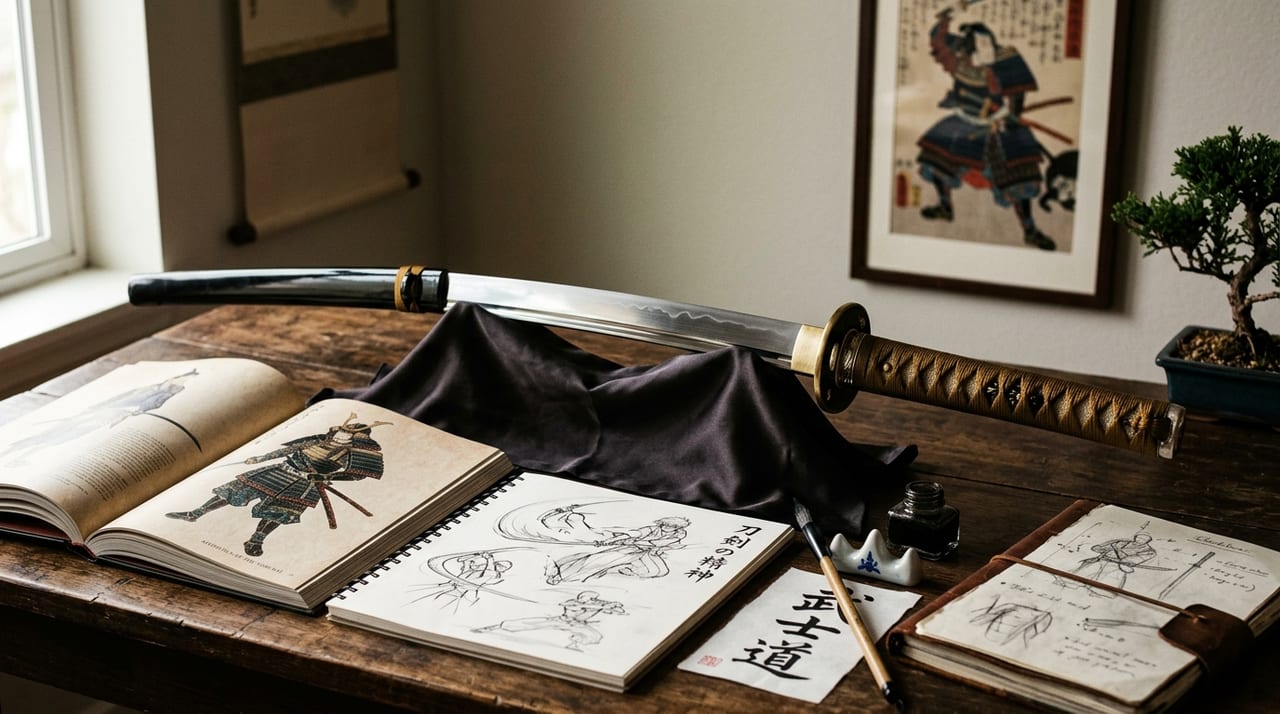
 * Image is for illustrative purposes only.
Katsugeki Touken Ranbu
活撃 刀剣乱舞
A 2017 TV anime produced by ufotable, based on the sword personification game Touken Ranbu by DMM Games and Nitroplus. Set in Edo during the Bakumatsu period, it follows sword warriors (touken danshi) battling the Time Retrograde Army that seeks to alter history. Famous swords such as Mikazuki Munechika and Tsurumaru Kuninaga appear as beautifully designed characters, spreading knowledge of Japanese sword names, smiths, and historical contexts to a wide domestic and international audience. The series made a significant contribution to popularizing sword culture as a leading work in the katana boom.
Description
Katsugeki Touken Ranbu — A Modern Sword Culture Movement Born from Sword Personification
Katsugeki Touken Ranbu (2017, produced by ufotable) is a TV anime series based on the browser game Touken Ranbu (service launched 2015), jointly developed by DMM Games and Nitroplus. Within the Touken Ranbu franchise, a stage play version premiered in 2016 (Touken Ranbu: Kyoden — Moyuru Honnoji), an alternate anime version premiered in 2016 (Touken Ranbu: Hanamaru), and this anime version premiered in 2017 (Katsugeki Touken Ranbu). Katsugeki is positioned as the serious-action installment, renowned for ufotable's high-quality battle animation.
### Sword Personification — Experiencing Famous Blades as Personalities
The core concept of the Touken Ranbu franchise is the personification of famous Japanese swords as beautiful young men. This applies Japan's broader "gijinka" (anthropomorphism) culture — representing non-human entities such as warships, weapons, flora, and nations as human characters — to the realm of swords, reinterpreting blades that were previously discussed only within sword history, archaeology, and art history as relatable characters for younger and female audiences.
The touken danshi (sword warriors) in Katsugeki are modeled on real, historically documented famous swords.
Mikazuki Munechika is a tachi attributed to the Heian-period smith Sanjo Munechika, designated a National Treasure and held by the Tokyo National Museum. Renowned for its elegant curvature and beautiful temper pattern, it is counted among the "Five Great Swords of Japan." In the series, it is depicted as "the most senior sword warrior with a languid manner of speech," a character design that can be understood as embodying the eternal time the blade has witnessed — more than a thousand years from the Heian period to the present.
Tsurumaru Kuninaga is a tachi attributed to the Heian smith Kuninaga and serves as one of the protagonists. Its distinctive personality — "a love of surprising others" — can be read as a personification of the sword's essential duality: the astonishing paradox that a masterwork of beauty is also an instrument of death.
Ishikirimaru is a tachi enshrined at Ishikiri Tsurugiya Shrine in Osaka. The historical fact that its blade bears many chips (worn from actual use and long dedication) is reflected in the character's design.
### The Bakumatsu Setting — The "History Alteration" Theme and Sword History
The story adopts a science-fiction fantasy framework: sword warriors battle the Time Retrograde Army, which seeks to alter history in Edo during the Bakumatsu period (set in 1863). This setting carries significant meaning from a sword history perspective.
The Bakumatsu era (1853–1868) is itself a pivotal turning point in the history of the Japanese sword. Amid the political conflicts over "opening the country" and "expelling the barbarians" that followed Commodore Perry's arrival in 1853, samurai actually bore their swords, and many blades were used in real combat and assassinations. Historical records note that numerous swords belonging to the Shinsengumi broke during the Ikedaya Incident (1864), making the Bakumatsu arguably the last era in which Japanese swords saw serious battlefield use.
The choice of the Bakumatsu as the setting thus carries high historical coherence for a sword personification work — it selects the period in which the Japanese sword bore its most visceral historical role. In the series, sword warriors interact with real Bakumatsu figures such as Kondo Isami and Katsura Kogoro, embodying the theme of "the sword as guardian of history" at the narrative level.
### ufotable's Visual Quality — Artistic Expression of Sword Combat
ufotable, the studio behind Katsugeki, is renowned for high-quality animation including Fate/Zero and Demon Slayer: Kimetsu no Yaiba. The sword-combat sequences in Katsugeki feature high artistic precision in the depiction of blade trajectories, the moment of impact, and afterimages, allowing viewers to experientially grasp the aesthetic qualities of the Japanese sword — formal beauty, functional beauty, and kinetic beauty — through "the movement of the blade," "light reflecting off the edge," and "the choreography of the strike."
In particular, the depiction of Mikazuki Munechika's tachi-suji — the motion of bringing a tachi sweeping down in a wide arc — can be evaluated as motion design referencing the actual characteristics of tachi technique: the use of centrifugal force in wide sweeping cuts and the engagement of the entire body.
### Contribution to the Katana Boom — Museum Attendance and Shifting Awareness
The Touken Ranbu franchise (encompassing game, stage, and anime) dramatically transformed social interest in Japanese sword culture.
At the Tokyo National Museum, significant increases in visitor numbers — centered on younger female demographics — were recorded during exhibitions of swords featured in Touken Ranbu, such as Mikazuki Munechika and Sancho Mou. During the "Katana Boom" of 2015–2018, multiple sword museums and art museums reported the "Touken Ranbu Effect": rising proportions of female visitors and new participation from younger demographics.
This phenomenon — in which sword personification content stimulates interest in actual swords — stands as a noteworthy case in the history of cultural heritage promotion in Japan.
### A Collector's Perspective
Katsugeki Touken Ranbu and the broader Touken Ranbu franchise serve as gateways to the real Japanese swords on which their sword warrior characters are modeled. Mikazuki Munechika (Tokyo National Museum), Tsurumaru Kuninaga (Imperial Household Collection), Ishikirimaru (Ishikiri Tsurugiya Shrine), and others all survive in museums and shrines across Japan, and the series acts as a bridge to the experience of viewing these actual blades. Readers interested in sword collecting are encouraged to use the Touken Ranbu character roster as a systematic introduction to the location and cultural significance of National Treasure and Important Cultural Property designated Japanese swords.
Real Swords Featured
Mikazuki Munechika (Heian period, crafted by Sanjo Munechika, National Treasure, housed in the Tokyo National Museum)
Tsurumaru Kuninaga (Heian period, crafted by Kuninaga, Imperial Regalia, managed by the Imperial Household Agency)
Ishikirimaru (Heian period, housed at Ishikiri Tsurugiya Shrine)
Yamatorige (Kamakura period, Bizen Fukuoka Ichimonji school, transmitted through the Uesugi clan)
See authentic Japanese swords
See authentic Japanese swordsThis page is intended to introduce Japanese sword culture and is not affiliated with any of the works mentioned.