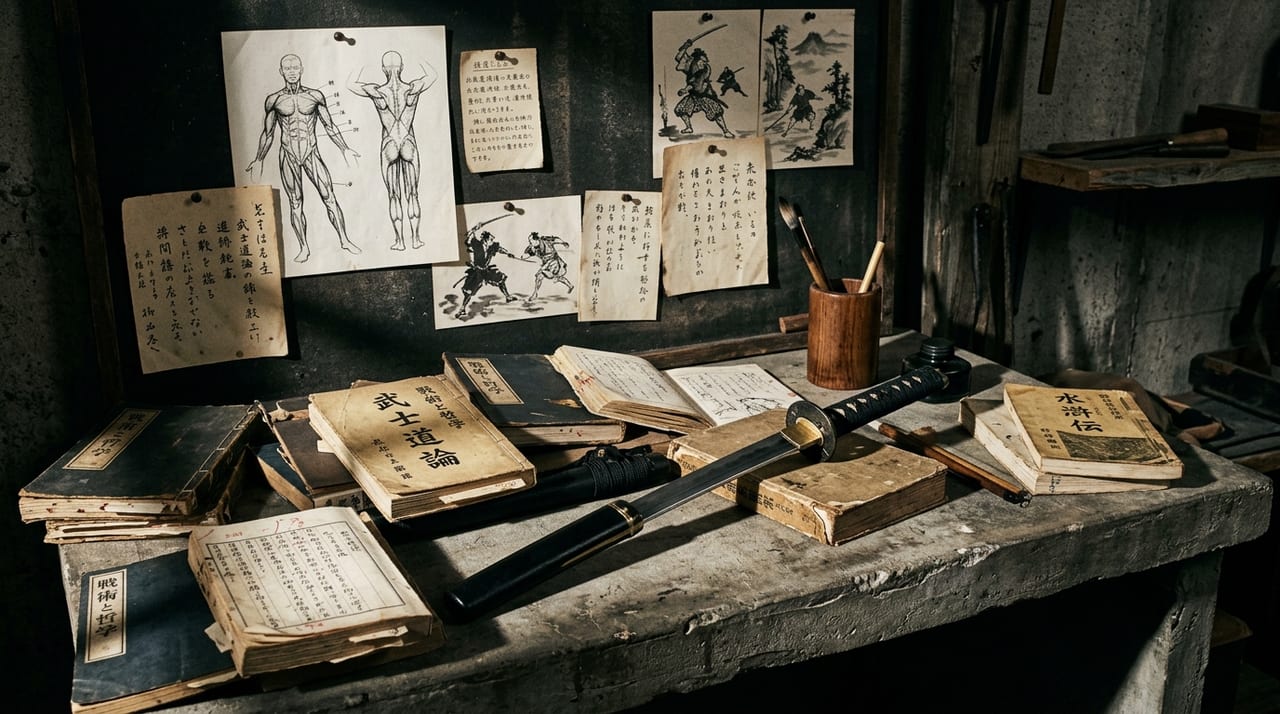
 * Image is for illustrative purposes only.
Kamui-den (Legend of Kamui)
カムイ伝
Historical manga by Shirato Sanpei (serialized 1964–1971 in the monthly magazine Garo; his representative work). Set in the Edo period, it tells the story of Kamui—a ninja from a discriminated-against burakumin community who fights against the system while seeking freedom. One of the highest achievements in manga history for its realistic depiction of ninja weapons, ninja-sword technique, sword-fighting theory, and the sword-drawing style called henai battou kasumigiri ("shifting-movement draw-mist-slash"). A representative work of the gekiga movement that united the social criticism of the 1960s with Japanese and ninja sword culture—a revolutionary work.
Description
Kamui-den — Gekiga at Its Peak: The World of Ninja Swords and Drawing Techniques
Kamui-den (Shirato Sanpei, 1964–1971) is a historical gekiga serialized in the avant-garde monthly manga magazine Garo, and remains one of the most important works in Japanese manga history. Against the backdrop of Edo-period feudalism and caste discrimination, the story of the ninja Kamui — born into a discriminated-against community (hinin/eta) — fighting the system in pursuit of freedom reflects the political atmosphere of the 1960s student movement and social transformation. However, this essay focuses on why the work is regarded as one of the highest standards in manga history in its depiction of Japanese swords and ninja swords.
### Technical Depiction of Ninja Swords and Japanese Swords
One of the greatest characteristics of Kamui-den is that it depicted the use of the ninja sword (shinobi-gatana) — the weapon of the ninja — with extreme realism. Unlike the standard uchigatana (sword) or tachi (sword), the ninja sword has a short, straight-blade-like shape and is designed to specialize in thrusting and assassination rather than cutting. The ninja sword techniques employed by Kamui possess the following characteristics: close-range thrusting tactics after closing the distance, the "kuzushi" (disruption) that reverses the opponent's sword forms, and lethal strikes accomplished through a single blow using gravity and body-weight transfer. These technical depictions reach a standard that sword-art and martial-arts researchers evaluate as "theoretically coherent."
### "Henui Battō Kasumi-Giri" — Kamui's Drawing Technique
The most famous technique in this work is the "Henui Battō Kasumi-Giri" — Kamui's drawing technique. This is a form of iai (drawing) in which the sword is drawn from its sheath in an instant to simultaneously kill multiple enemies. The technique depicts the essence of iai — "a sword in its sheath can be faster than a drawn sword under certain conditions" and "the drawing motion itself becomes the attack" — visualized at the highest level as dynamic manga depiction in "Henui Battō Kasumi-Giri." This technique depiction has high affinity with the theory of actual iaido and is evaluated as evidence that Shirato Sanpei seriously researched martial arts and reflected that research in his artwork.
### Shirato Sanpei's Martial Research and Gekiga Technique
Shirato Sanpei (born 1932) had training in judo and kendo from childhood, and is said to have conducted extensive documentary research into swordsmanship, ninjutsu, and classical martial arts in the creation of this work. The gekiga (dramatic pictures) visual style — realistic and dramatic — made it possible to express with manga the closest approximation to reality: the swift movements of ninja, the trajectory of blades, the spray of blood, the angles of cuts. The depiction of swords and blades in Kamui-den set a foundational precedent that fundamentally elevated the depiction standards of subsequent ninja manga and period-drama manga, making it a technical milestone in Japanese manga history.
### Caste System and "The Right to Bear a Sword"
Another important theme of Kamui-den is the question "Who may carry a sword?" After the Edo period sword hunts (by Toyotomi Hideyoshi), sword-bearing was a privilege of the samurai class and was in principle forbidden to farmers, non-persons (hinin), and the discriminated-against classes (eta). Kamui's possession of a ninja sword is an act that violates this social taboo and is also a physical expression of his "will to freedom." The relationship between "the right to carry a sword" and "social rank and power" — this is a theme with essential political dimensions in Japanese sword culture, and Kamui-den is the work that has most fundamentally questioned this theme in manga form.
### Intersection of 1960s Social Movements and Sword Culture
The years 1964–1971, when Kamui-den was serialized, completely overlap with the period when Japan's student movement and social transformation movement reached its peak. As an avant-garde manga magazine of the time, Garo was read by a different audience than mainstream boys' manga magazines — students, intellectuals, and left-wing activists. In this context, the story of Kamui wielding his ninja sword in rebellion against the system was read not merely as period-drama entertainment but politically as a "metaphor for resistance against the system." As a manga expression in which the sword functioned as a "weapon of anti-establishment resistance," Kamui-den is an essential reference point for understanding the political dimensions of Japanese sword culture.
### Perspective for Sword Collectors
Kamui-den, as a manga that depicts the practical technical theory of Japanese swords and ninja swords at the highest level, provides sword enthusiasts with profound knowledge. The essence of iai (depicted as "Henui Battō Kasumi-Giri"), the design philosophy of the ninja sword (specialization in thrusting, portability), and the "kuzushi" theory of swordsmanship — these are important concepts in actual sword and swordsmanship research, and this work provides a rare opportunity to experience them through the gekiga form. Furthermore, through the social question "Who may carry a sword?" one can deeply understand as narrative the Japanese sword-bearing culture and the historical significance of the sword hunts.
Real Swords Featured
Shinobi-gatana (Ninja Sword)
Uchigatana
See authentic Japanese swords
See authentic Japanese swordsThis page is intended to introduce Japanese sword culture and is not affiliated with any of the works mentioned.