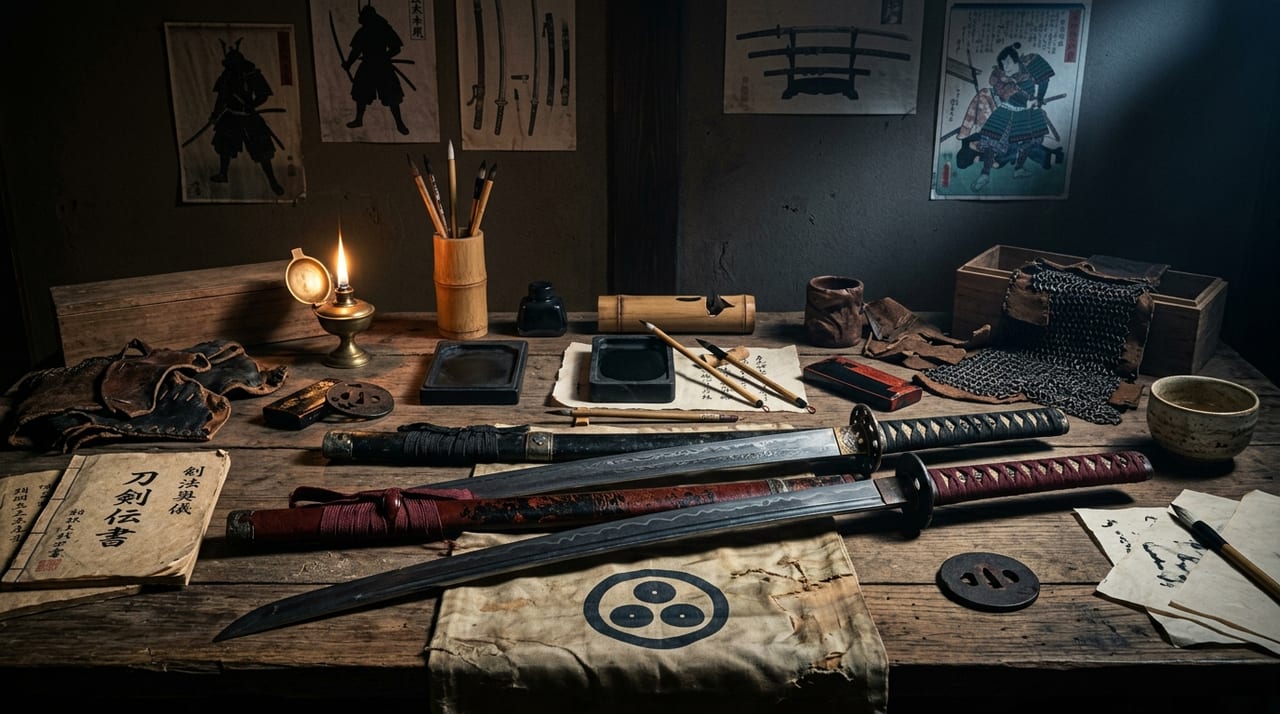
 * Image is for illustrative purposes only.
Kagemusha
影武者
A historical film from 1980 directed by Akira Kurosawa. Through the story of a lower-ranking warrior who became the shadow warrior (kagemusha) of Takeda Shingen, it depicts power, death, and honor in the Sengoku period as a grand work. Co-winner of the Palme d'Or at the Cannes Film Festival with "All That Jazz." Starring Tatsuya Nakadai, it is renowned for its meticulous recreation of swords, armor, and tactics on the battlefield.
Description
Kagemusha — Kurosawa's Masterwork Where Sengoku Power and the Japanese Sword Converge
Kagemusha (1980) stands alongside Ran (1985) as one of Akira Kurosawa's supreme achievements in his final creative period. Produced at a then-record budget of ¥2 billion, the film follows a nameless thief forced to impersonate the dying warlord Takeda Shingen, interrogating the nature of power and the illusions of warrior identity. Francis Ford Coppola and George Lucas famously championed the film's international distribution.
### Takeda Shingen and the Japanese Sword
Takeda Shingen founded the Kōshū-ryū tactical school, and his army's armaments carry significant meaning in sword history. The weapons, armor, lances, and bows of the Takeda forces were reproduced under expert supervision to reflect mid-sixteenth-century originals from the final phase of the ko-tō (old sword) period, when regional blade traditions — Sōshū-den, Yamato-den, Bizen-den — coexisted at their historical peak.
The swords depicted for the Takeda house reflect the practical characteristics of the battlefield uchigatana: blade length, curvature, and spine thickness suited to mounted and dismounted combat. Alongside the depiction of Takeda's famed cavalry, the film provides a visual record of on-horseback blade use — how swords were carried, sheaths secured, and the draw executed at speed.
### The Shadow's Sword: The Boundary Between Reality and Fiction
The film's central theme — the boundary between authentic and counterfeit — resonates deeply with the world of Japanese swords. The tradition of utsushi (replicas made in deliberate homage to famous blades) parallels the kagemusha's role precisely: embodying authority's outer form while lacking the inner original. The thief's anguish at being forced to perform a dead man's identity mirrors the philosophical question posed by every fine utsushi: does authentic power reside in the form, or in the spirit that animated it?
### The Battle of Nagashino and the End of the Sword's Battlefield Era
The film's climax recreates the Battle of Nagashino (1575), where the Oda–Tokugawa alliance's volley fire annihilated the Takeda cavalry — the historical turning point at which firearms began displacing swords and bows as the dominant battlefield technology. Kurosawa's depiction of approximately 200 mounted warriors against massed arquebusiers records the moment the sword's military supremacy began its decline. The aftermath — broken lances, fallen swords, blood-soaked armor — speaks without words to the truth that the katana was, above all, a tool of lethal work.
### Perspective for Sword Collectors
Kagemusha is recognized for its faithful recreation of Takeda-clan armor and weapons, drawing on historical materials preserved at Takeda Shrine in Yamanashi and the Kōfu City Historical Museum. The film has introduced many sword enthusiasts to Kōshū-kaji — the smithing tradition of Kai Province, which absorbed Sōshū-den influences under Takeda patronage to produce a distinctive regional lineage. Kurosawa's exacting historical eye makes this film a visual encyclopedia of Sengoku-era sword culture that rewards repeated viewing by collectors and scholars alike.
See authentic Japanese swords
See authentic Japanese swordsRelated Content
Nobunaga's Ambition
Game信長の野望
Japan's longest-running historical simulation game series by Koei Tecmo (1983–). Players control Sengoku warlords including Oda Nobunaga in a quest for national unification. The series systematically parameterizes warriors' swords and equipment, providing one of the most comprehensive frameworks for learning about Japanese sword history, distribution, and connections to historical figures.
Seven Samurai
Film七人の侍
Akira Kurosawa's timeless masterpiece that introduced the world to Sengoku-era warriors and swords, influencing all subsequent action cinema.
Legend & Butterfly (Film, 2023)
Filmレジェンド&バタフライ(映画・2023年)
Toei 70th Anniversary commemorative work (directed by Otomo Keishi, screenplay Furusawa Yoshita, released January 2023). Kimura Takuya portrays Oda Nobunaga and Ayase Haruka portrays his primary consort Nōhime (Kicho), depicting the unknown bond between Nobunaga and Nōhime. A large-scale historical film with a total production cost of 2 billion yen and cumulative attendance exceeding 1.8 million. Rooted in the historically documented famous swords of Nobunaga — Sozan Samonji (Yoshimoto Samonji) and Heshikiri Hasebe — this is an important work from the perspective of sword culture, in which Nobunaga's sword aesthetics under the banner of 'Tenka Fubu' (Rule the Realm Through Arms) intersect with Nōhime's strength.
Blue Exorcist
Anime and Manga青の祓魔師
A shonen manga where exorcists who banish demons battle with swords. The protagonist's holy sword is central to the story.
This page is intended to introduce Japanese sword culture and is not affiliated with any of the works mentioned.