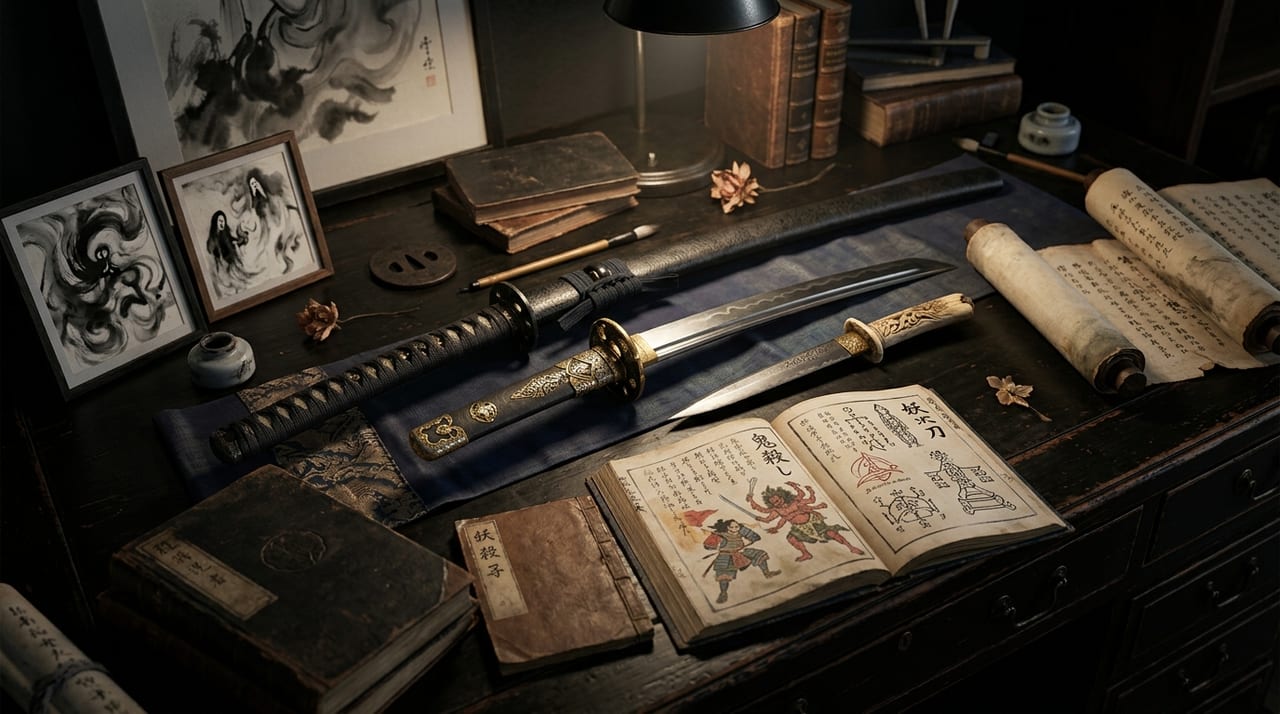
 * Image is for illustrative purposes only.
Jujutsu Kaisen
呪術廻戦
A shonen manga by Akutami Gege, serialized in Weekly Shonen Jump (Shueisha, 2018–present). A dark fantasy set in contemporary Japan where jujutsu sorcerers wielding cursed energy battle cursed spirits. Many characters fight with Japanese swords and cursed tools; blades serve a critical role as spiritually charged weapons imbued with cursed energy, including Zenin Shinai's revolver, Hisya Kanmi's sword, and Okkotsu Yuta's sword. Adapted into a TV anime (2020–2024) and theatrical films, it is one of the defining manga of its era, with over 85 million copies in circulation worldwide.
Description
Jujutsu Kaisen — Cursed-Energy Swords and the Contemporary Expression of Japan's Sacred Weapon Culture
Jujutsu Kaisen (2018–present, by Akutami Gege, serialized in Weekly Shonen Jump, Shueisha) has a cumulative circulation exceeding 85 million copies (as of 2024), with a TV anime (produced by MAPPA) streaming worldwide, making it one of the defining manga of contemporary Japanese pop culture. The work is particularly noteworthy from the perspective of Japanese sword and blade culture for its design in which "swords and blades function as a systematic expression of the spiritual weapons (cursed tools) that harbor cursed energy."
### Cursed Tools as Swords — The Traditional Context of Weapons That "Harbor" Spiritual Power
In the world of Jujutsu Kaisen, "cursed tools (jugu)" are "special implements in which cursed energy dwells," with the majority taking the form of swords and bladed weapons. Cursed tools are classified by "grade," with the highest-tier Special Grade tools linked to advanced cursed techniques such as the "Ten Shadows Technique" and "Barrier."
This design—in which bladed weapons harbor spiritual power—can be understood as a contemporary manga interpretation of "the spirituality of famous swords" in Japanese traditional sword culture. Since ancient times, swords in Japan have been treated as "objects that harbor spiritual force." Mythological swords such as the Kusanagi no Tsurugi and the Totsuka no Tsurugi embody divine power itself, and real-world famous swords—Muramasa, Dojigiri Yasutsuna, Onigiri Yasutsuna—have been passed down in folk tradition as "cursed or spiritually charged blades."
The "swords as cursed tools" in Jujutsu Kaisen translates this lineage of Japan's "sacred weapon" culture into the context of a modern battle manga.
### Gojo Satoru and "Limitless Cursed Technique" — A Philosophical Expression of Ma-ai
Gojo Satoru, the most powerful character in this work, does not directly wield a sword, yet his technique—the Limitless Cursed Technique (Mukagen Jujutsu)—possesses deep affinities with the concept of ma-ai (interval, spatial relationship) in Japanese swordsmanship.
"Limitless" is established as "infinitely dividing the space between oneself and the opponent, thereby rendering all attacks void." This can be read as a metaphysical extension of the swordsmanship concept of ma-ai—the management of distance and space between the swordsman and opponent. The fundamental swordsmanship concepts of "the distance at which the sword reaches (one step, one sword)" and "the distance the sword cannot reach (far interval)" are extended to their logical limit through the modern mathematical and physical concept of "infinitely divided space" (referencing Cantor's transfinite set theory and Zeno's paradoxes). Gojo Satoru's Limitless technique can thus be understood as the ultimate manga expression of "the philosophy of ma-ai."
### The Zenin Clan and the Ten Shadows Technique — The Legacy of a Sword-Fighting Family
The Zenin clan, one of the "Big Three Families" in this work, is established as "a lineage of swords and martial arts," with multiple members wielding swords as their primary weapon.
Zenin Maki possesses an exceptionally rare constitution in which cursed energy is near zero, yet she demonstrates extraordinary physical ability and martial technique in wielding high-quality cursed tools (swords, spears, axes, and so forth). Her handling of blades—rapid drawing, interval management, slashing techniques leveraging body movement—can be read as a manga expression of the fundamental sword-art movements of taisabaki (body movement) and ashihakobi (footwork).
Zenin Naobito has a combat style combining "Projection Sorcery," a technique of linear cursed energy projection, with the sword. His technique, which fuses the "linear slash of the sword" with the "linear projection of force" of his sorcery, can be understood as a design that extends the mechanics of the sword (the linearity and penetrating force of the blade) into supernatural power.
### Ryomen Sukuna and the Ten Fingers — Ancient Swords and the Ryomen Sukuna Legend
The work's ultimate antagonist, Ryomen Sukuna, is a character based on an actual ancient Japanese legend. The Nihon Shoki contains records of a creature named Ryomen Sukuna (a demon with "two faces"), said to have been subjugated by the armies of the Yamato Court.
In Jujutsu Kaisen, Sukuna is established as "the most powerful jujutsu sorcerer of over a thousand years ago," and his primary offensive techniques consist of sword-based slashing attacks—with technique names derived from the actions of cutting, piercing, and opening with a sword: Kai (Dismantle), Sabaki (Cleave), and Hiraku (Open).
Sukuna's sword techniques can be read as a sublimation into cursed power of the three fundamental uses of the Japanese sword—the drawing cut (corresponding to "Kai"), the deflecting cut ("Sabaki"), and the pushing cut ("Hiraku"). This translates the basic hasuji (blade angle) techniques of the Japanese sword—the "drawing cut," "thrust," and "pushing cut," the skills of "cutting with correct blade alignment" emphasized in actual sword training—into the language of the cursed-power manga.
### Jujutsu Kaisen and Japan's Sacred Weapon Culture — The Onmyoji's and Sorcerer's Sword
At the foundation of Jujutsu Kaisen's worldview lie the spiritual cosmologies of onmyodo (the Way of Yin and Yang) and shugendo (mountain asceticism). Onmyoji used "swords, protective talismans, and curses" as weapons against supernatural beings, and practitioners of shugendo wielded "shakujo (ringed staffs), swords, and bows" as spiritual weapons. The setting of Jujutsu Kaisen—in which jujutsu sorcerers use cursed tools (swords) to battle cursed spirits—is a reconstitution for contemporary manga of the traditional Japanese role of the "sorcerer as wielder of sacred weapons," rooted in the traditions of onmyodo and shugendo.
### A Perspective for Sword Collectors
Through its setting of "swords imbued with cursed energy," Jujutsu Kaisen functions as content that stimulates interest in Japan's traditional "sword as sacred weapon" culture—the spirituality of famous swords (the legends of Muramasa, Dojigiri Yasutsuna, and Onigiri Yasutsuna), mythological swords (the Kusanagi no Tsurugi and the Amenomurakumo no Tsurugi), and the traditions of warrior family heirloom blades. The framework of "cursed energy = spiritual power" in contemporary manga can serve as a modern gateway for sword collectors exploring the dimensions of spirituality and divinity inherent in the Japanese sword.
Real Swords Featured
Dojigiri Yasutsuna (National Treasure, Tokyo National Museum, Heian period, by Yasutsuna — legendary demon-slaying sword of Minamoto no Yorimitsu)
Onigiri Yasutsuna (Daikakuji Temple, famous sword of Minamoto no Yorimitsu)
Muramasa (renowned for cursed sword legends, by the Kuwana smith Muramasa of Mie Prefecture, the blade shunned by Tokugawa Ieyasu)
Kusanagi no Tsurugi (Atsuta Shrine, one of the Three Imperial Treasures)
See authentic Japanese swords
See authentic Japanese swordsThis page is intended to introduce Japanese sword culture and is not affiliated with any of the works mentioned.