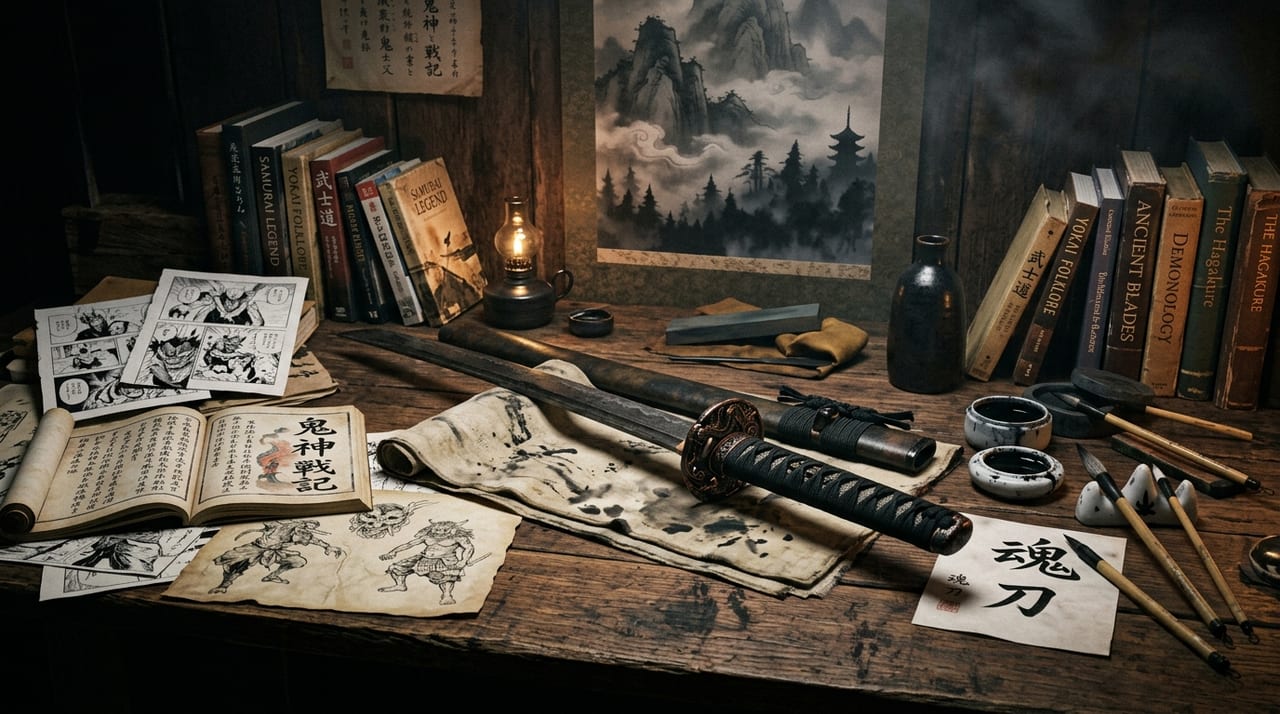
 * Image is for illustrative purposes only.
Inuyasha
犬夜叉
Manga by Takahashi Rumiko (serialized 1996–2008, Weekly Shonen Sunday) and anime series (2000–2004, 2009–2010). The half-demon Inuyasha's blade Tessaiga (鉄砕牙) is one of the world's most globally recognized fictional Japanese swords. Its transforming abilities (including the 'Wind Scar' technique) and origin as the sword of Inuyasha's demon father embody the traditional Japanese concept of the 'sword with a soul' at maximum pop-culture scale. Broadcast and streamed in over 100 countries.
Description
Inuyasha — Tessaiga's Global Transmission of the "Soul-Bearing Named Sword"
Inuyasha (Takahashi Rumiko, 1996–2008) is a long-form manga serialized in Weekly Shonen Sunday and an international hit that led the anime boom of the 2000s. The story follows Kagome, a contemporary high school girl who time-slips into the Sengoku era and, together with Inuyasha, a half-demon boy, embarks on an adventure to collect the fragments of the "Four-Soul Jewel." The work's singular importance for sword culture is that Inuyasha's beloved blade, Tessaiga (鉄砕牙), became one of the world's most recognized fictional Japanese swords and transmitted the core Japanese sword-culture concept of the "soul-bearing named blade" to anime audiences in over 100 countries.
### Tessaiga's Conceptual Depth — "The Father's Keepsake Sword"
Tessaiga's setup embodies the concept of "lineage and inheritance of named blades" in Japanese sword culture with remarkable skill. Tessaiga was originally forged from the fang of Inuyasha's father, the Great Dog Demon (Inu no Taishō), and possesses a clear purpose: "forged to protect the half-demon son from human enemies." This setup — "a sword forged for a specific person" — resonates with the real Japanese sword-culture concept of "custom-forged blades" (chūmon-uchi) — named swords specially commissioned for specific warriors or lords.
Furthermore, the narrative structure of "the father's keepsake sword inherited by the son" embodies the Japanese sword-culture concept of "family-treasure swords" — named blades passed down through generations of successive masters that serve as the spiritual bond of a clan. The traditional Japanese belief that heirloom swords of great families "enshrine the souls of ancestors" is translated into manga form as Tessaiga's setting: "a sword that inherits the will of the Great Dog Demon."
### Tessaiga's "Transformation" — The Concept of the Blade's "Awakening Latent Power"
Tessaiga's defining characteristic is its "transforming blade" setting. A rusted sword bearing the shape of an aged dog's fang responds to the presence of demonic energy (yokai) and transforms into a massive blade, manifesting signature techniques such as the "Wind Scar" (Kaze no Kizu), "Explosive Blast Rupture" (Bakuryū-ha), and "Underworld Waning-Moon Rupture" (Meidō Zangetsu-ha). This motif — "a dormant named blade harboring hidden power reveals its true strength as its master grows" — is a manga translation of the Japanese sword-legend concepts of "the spiritual power of named blades" and "the soul dwelling in a sword."
In actual Japanese sword culture, named blades carry legends such as "the edge never chips," "the cutting power increases," and "it possesses spiritual power." The "demon-blade legend" of Muramasa, the "Buddha-natured edge" legend of Masamune, the "demon-slaying blade" legend of Dōjikiri Yasutsuna — the cultural contexts of these actual named-blade legends form the cultural foundation for Tessaiga's setting as a "supernatural demon-destroying blade."
### The "Wind Scar" — The Cultural Meaning of the Strike Beyond Ma-ai
Tessaiga's signature technique, the "Wind Scar," generates an "air blade" through the swing of the sword that severs distant enemies. This concept of "a strike that transcends ma-ai (distance)" can be interpreted as a manga expansion of Japanese swordcraft concepts such as "flying sword" (hikken) and "flying cut" (tobikiri) as the ultimate principle of iai — the idea that a sword's power can exceed its physical reach. In actual iai-dō, the concept exists of "using the sword pressure at the moment of draw to overwhelm an opponent," and Tessaiga's "Wind Scar" is positioned as a supernatural extension of real swordcraft philosophy.
### International Reach — Transmitting Sword Culture to Audiences in Over 100 Countries
The Inuyasha anime broadcast and streamed in over 100 countries including North America, Europe, Southeast Asia, and Latin America, and the name "Tessaiga" became established as a proper noun among anime fans in English-speaking, Spanish-speaking, and French-speaking regions. Through this international proliferation, Tessaiga became one of the most globally recognized fictional Japanese sword names, and alongside actual sword names such as "katana" and "wakizashi," it functions as one of the primary entry points through which non-Japanese speakers encounter Japanese sword culture.
### The Sequel "Half-Demon Yasha Princess" — Inheritance for the Next Generation
In the sequel anime "Half-Demon Yasha Princess," broadcast in 2020–2021, Moroha, the daughter of Inuyasha and Kagome, appears, and the inheritance of Tessaiga becomes one of the central axes of the narrative. The setting of "a daughter inheriting her father's sword" is a restatement of the fundamental value of Japanese sword culture — "named blades are passed down through a clan" — and demonstrates that Inuyasha as a work consistently places the theme of "the inheritance of named blades" at its center.
### Perspective for Sword Collectors
Inuyasha and Tessaiga occupy a singular position in the pop-culture history of Japanese sword lore: a fictional Japanese blade that transmitted the core concepts of Japanese sword-culture's named-blade legends — soul-bearing swords, father-to-son inheritance, awakening latent spiritual power — to the world's largest audience. As a contemporary reference point for understanding the importance that "the origins, transmission history, and spiritual legends of named blades" hold in actual Japanese sword collecting and appreciation, Tessaiga is a singular example of a fictional blade that, despite being imaginary, conveys the essence of actual sword culture.
See authentic Japanese swords
See authentic Japanese swordsThis page is intended to introduce Japanese sword culture and is not affiliated with any of the works mentioned.