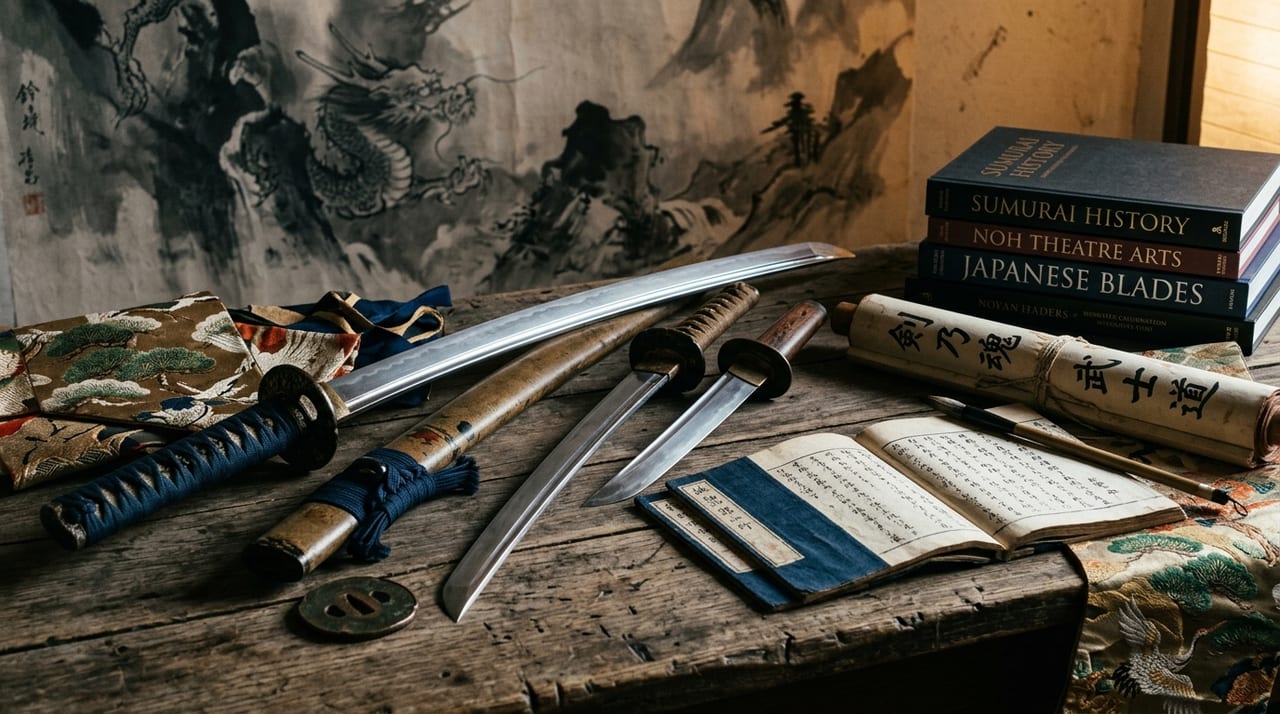
 * Image is for illustrative purposes only.
Inuō
犬王
A 2022 animated film directed by Masaaki Yuasa. This story of music and swords features Inuō, a noh performer of the Muromachi period, and Tomonaga, a blind biwa priest. The narrative centers on the karma surrounding the Heike swords that sank in the Battle of Dan-no-ura.
Description
Overview of the Work
"Inuō" is an animated film directed by Masaaki Yuasa, based on the novel "Tales of the Heike: The Inuō Chapter" by Hideo Furukawa, and released in 2022. Set in the early Muromachi period (late 14th century) Kyoto, it depicts the strange friendship and creative journey of Inuō, an unusually formed noh performer, and Tomonaga, a blind biwa priest. While situated in the context of classical period drama, it received high international acclaim as a distinctive work that boldly incorporated rock-musical-style musical direction.
The Swords of Dan-no-ura and the Heart of the Narrative
The narrative originates with the recovery of Heike treasures and swords that sank to the seafloor during the Battle of Dan-no-ura (1185). Tomonaga's father attempts to raise a sword connected to the Heike from the depths and dies from its curse. Tomonaga himself pays the price of blindness while receiving the spiritual essence of the sword from the seafloor. This motif of "Heike swords sunk beneath the waves" places at the narrative's core the concept of the Japanese sword as a spiritual entity transcending mere weaponry—the belief that a blade possesses a soul and retains power even after its master's death—and touches upon the deepest stratum of Japanese sword culture.
The Intersection of Noh and the Sword
Noh theater is a traditional Japanese performing art perfected by Zeami during the Muromachi period, and many of its plays center on themes of warfare, warriors, and swords. Noh pieces drawing from the Genpei War—such as "Funa Benkei," "Tomoe," and "Tomomori"—preserve the choreography and aesthetics of armor and tachi in formalized style, maintaining an inseparable relationship with Japanese sword culture. Inuō was a historical noh performer, and "The Inuō Chapter" represents a fantastical interpretation of this historical figure.
Masaaki Yuasa's Visual Aesthetics and Music
The direction in this work is highly regarded for boldly fusing noh's formal beauty with rock's liberated sensibility. The performance scenes featuring Inuō and Tomonaga are depicted as the "rock concerts" that captivated 14th-century audiences, reviving in contemporary idiom the raw energy inherent in classical performing arts. The musical score, composed by Yoshihide Otomo, a stalwart of anime music, embodies in sonic form the theme of the fusion of traditional and contemporary music.
The Crossroads of History and Legend
"Inuō" is a work that moves fluidly between historical fact (the historical noh performer Inuō, the Battle of Dan-no-ura) and legend/fantasy (the curse of the seafloor swords, the spirit of the Heike embedded in noh). It beautifully embodies in an entertainment film context the cultural legacy of the Japanese sword—simultaneously a historical artifact and a vessel of spiritual power passed down through the ages. It premiered at the 78th Venice International Film Festival in the Orizzonti section in 2021, becoming the first selection of a full-length 2D anime from Japan in that category, and has become widely known among international anime fans.
Real Swords Featured
The Three Imperial Regalia That Sank at Dan-no-ura (Kusanagi Sword)
During the Battle of Dan-no-ura in 1185, when the Heike fell and Emperor Antoku perished, the Kusanagi Sword (Ama no Murakumo no Tsurugi), one of the Three Imperial Regalia, is said to have sunk to the ocean floor. While the mirror and magatama were recovered, the sword remained lost and continues to elude discovery to the present day. This legend of the "divine sword sleeping in the depths" symbolizes the apex of sword mysticism in Japanese culture and serves as the direct prototype for the motif of the "Heike swords in the depths" in Inuō's narrative.
Tachi from the Late Heian to Kamakura Periods (Swords Associated with the Heike)
The Heike swords that sank at Dan-no-ura are believed to have been superior blades crafted from the late Heian to early Kamakura periods. Tachi from this era correspond to the oldest groups of celebrated swords, such as those designated "Koto Bizen," "Koto Seigo," and "Koto Hoki," and are characterized by elegant curvature and refined jihada and hamon. Indeed, among the swords transmitted as being associated with the Heike, some have been designated as Important Cultural Properties or National Treasures.
See authentic Japanese swords
See authentic Japanese swordsThis page is intended to introduce Japanese sword culture and is not affiliated with any of the works mentioned.