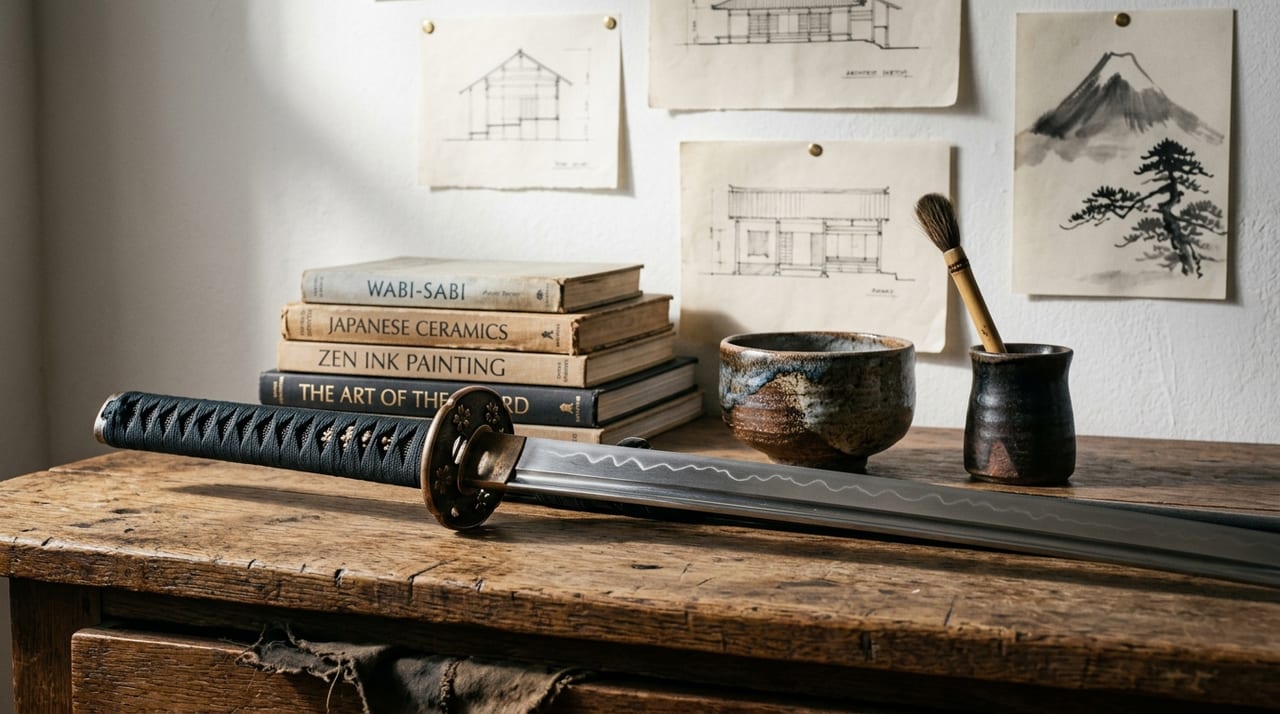
 * Image is for illustrative purposes only.
Hyouge Mono (The Warring States Comedy)
へうげもの
A manga and anime following Furuta Oribe, real-life tea master and samurai of the Sengoku era, who navigates the ambitions of Nobunaga, Hideyoshi, and Ieyasu through the lens of aesthetic obsession. Unique for treating the Japanese sword as an art object alongside ceramics and tea implements.
Description
Hyouge Mono and the Aesthetics of "Suki"
Hyouge Mono is a manga work by Yamada Yoshihiro (serialized in Kodansha's Morning, 2005–2017) and was adapted as a television anime by NHK (2011–2012). The work won the 13th Japan Academy Prize for Manga/Media Arts Excellence Award and the 14th Tezuka Osamu Cultural Prize for Manga. Its protagonist is the historical Sengoku samurai and tea master Furuta Oribe (birth name: Koteda Shigethen, 1544–1615). As a disciple of Sen no Rikyu, Furuta Oribe perfected the way of tea and later established a unique aesthetic sensibility known as "Oribe-yaki"—a genius practitioner of the art of appreciation (suki). In the era of Tokugawa Ieyasu, he met a tragic end through seppuku following the Siege of Osaka. Hyouge Mono is a masterpiece depicting the life of Furuta Oribe against the backdrop of the struggles among three great unifiers—Nobunaga, Hideyoshi, and Ieyasu—portraying a human figure wavering between "martial valor" and "suki" (the yearning for beauty).
Viewing the Japanese Sword as a "Work of Art"
The most original contribution of Hyouge Mono lies in positioning the Japanese sword not only as a "weapon" but as a "work of fine art equivalent to tea utensils and ceramics." The aesthetics of "wabi tea" perfected by Sen no Rikyu—which perceives the essence of the universe in humble, imperfect beauty—has profoundly influenced the appreciation of Japanese swords. The beauty of the ground pattern (jihada) and reflection (utsuri) appearing on the iron's surface, the individuality and skill manifested in the hamon (temper pattern), the pride and lineage of the swordsmith conveyed through the mei (signature) on the tang (nakago)—all these have been appreciated as objects of suki appreciation in the same manner as tea utensils. By depicting Furuta Oribe's perspective in Hyouge Mono—rendering the aesthetic emotion of "finding this utterly precious" before a famous blade equivalent to the emotion before a tea bowl—the work vividly reveals the essential truth that the Japanese sword is simultaneously both a tool of the martial way and the ultimate achievement of the fine arts.
Oda Nobunaga and the Honnō-ji Incident
The first half of Hyouge Mono depicts the era of Oda Nobunaga in detail, emphasizing Nobunaga's aspect as an art collector and art producer. Nobunaga was a daimyo who greedily accumulated treasures ranging from "exotic goods brought by the Southern Barbarians" to "Japan's finest tea utensils," and his aesthetic sensibility was inseparable from his self-presentation as "the greatest suki enthusiast under heaven," who wielded the tea ceremony as a political tool. Nobunaga's attachment to his prized swords and famous blades was an extension of this aspect as an art collector. Hyouge Mono's unique interpretation of the Honnō-ji Incident (1582)—depicting it not merely as Mitsuhide's rebellion but as a "clash of aesthetic values in the world of suki"—brought fresh intellectual stimulation to Japanese historical interpretation.
Sen no Rikyu's Seppuku and the "Martyr for Beauty"
One of the most memorable scenes in the work is the scene of Sen no Rikyu's seppuku (1591). Hyouge Mono portrays Rikyu being ordered to commit seppuku by Hideyoshi as a result of "fundamental conflict in aesthetic values," interpreting his death as the ultimate act of a suki practitioner—"dying for beauty." Furuta Oribe witnessed his master Rikyu's seppuku and, deeply affected by it, chose to continue living; yet this choice would eventually lead him toward his own seppuku. This structure precisely depicts the theme of "the inseparability of death and beauty in Japanese aesthetics" through the historical facts of the late Sengoku period.
Modern Influence and Toukenza
Hyouge Mono contributed to the widespread popularization of the perspective of "the Japanese sword as a work of fine art," establishing a cultural foundation for younger generations to recognize swords not merely as "weapons" but as "works of art worthy of appreciation." The attention drawn to the "distorted beauty" and "beauty of imperfection" exemplified by Furuta Oribe's "Oribe-yaki" suggests the importance, in sword appreciation, of valuing not only "flawless technical achievement" but also "the imperfection in which the swordsmith's individuality, era, and spirit dwell." Toukenza embodies precisely this dual nature of the Japanese sword—both weapon and work of art—through its collection, and we strongly recommend experiencing the appreciation of actual renowned blades through the lens of "suki" that Hyouge Mono reveals. The experience of holding a sword in hand and sensing the character of the ground steel, the individuality of the hamon, and the swordsmith's pride conveyed through the mei on the tang is fundamentally the same "joy of suki" as sensing the universe in the touch of a tea bowl.
Real Swords Featured
Heshikiri Hasebe (Nobunaga's Sword)
Nobunaga's famous blade — used in the violent legend that gives it its name — embodies the dual nature Hyouge Mono explores: the sword as both an instrument of sudden, absolute violence and a named art object with spiritual and aesthetic dimensions. Now a National Treasure at Fukuoka City Museum, it is the ideal physical artifact for understanding the world Hyouge Mono depicts.
Furuta Oribe's Koshirae (Sword Fittings)
Historical records indicate that Furuta Oribe applied his distinctive aesthetic — the Oribe-yaki sensibility of asymmetry and deliberate imperfection — to sword fittings as well as ceramics. Momoyama-period sword fittings are an independent major category of Japanese art history, and Oribe's influence extended to tsuba and koshirae design. Hyouge Mono captures this aesthetic dimension of the sword.
Masamune (The Supreme Name-Object)
Okizaki Goro Nyudo Masamune of Sagami Province is historically Japan's most celebrated sword smith. Toyotomi Hideyoshi's obsessive collecting of Masamune tanto is historical fact — he treated them exactly as he treated the finest tea bowls, as supreme 'meibutsu' (famous objects) with aesthetic, political, and spiritual power. This is the historical reality behind Hyouge Mono's central thesis: the sword and the tea bowl occupy the same plane of aesthetic meaning in Japanese culture.
See authentic Japanese swords
See authentic Japanese swordsThis page is intended to introduce Japanese sword culture and is not affiliated with any of the works mentioned.