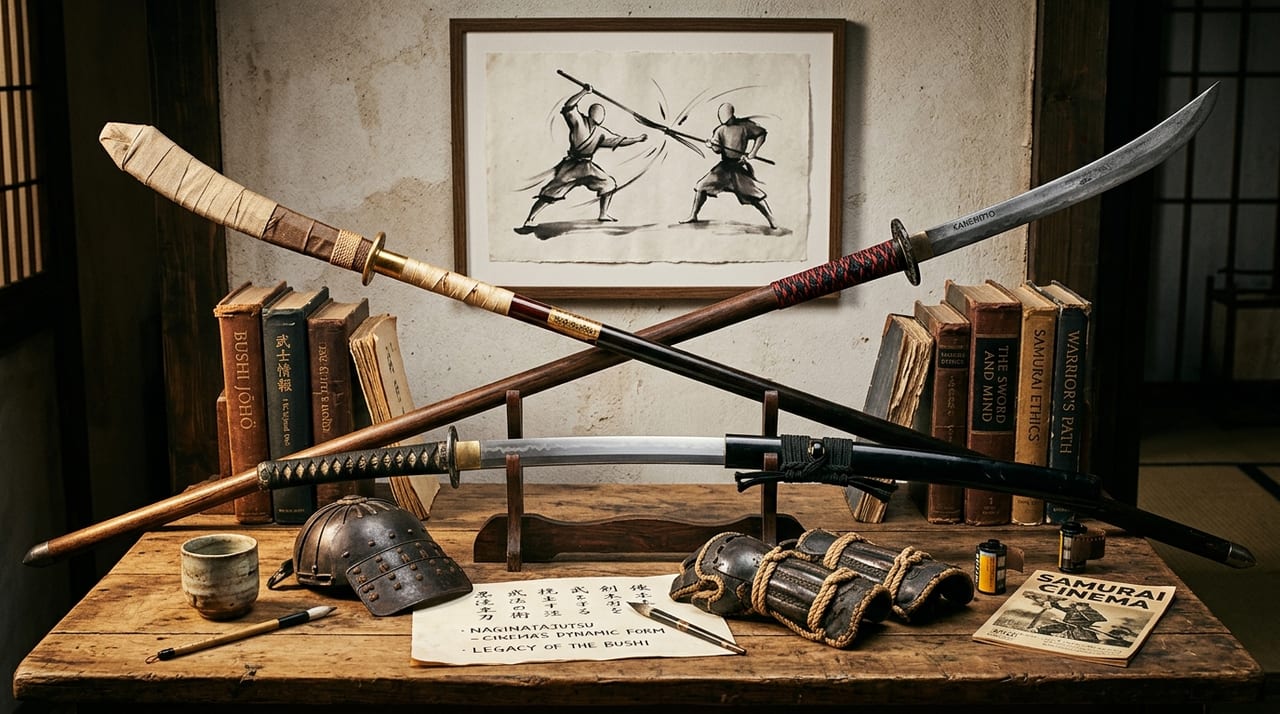
 * Image is for illustrative purposes only.
The Hidden Fortress
隠し砦の三悪人
A 1958 Akira Kurosawa jidaigeki starring Toshiro Mifune, internationally famous as a primary inspiration for Star Wars. Features some of the most dynamic sword and spear combat in cinema history, set during Japan's Sengoku period.
Description
Akira Kurosawa and The Hidden Fortress
The Hidden Fortress is a period drama film produced and distributed by Toho in 1958, directed by Akira Kurosawa, and starring Toshiro Mifune, Misa Uehara, Kamaari Fujiwara, and Minoru Chiaki. Set in the Sengoku-period province of Shinano, the story depicts a thrilling adventure in which Princess Yuki of the Akitsuki Clan—on the brink of destruction—and a samurai general, Rokurota Makabe, who guards her, flee while transporting gold, evading the encirclement of the enemy Yamana forces. It was the first work to make full-scale use of CinemaScope—then called Toho Scope in Japan—with its wide screen format, and Kurosawa's innovative visual direction shines throughout. George Lucas has publicly stated that he received strong influence from this film in conceiving Star Wars (1977), and it became internationally famous through the positioning of the peasant duo (Tahei and Matashichi) as the prototypes for C-3PO and R2-D2.
The Spear Duel Scene—A Masterpiece of Cinema History
The highlight of The Hidden Fortress is the scene in which Rokurota Makabe and Hyoei Tadokoro, a general of the Yamana forces, engage in single combat with spears. For Sengoku-period warlords, the spear and lance were primary weapons equivalent to the sword, and were used both on horseback and on foot. In this scene, the attack-and-defense between the two spear-wielders visually embodies the essence of actual spear technique—the "distance and spacing of the long spear," the "manipulation of the spear point," and the "importance of footwork"—achieving an exquisite balance between cinematic exaggeration and martial-arts realism. Toshiro Mifune trained extensively in martial movement for virtually every Kurosawa film, and in this spear-duel scene his movement clarity and power are outstanding. Film historians have noted that this scene is one of the stylistic origins of Lucas's "lightsaber duel," and it is fascinating that Japanese spear technique influenced the aesthetic of the world's greatest science-fiction film franchise.
Weapons Culture of Sengoku-Period Warlords
The Sengoku period depicted in The Hidden Fortress was an era in which swords, spears, bows, and firearms coexisted as warrior weapons. The various implements appearing in the film—armor called tousei-gusoku (contemporary-style armor) of the Sengoku period, swords large and small, long spears, and bows—are the product of historical research meticulously supervised by Akira Kurosawa, who is also renowned as a leading authority on Sengoku historical accuracy. Kurosawa's meticulous attention to detail in film props, costumes, and weapons transcends perfectionism as a filmmaker and is grounded in a cultural mission to accurately transmit Japanese samurai and weapons culture. In fact, in producing the film Kurosawa collaborated with historical-accuracy specialists, museum curators, and sword-and-blade researchers, devoting passionate effort to assembling weapons and armor as close as possible to originals.
Akira Kurosawa's Philosophy of the Japanese Sword
Throughout Akira Kurosawa's period-drama films, the Japanese sword functions not merely as a prop but as a symbolic presence indicating the character, status, and spiritual state of those who wield it. Just as "the right to draw the sword" is one of the themes of Seven Samurai, in The Hidden Fortress the way Rokurota uses both sword and spear embodies his pride and sense of responsibility as a warlord. Kurosawa's philosophy that "one who draws the sword must bear the resolve to be killed by it" deeply resonates with the Japanese swordsmanship philosophy of "drawing the sword as a last resort." This philosophy is reflected in The Hidden Fortress in Rokurota's behavioral pattern of avoiding drawing his sword whenever possible, prioritizing diplomacy, stratagem, and spear technique.
Global Influence and TOUKENZA
The Hidden Fortress is one of the most emblematic proofs of the influence Japanese period-drama cinema has exerted on world film history. The fact that it directly influenced the birth of Star Wars—the twentieth century's greatest film franchise—demonstrates that Kurosawa's films—and the Japanese samurai and sword culture underlying them—are deeply embedded in the world's imagination. TOUKENZA handles Japanese swords as bearers of such global cultural heritage, and is committed to transmitting to the present day the actual blades wielded by Sengoku warlords as depicted in The Hidden Fortress. Through authentic Sengoku swords, you can directly experience the world of swords, spears, and armor depicted in The Hidden Fortress.
Real Swords Featured
Sengoku Uchigatana (The Era's Combat Sword)
The Hidden Fortress is set at the height of the Sengoku period (mid-16th century), when the uchigatana — worn thrust through the belt, edge up — had completely supplanted the tachi as Japan's primary sword form. Sengoku uchigatana were built for combat efficiency above aesthetics: robust construction, practical geometry, designed to be drawn and used in a single fluid motion. The swords depicted in Kurosawa's film reflect this functional martial sword culture.
Bizen Osafune Sukesada (Mass-Produced Combat Blades)
Bizen Osafune Sukesada smiths produced enormous quantities of practical swords for Sengoku-era warriors of all ranks. These blades represent the 'standard issue' sword culture that Kurosawa's lower-ranking warrior characters would have carried. Thousands survive today, making them the most accessible direct connection to the era The Hidden Fortress depicts. A genuine Sukesada blade is the real-world equivalent of the swords worn by Rokurota's enemies.
Tosei-Gusoku (Sengoku Armor) and Its Sword Implications
The full tosei-gusoku armor prominently featured in The Hidden Fortress had important implications for sword use: armor-clad opponents required specialized techniques — targeting gaps with the yoroidoshi (armor-piercing tantō) or grappling (kumiuchi). Kurosawa's meticulous weapons research captured this reality, making his battle scenes historically accurate documents of how swords were actually used in armored Sengoku combat.
See authentic Japanese swords
See authentic Japanese swordsThis page is intended to introduce Japanese sword culture and is not affiliated with any of the works mentioned.