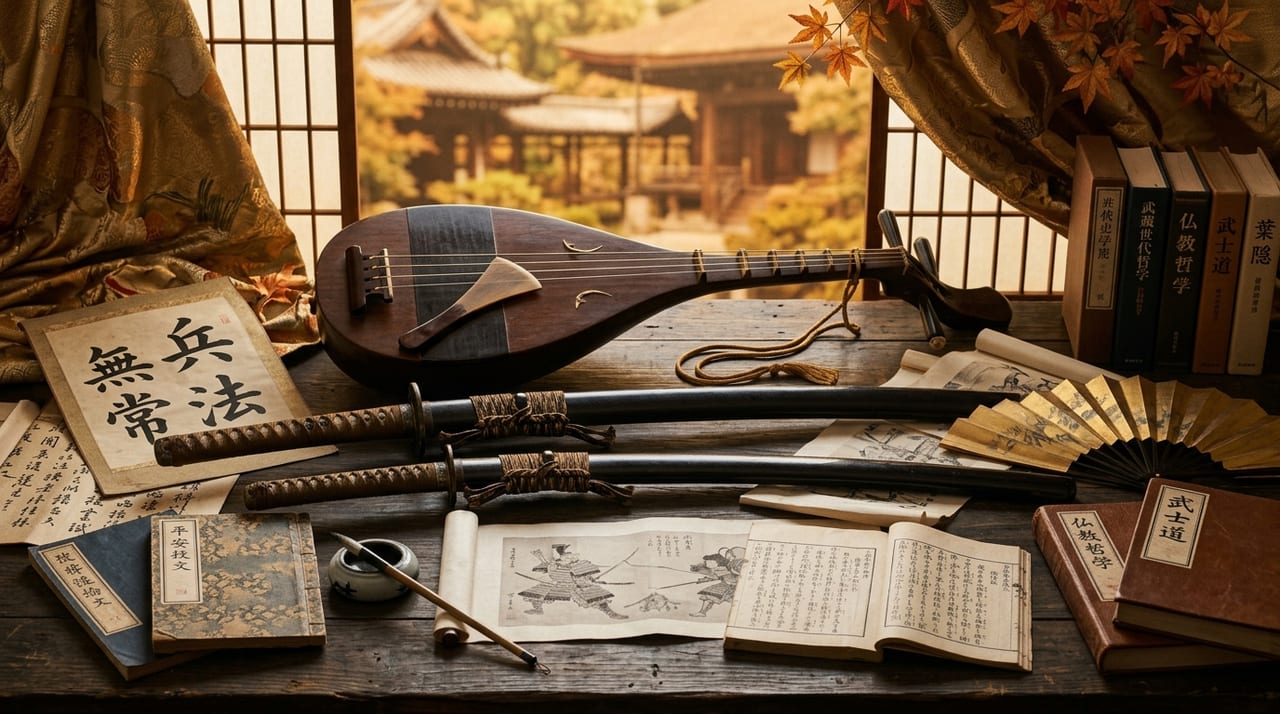
 * Image is for illustrative purposes only.
The Tale of the Heike (Anime)
平家物語(アニメ)
A 2021 anime series directed by Naoko Yamada and produced by Science SARU. An epic work depicting the Genpei War of the late Heian period from the perspective of Biwa, a girl with heterochromic eyes who serves the Heike clan.
Description
Background and Overview
"The Tale of the Heike" is a military chronicle (gunki monogatari) established during the Kamakura period, depicting the Genpei War of the late Heian period (1180–1185) and ranks among the pinnacles of Japanese literature. Symbolized by its opening lines—"The sound of the bell at Gion Shōja echoes the transience of all things"—the work chronicles the fall of the once-glorious Heike clan through the Buddhist lens of impermanence (mujo) and serves as a historical record documenting the dawn of samurai culture and the culture of the sword. The 2021 anime adaptation, directed by Naoko Yamada and broadcast on Fuji Television's "+Ultra" block, garnered high acclaim as a masterpiece that reinterpreted the essence of the original text through a new aesthetic.
Biwa as the Perspective Character
The anime's unique element is its positioning of Biwa, a blind biwa priest's daughter who serves the Heike, as the narrator. Possessing the ability to see the future in her right eye, she becomes deeply involved with the Heike despite knowing their inevitable doom. This structure brings into sharp relief the tension between historical inevitability and personal emotion, enabling a human drama that transcends the mere victory and defeat of battles.
The Depiction of Warfare and Swords
The age of the Genpei War corresponds to the period immediately following the evolution of the Japanese sword (nihontō) into its present curved form. From the late Heian through the early Kamakura period, the transition from the straight blades of antiquity to the curved tachi was completed, establishing a form suited to overhead slashing from horseback. The anime depicts major battle scenes such as the Battle of Dan-no-ura, combining Yamada's distinctive delicate portrayal of characters with poetic expression of both the beauty and cruelty of warfare. Naginata, tachi, bow, and other weapons of the late Heian period are faithfully rendered, making the work a valuable reference for studying the history of the Japanese sword.
Innovation in Art and Music
This work stands as a visual and auditory masterpiece that fuses Science SARU's elegant animation style with the music of Kensuke Ushio. The costumes, architecture, and artifacts of the Heian period are carefully researched, achieving both the persuasiveness of historical drama and the stylized beauty unique to anime. The melodies of the biwa played by Biwa revive the character of the original as a "narrative tale" (katari-mono), functioning as a device through which audiences musically experience the rise and fall of the Genpei clans.
The Significance of "The Tale of the Heike" in Japanese Culture
The Tale of the Heike is not merely a historical novel, but a foundational text that shaped Japanese samurai culture, aesthetics, and views on life and death. The aesthetic concept of "mono no aware" (the pathos of things), the origins of bushidō that celebrate the beauty of a noble passing, and the archetype of samurai ethics centered on respect for one's enemy all reside within this work. Episodes such as Kumagai Naozane's entry into monastic life after defeating Taira no Atsumori and Taira no Tomomori's final scene of binding an anchor to his body and wading into the sea exemplify scenes that became the archetypes of Japanese aesthetic sensibility. The anime version successfully reinterprets these scenes in a form that allows modern viewers to emotionally connect with them, successfully conveying the value of classical literature to a new generation.
Real Swords Featured
Tachi of the Late Heian to Early Kamakura Period
The era of the Genpei War was when the tachi, the fundamental form of the Japanese sword, achieved its mature style. Developed as the "mounted tachi" (umaue-tachi) with a curved long blade for cutting downward from horseback, the standard blade length was two shaku six sun to two shaku eight sun (approximately 80–85 cm). Famous blades of this period include Yukihira from Bungo Province, Norisune (Koh-Bizen) from Bizen Province, and Munechikas from Yamashiro Province, each featuring elegant curves and delicate hamon within a grand, powerful construction. Most extant examples are designated as Important Cultural Properties or National Treasures.
Kogarasumaru (National Treasure · Heike-Related Sword)
Kogarasumaru is counted among the oldest tachi, believed to have been forged during the Heian period, and has been transmitted as the "guardian sword of the Heike." The blade exhibits a unique construction called "iori-mune-zukuri" (a precursor to shinogi-zukuri), representing the transitional phase from straight sword to curved tachi—a supreme artifact in the history of Japanese sword evolution. Currently held by the Imperial Household Agency as an imperial treasure, it bears exceptional historical significance as a tangible relic of the era depicted in The Tale of the Heike.
See authentic Japanese swords
See authentic Japanese swordsThis page is intended to introduce Japanese sword culture and is not affiliated with any of the works mentioned.