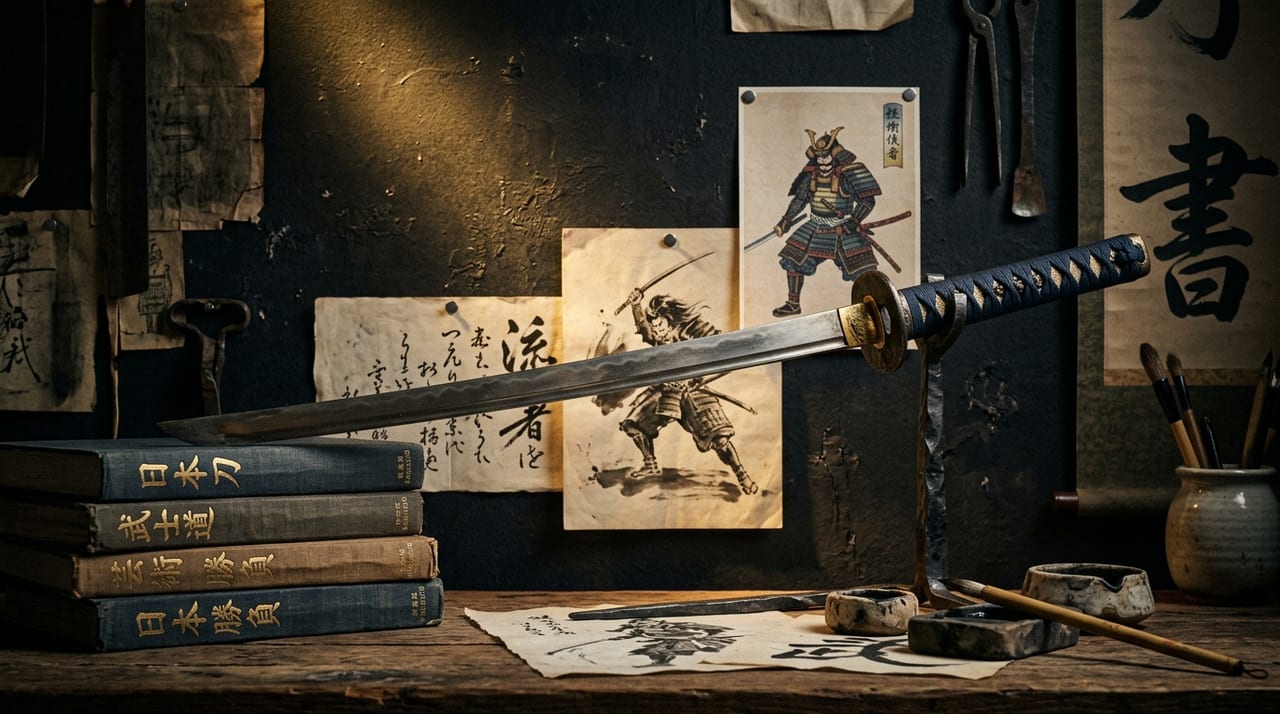
 * Image is for illustrative purposes only.
Hana no Keiji (Lord of the Samurai Drifter)
花の慶次〜雲のかなたに〜
Historical manga illustrated by Hara Tetsuo, based on the novel by Ryū Keiichirō (serialized 1990–1993 in Weekly Shonen Jump). Set in the Sengoku period, it follows Maeda Keiji, a kabukimono (flamboyant free-spirited samurai), as he crosses blades with the era's greatest strategists and warlords. Against the backdrop of the period surrounding Toyotomi Hideyoshi's unification of Japan, Maeda Keiji's distinctive "one-handed strike" sword technique and the symbolic kaishū spear (all-red spear) he wields on the battlefield are depicted through Hara Tetsuo's overwhelming sword-battle artwork. The complete 18-volume tankōbon series, with cumulative print runs reaching tens of millions of copies, is still remembered as a "masterpiece of Sengoku manga."
Description
Hana no Keiji — The Samurai Kabukimono's Spear Embodying Freedom and Beauty of Sengoku Swordsmanship
Hana no Keiji ~ Kumo no Kanata ni ~ (Hara Tetsuo · Ryū Keiichirō, 1990–1993) is a landmark of historical manga serialized in Weekly Shonen Jump, inscribing into modern manga both the overwhelming scale of its sword-battle artwork and the cultural existence of the "kabukimono" (flamboyant free-spirit samurai) of the Sengoku period. The protagonist Maeda Keiji (前田慶次) is a historical figure—a retainer of the Kaga Maeda clan who became famous as "the kabukimono of the realm" during the period around the Battle of Sekigahara. The reason this work is particularly noteworthy in Japanese sword culture is that it embodies at the highest manga level the "freedom and rule-breaking" of swordsmanship in the Sengoku period through the sword techniques of "an unconventional swordsman," Maeda Keiji.
### Maeda Keiji's "One-Handed Strike" — An Unconventional Sword Style
The defining sword technique in Hana no Keiji is Maeda Keiji's "one-handed strike" (katate-uchi). The standard way of using a Japanese sword is with "both hands" (morote)—gripping the hilt (tsuka) with both hands—and single-handed use, called "one-handed strike" (katate-uchi), is considered a specialized and highly difficult technique within swordsmanship. Advantages of one-handed strikes: securing a longer engagement distance than usual (arm length adds to the distance), attacks from trajectories difficult for opponents to predict, maximum power in cutting strokes through centrifugal force from body weight transfer. In Hana no Keiji, Maeda Keiji has mastered this one-handed strike as "his own form" (kata), and holds his own against the finest swordsmen of his era. Keiji's one-handed strike is depicted as a symbol of "free swordsmanship unconstrained by form," and this directly connects to the identity of the kabukimono as "a being who breaks society's forms."
### His Weapon — "The Vermilion Spear" (Kaishu no Yari)
The weapon that symbolizes Maeda Keiji in Hana no Keiji is the "vermilion spear" (kaishu no yari). The "vermilion spear" refers to a spear painted entirely in vermilion (aka) from haft to spearhead, and it is said that only those who had established extraordinary martial prowess on the battlefield were permitted to carry such an honored weapon. While Maeda Keiji wears a sword at his waist, he is depicted as a kabukimono who wields this vermilion-painted long spear as his primary weapon in battle, and the brilliant vermilion spear visually embodies his unconventional martial prowess and the spirit of "the kabukimono of the realm."
It should be noted that the uchi-gatana (sword worn at the waist) that Keiji carries also plays an important role in the sword-battles depicted in the work; however, the weapon that most powerfully defines Maeda Keiji's image in this work is none other than the eye-catching vermilion spear on the battlefield.
### Hara Tetsuo's Sword-Battle Artwork — A Landmark in Manga History
The primary reason why Hana no Keiji's sword-battle depiction is regarded as a landmark in manga history is Hara Tetsuo's art style. Hara Tetsuo applied to historical manga sword-battle depiction the "massive panel compositions," "impactful depictions utilizing black-and-white contrast to the extreme," and "three-dimensionality through the fusion of human body movement and screen tone" that he cultivated in "Fist of the North Star" (1983–1988). The following specific expressive techniques are employed: two-page spreads depicting a single moment of sword-battle—a "moment-freeze" panel composition that expresses the sword's trajectory, speed, and impact all at once in a single frame. "The expression of 'ma' (interval)"—the "interval" signifying the stillness before sword-battle is expressed visually through page margins and stationary characters. "The expression of the 'sound' of a slash"—the character design of sound effects (onomatopoeia) itself is used as a visual component of the sword-battle. These techniques greatly advanced the visual "grammar" of sword-battle depiction in Japanese historical manga.
### Kabukimono (傾奇者) and Sword Culture — Rebels of the Sengoku
"Kabukimono" refers to those who existed from the Sengoku period through the early Edo period and "deliberately deviated from social norms," recorded as presences who overwhelmed their surroundings through flamboyant dress, eccentric behavior, and unusual weapons. The "sword kabuki" that Maeda Keiji embodied as a kabukimono—the intentional breaking of the standard way of using a sword (two-handed strike) with one-handed strike—is a challenge to the fixed idea within swordsmanship that "the sword is used through form." This concept of "form-breaking swordsmanship" embodies an important duality in Japanese sword culture: the tension between "orthodox swordsmanship (dojo swordsmanship)" and "practical individual swordsmanship (iaijutsu · kabuki style)."
### Samurai under Toyotomi Rule and the Sword — The Sword Hunt
The historical setting of Hana no Keiji—Toyotomi Hideyoshi's unification of Japan in the 1590s—is an extremely important turning point in Japanese sword culture. The "sword hunt" (katanagari)—Toyotomi Hideyoshi's 1588 decree disarming farmers and monks—was a historical event that fundamentally transformed the social definition of "who may carry a sword" in Japan. Hana no Keiji is set in the period around this sword hunt, with the backdrop of a transitional era between "the time when swords still existed broadly in society" and "the time when swords were being concentrated in the samurai class." The image of Maeda Keiji as a kabukimono freely wielding his blade is also a symbol of this "final freedom of the age of the sword."
### Perspective for Sword and Weapon Enthusiasts
Hana no Keiji is an intriguing work for those interested in weapons, as it establishes the "vermilion spear"—a vermilion-painted long spear—as the protagonist's symbolic weapon. By depicting the vermilion spear, said to be an honored weapon, as "the weapon of a kabukimono," this work embodies the core theme of warrior culture: "the resonance between a weapon and the spirit of its bearer." Furthermore, the "one-handed strike," a specialized sword technique, provides an interesting point of reference when considering the relationship between the physical design of a sword—the length and weight balance of the hilt—and swordsmanship.
Real Swords Featured
Tachi
See authentic Japanese swords
See authentic Japanese swordsThis page is intended to introduce Japanese sword culture and is not affiliated with any of the works mentioned.