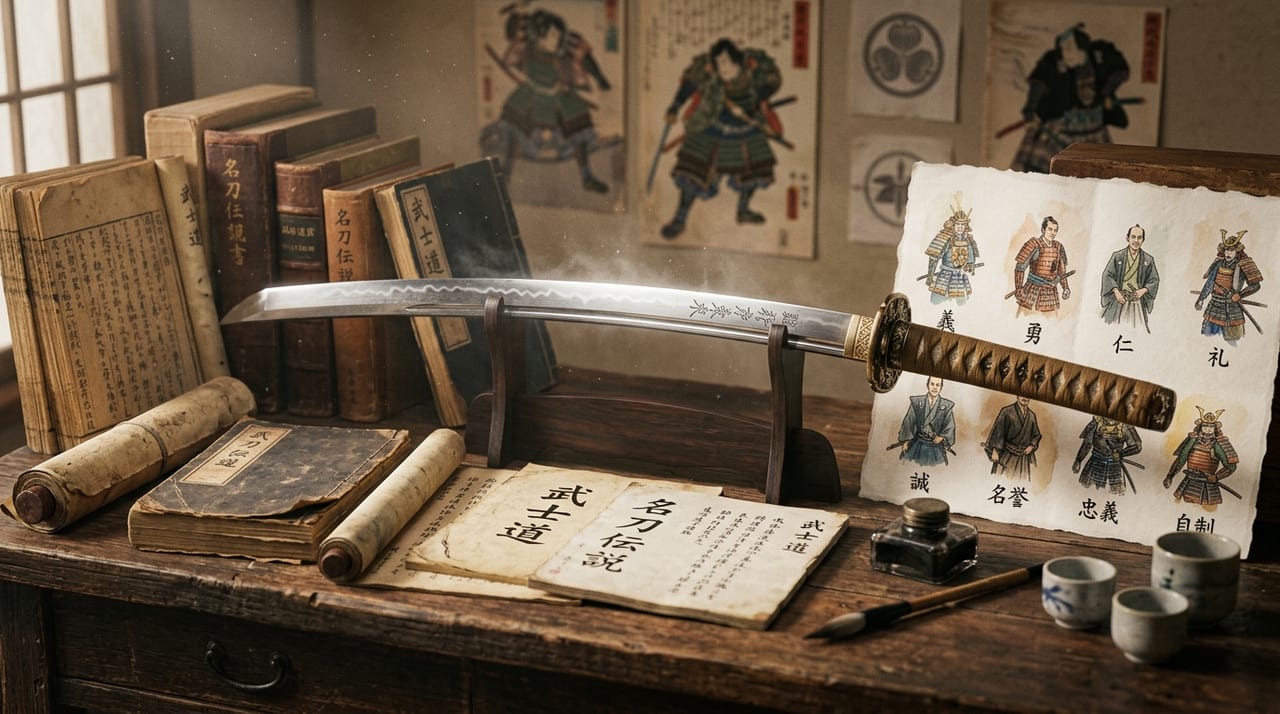
 * Image is for illustrative purposes only.
Nansō Satomi Hakkenden
南総里見八犬伝
Monumental 98-volume novel by Kyokutei Bakin, composed over 28 years (1814–1842) — one of Japan's longest works of fiction. Eight warriors (kenshi) of the Satomi clan each embody one of the Eight Virtues, bear names with the character for 'dog,' and are linked to specific legendary swords including Murasame-maru. Repeatedly adapted for manga, anime, and games, it is a classic of Japanese literature with deep connections to the cultural role of the named sword.
Description
Nansō Satomi Hakkenden — The Classical Crystallization of the "Named Sword and Hero" Narrative Inscribed in Edo Literature
The Nansō Satomi Hakkenden (南総里見八犬伝) is a monumental 98-volume novel completed by Kyokutei Bakin (also known as Takizawa Bakin, 1767–1848) over the course of twenty-eight years, from the 11th year of the Bunka era (1814) through the 13th year of the Tenpō era (1842). With an estimated total of approximately fifty million characters, it stands as one of the longest novels written in the Japanese language in literary history. As the apex of the Edo period's yomihon (popular illustrated literature) tradition, this singular fictional world, in which Bushidō, the Confucian virtues of benevolence, righteousness, propriety, and wisdom, and the "spiritual power" of the Japanese sword converge, exercised an incalculable influence on subsequent Japanese popular literature, manga, and games.
### The Eight Dog Warriors and the Symbolic System of the "Dog" Character — Names and Blades
The story's protagonists are the "Eight Dog Warriors" (Hakkenshin) — eight heroic samurai serving the Satomi clan of Bōsō. Each of the Eight Dog Warriors bears the character for "dog" in his name, such as Inuē Shinbē (犬江親兵衛) and Inuzuka Shino (犬塚信乃), and each harbors within his body a "spiritual jewel" (reishu) representing one of the Eight Virtues: benevolence (jin), righteousness (gi), propriety (rei), wisdom (chi), loyalty (chū), honesty (shin), filial piety (kō), and fraternity (tei). This design expresses Confucian personality theory through the form of the supernatural tale, with each character's embodied virtue determining his swordsmanship style and relationship to the blade.
Inuzuka Shino, one of the story's protagonists, carries the "Murasame-maru" (村雨丸), the most crucial sword in the narrative and a central force in the tale. Murasame-maru is a legendary blade with the extraordinary property that "mist-rain flows from its edge" (murasame), and when drawn, its blade is said to emanate spiritual qi. This depiction of "a sword from which mist rises" stands as the most poetic embodiment in Japanese literature of the ancient belief that the Japanese sword is "a medium of spiritual energy," and it became the archetype for all subsequent "legendary sword tales" in later generations.
### The Position of Swords in Edo Literature — The Narrative Theory of "Bonds Between Named Blade and Hero"
The significance of the Nansō Satomi Hakkenden within the history of Japanese sword culture lies in its establishment of the narrative archetype of "the bond between a named sword and a hero." Although the sword had appeared as an important implement in Japanese literature prior to this work, the Hakkenden was the first large-scale narrative to place at its very core "the fateful union of a particular sword and a particular hero, walking together through destiny" — a "fateful bond between blade and human."
This conception of "the named sword as proof of a hero's destiny" became the prototype for the "special relationship between sword and protagonist" seen in later modern sword-related content such as "Touken Ranbu," "Rurouni Kenshin," and "Berserk." In other words, the Nansō Satomi Hakkenden stands as the classical work that constructed the fundamental framework governing "the relationship between sword and hero" in Japanese pop culture, and thus serves as the progenitor of modern sword-themed content.
### Bakin's Blindness and Oral Dictation — The Spirit of Indomitable Authorship
The creative process of this work is renowned for one of the rarest episodes in literary history. Late in his life, Bakin lost his sight and feared dying before completing the work. Therefore, his wife, Michi (路), transcribed Bakin's oral dictation despite his blindness, negotiated with the illustrator and publisher according to his instructions, and brought the work to completion. The final sections of all ninety-eight volumes were completed in an unprecedented form of composition: a blind, elderly author dictating to his wife, who transcribed his words. This narrative of "a great work completed through unwavering will" resonates with the Bushidō ideal of "the will to accomplish," and has been passed down as an anecdote that embodies the spiritual essence of the work itself.
### Modern Influence — The Cascade Through Manga, Anime, and Games
The Nansō Satomi Hakkenden continues to be remade repeatedly in the contemporary era, and among the representative modern works are the following. The anime "Shin Hakkenden" (1973–1975, NHK) — produced in puppet-theater form, it became widely disseminated as children's entertainment. The manga influence on Togashi Yoshihiro — Togashi, creator of "YuYu Hakusho" and "Hunter × Hunter," has publicly stated that he was influenced by the Hakkenden's structural device of "characters embodying specific virtues gathering together." The video game "Satomi no Nazo" (1996, Santech Japan) — released during the PlayStation's early era, it garnered significant attention (setting aside the game's quality, the selection of the Hakkenden as material demonstrates cultural inheritance). The manga and anime "Hakkenden: Tōhō Hakken Ibun" (2013) — a contemporary reimagining for younger generations, set in the modern day.
### Perspective for Sword Collectors
The Nansō Satomi Hakkenden constitutes essential knowledge for sword enthusiasts, as a classical work that established the fundamental narrative of Japanese culture: "a named sword determines the destiny of a hero." The legendary properties of the sacred blade typified by the Murasame-maru — the mist that rises from its edge, its power to repel evil, its protective function toward its wielder — are the cultural roots of "reverence for and awe of the famous blade" in actual sword-collecting culture. The contemporary perspective that regards the Japanese sword not as a mere metal artifact but as "a vessel of spirituality" has been reinforced and sustained by the narrative framework of "the fateful union of sword and hero" that the Hakkenden established. This tale, read continuously by common folk over twenty-eight years during the Edo period, is a cultural program embedded in the depths of the Japanese consciousness regarding swords — and whether or not contemporary sword enthusiasts are directly aware of it, it forms the foundation of their aesthetic sensibility.
See authentic Japanese swords
See authentic Japanese swordsThis page is intended to introduce Japanese sword culture and is not affiliated with any of the works mentioned.