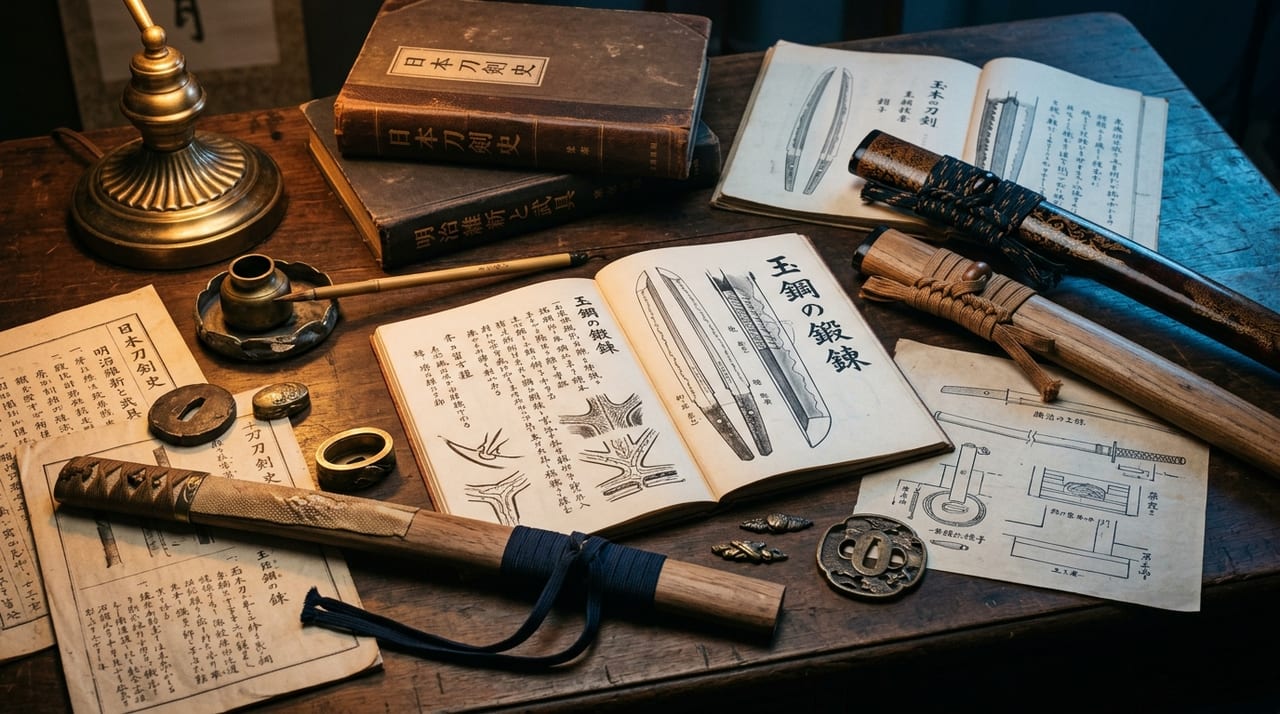
 * Image is for illustrative purposes only.
Golden Kamuy
ゴールデンカムイ
Manga by Satoru Noda (Young Jump, Shueisha, 2014–2022) and anime series (2018–2020), live-action film (2024). Set in Hokkaido at the end of the Meiji era, this adventure chronicle follows Russo-Japanese War veteran Sugimoto Saichi and young Ainu girl Asirpa as they compete over hidden gold. The historical accuracy of military swords (guntō) and mounting styles (koshirae), and the transformation of sword culture in the Meiji military, are depicted in meticulous detail.
Description
Golden Kamuy — Testimony to Sword Culture at the Intersection of Meiji Military Swords and Modernization
Golden Kamuy (Satoru Noda, 2014–2022) is a full 31-volume historical adventure manga serialized in Weekly Young Jump by Shueisha. It won the 9th Manga Taisho (2016) and the 22nd Osamu Tezuka Cultural Prize for Manga, and an anime of 36 episodes (2018–2020) was produced. The setting is Hokkaido and Sakhalin in the late Meiji period (around 1906), and this era represents a turbulent period in which Japanese sword culture underwent a fundamental transformation: "from the samurai's blade to the military sword."
### Meiji Military Swords — Japan's Modernization and the Blade's Contradiction
After the Meiji Restoration (1868) abolished the samurai class and the Sword Abolition Edict (1876) was issued, Japan's military — officers and non-commissioned officers — continued to carry swords as "military swords (guntō)." The military swords adopted from the middle of the Meiji period took diverse forms, ranging from Western-style saber form (yōtō) to Japanese sword form (wa-tō). Golden Kamuy's historical setting (immediately after the Russo-Japanese War, around 1906–1907) corresponds to a transitional period when military swords were being rapidly unified into the "Japanese sword form."
Protagonist Sugimoto Saichi is a returning veteran of the Russo-Japanese War, and his carried weapons possess the practical utility of an active military officer. The work depicts modern-style combat combining firearms and swords, faithfully recreating the era when the sword was transformed from "the samurai's soul" into "an auxiliary weapon of the modern military."
### The Meticulous Period Detail of Koshirae (Blade Mountings)
What deserves special mention in the sword depictions of Golden Kamuy is the meticulous period research of "koshirae (mountings)" — the external fittings of the sword (scabbard, handle, guard, collar, and pommel). The military sword koshirae of the Meiji period was fundamentally different from the samurai koshirae of the Edo period. Standardized metal fittings, scabbard materials, and handle-wrapping patterns mandated by military regulation were employed, which shows a rupture with "Edo sword-mounting culture that reflected individual preference."
The work deliberately depicts these detailed differences; the style of koshirae varies for each character, visually narrating "that character's origins, status, and era." Characters from former samurai families carry Edo-period samurai koshirae, while active military personnel carry regulation military sword mountings — such "backstory depiction through swords" is an unparalleled pleasure for sword enthusiasts.
### Ainu Culture and Blade Tradition
Another axis of the work is the culture of the Ainu people. The Ainu possessed a distinctive blade culture and routinely and ceremonially used blades called "makiri" (small knife) and "tashiro" (large blade). These were made through Ainu's unique iron-working techniques (a fusion of Japanese iron and Ainu iron), and while influenced by Japanese swords, they retained distinctive forms and patterns.
By carefully depicting Ainu blade culture, Golden Kamuy provides a broader perspective: Japanese sword culture was "not merely a phenomenon of Yamato culture, but was formed through exchange with the peoples of the North." The historical process by which Japanese iron (wa-tetsu) flowed into Ainu society through Hokkaido trade, and through which Ainu blade culture was formed, is an important aspect that sword-history textbooks tend to overlook.
### Shiraishi Yoshitake and Sword Humor
Shiraishi Yoshitake (the Escape King), who serves as comic relief in the work, also plays a unique role in the depiction of swords. Repeatedly escaping, Shiraishi is depicted as "the man without a sword," surviving through stratagems and physical ability without relying on weapons. This character trait of being "without a sword" functions as a device that paradoxically brings to the fore the work's theme: "What is the meaning of carrying a sword?"
### Live-Action Film Adaptation (2024) and Period Research
The live-action film adaptation released in 2024 (starring Kento Yamazaki and Anna Yamada) was highly praised for its meticulous recreation of Meiji-period military uniforms and weapons. The costume and weapons research was conducted by specialists, and faithful recreations based on actual Meiji-period military swords and military uniforms were achieved. The live-action version, where the texture and weight of actual objects are more readily conveyed than in anime, also serves as an excellent visual resource for experiencing Meiji military sword culture.
### Perspective for Sword Collectors
Golden Kamuy, as a work depicting "the transition period of sword culture from Edo to Meiji," provides important insights to sword enthusiasts. Meiji-period military swords — blades from the transitional period from "old swords (ebira)" to "regulation military swords" — are a relatively accessible yet historically significant field in the contemporary sword market. Many enthusiasts have found that reading the work deepened their interest in Meiji-period mounting styles, sword standards, and military sword history, becoming an impetus to broaden their collections. Furthermore, the perspective of Ainu blade culture provides a new viewpoint for positioning the Japanese sword within "the broader history of blade cultures," and the work is highly valued as one that expands the horizons of sword research.
See authentic Japanese swords
See authentic Japanese swordsThis page is intended to introduce Japanese sword culture and is not affiliated with any of the works mentioned.