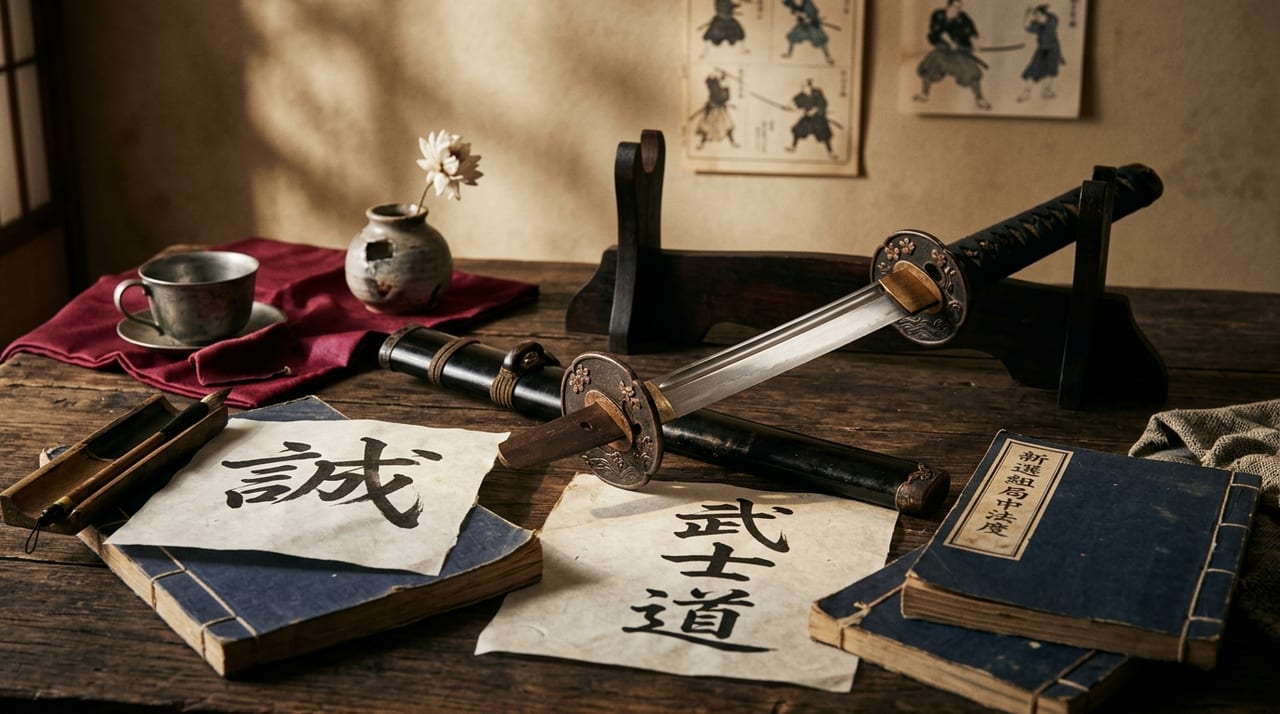
 * Image is for illustrative purposes only.
Gohatto (Taboo)
御法度
A 1999 film directed by Nagisa Oshima. Set in the Shinsengumi of the late Edo period, it depicts the turmoil and desire unleashed within the organization by the presence of a beautiful new recruit, Kano Sozaburo. The film features Matsuda Ryuhei, Beat Takeshi (as Hijikata Toshizo), and Asano Tadanobu. The real sword school Tennen Rishin-ryu (天然理心流) forms the historical background of the Shinsengumi's organizational culture, with the discipline and 'gohatto' (taboos/laws) of swordsmanship as the work's core theme. An artistic reinterpretation as a modern film of the final chapter of Edo-period sword culture — the era of the Shinsengumi's Ikedaya Incident in Kyoto.
Description
Gohatto — The Final Chapter of Edo-Period Sword Culture Through the Shinsengumi's Sword Discipline
Gohatto (1999, Nagisa Oshima) is an artistic work by the master of Japanese cinema, depicting the theme of "the discipline of the sword and human desire" through the Shinsengumi — a historically significant organization — and is an important period film that reinterprets as a modern film the swordsmanship culture of the late Edo period: specifically the culture of Tennen Rishin-ryu (天然理心流), the sword school that was the Shinsengumi's founding tradition. The source material is Shiba Ryotaro's short stories "Maegami no Sozaburo" and "Sanjo Gakabito Ranja" (from the collection Shinsengumi Keppūroku), and the film is known as Oshima's unique visual reinterpretation of Shiba's Shinsengumi literature.
### Tennen Rishin-ryu — The Shinsengumi's "Sword Foundation"
The core of the Shinsengumi sword culture depicted in Gohatto is Tennen Rishin-ryu — a real sword school founded in the late 18th century by Kondo Kuranojo. This school was studied by Kondo Isami, Hijikata Toshizo, and Okita Soji — the Shinsengumi's core members. The alternate name "nōson kenjutsu" (farming village swordsmanship) captures Tennen Rishin-ryu's defining characteristic: it oriented toward "immediately functional combat swordsmanship" rather than "form-centered dojo swordsmanship for the samurai class." Mainly studied by young men from farming backgrounds, the school's practical-combat features include: powerful close-range striking, using the full body weight for impact, and training premised on one-against-many real combat. This "practical combat orientation of farming village swordsmanship" is cited as one reason for the Shinsengumi's extraordinary effectiveness in assassinations and local skirmishes in late-Edo-period Kyoto.
### "Gohatto" — The Shinsengumi's Sword Discipline
The "Gohatto" (taboos/laws) that title the film refers to the Kyokuchū Hatto (局中法度) — the organizational regulations the Shinsengumi imposed on their members. Key articles: Do not depart from the samurai code; desertion from the organization is forbidden; unauthorized financial dealings are forbidden; unauthorized legal disputes are forbidden; private fighting is forbidden. These "gohatto" embody an important dimension of Japanese sword culture: "the discipline imposed on those who carry swords." To wear a sword is to take on social responsibility, and the regulations (gohatto) fulfilling that responsibility were strictly imposed within the Shinsengumi as an organization. The film Gohatto depicts, through the figure of Kano Sozaburo, how "human desire and emotion" existing outside "the discipline of the sword" — particularly desire for beauty — can shake the organizational structure maintained by sword discipline from within.
### Late-Edo-Period Kyoto's Swords — The Ikedaya Incident and Shinsengumi Swordsmanship
The historical background of Gohatto — late Edo period Kyoto (around 1864) — is one of the most intense eras from the perspective of the Japanese sword's "actual combat use." The Ikedaya Incident (1864) — the Shinsengumi's surprise raid on a Kyoto inn holding sonnō-jōi activists — is recorded in Japanese history as an extremely rare actual-combat example of "collective indoor sword combat." The Shinsengumi's fight at Ikedaya was "multiple-against-multiple Japanese sword combat in a narrow indoor space," providing a concrete example of the Japanese sword's practical dimension: how Tennen Rishin-ryu's characteristic "close-range powerful striking" functioned — or failed to function — in indoor combat. Gohatto is set in the period around the Ikedaya Incident, and the tension of this "era when swords were actually used" pervades the entire work.
### Oshima's Cinematic Perspective — The Symbolism of "Sword and Gohatto"
Oshima's cinematic approach in Gohatto simultaneously depicts "the sword (and the discipline of the sword) controlling human desire, emotion, and power" and "the failure of that control." The presence of the beautiful swordsman Kano Sozaburo awakens within the organization the "desires the gohatto forbids," shaking from within the organizational structure maintained by sword discipline. This opposition between "sword discipline (gohatto)" and "human desire" explores, as art rather than entertainment, the aspect of Japanese sword culture defined as "the discipline imposed by the sword" — the social responsibility and norms arising from carrying a blade. Through the theme of "sword and gohatto," Oshima recorded in film "the final culture of the samurai class's sword" — its brilliance, contradictions, and collapse — in the period immediately before Japan's modernization.
### The Shinsengumi's Swords — Late Edo-Period Shin-shinto
The historical period of Gohatto (late Edo, 1860s) corresponds in Japanese sword history to the "shin-shintō" era. Shin-shintō are swords forged in the late Edo period (from the Bunka-Bunsei era through the end of the Edo period) — "new swords attempting to revive the techniques of ancient swords." The swords actually used by Shinsengumi members were primarily shin-shintō uchigatana, with blades by late-Edo masters such as Katayama Munetsugu, Minamoto no Kiyomaro, and Yamaura Kiyomaro recorded as their favored blades. Notably, Kondo Isami's famous sword "Nagasone Kotetsu" is the most famous Shinsengumi blade — but scholars have debated whether it might have been a sword with a forged Kotetsu attribution rather than an authentic blade, providing an intriguing dimension of the "authentication of sword signatures" problem in late-Edo sword connoisseurship.
### Perspective for Sword Collectors
Gohatto is an important film for Japanese sword collectors and enthusiasts as the most artistically realized cinematic embodiment of three dimensions of the Japanese sword — "practical combat, culture, and spirit" — through the lens of "the culture of the real sword school Tennen Rishin-ryu" and "the history of late-Edo shin-shintō swords in actual combat." The time and place of the Shinsengumi's activities — late-Edo Kyoto — holds a special position in Japanese sword cultural history as "the final era in which Japanese swords were actually functional as weapons." The theme of "desire forbidden by gohatto and the discipline of the sword" also makes the film a rare visual reference for deeply understanding the spiritual and cultural dimensions of the Japanese sword: the core thought of Japanese sword culture that "carrying a sword entails social responsibility."
Real Swords Featured
Uchigatana (late-Edo shin-shinto practical sword)
Tennen Rishin-ryu shinai and bokken
Nagasone Kotetsu (Kondo Isami's famous blade — authenticity debated)
See authentic Japanese swords
See authentic Japanese swordsThis page is intended to introduce Japanese sword culture and is not affiliated with any of the works mentioned.