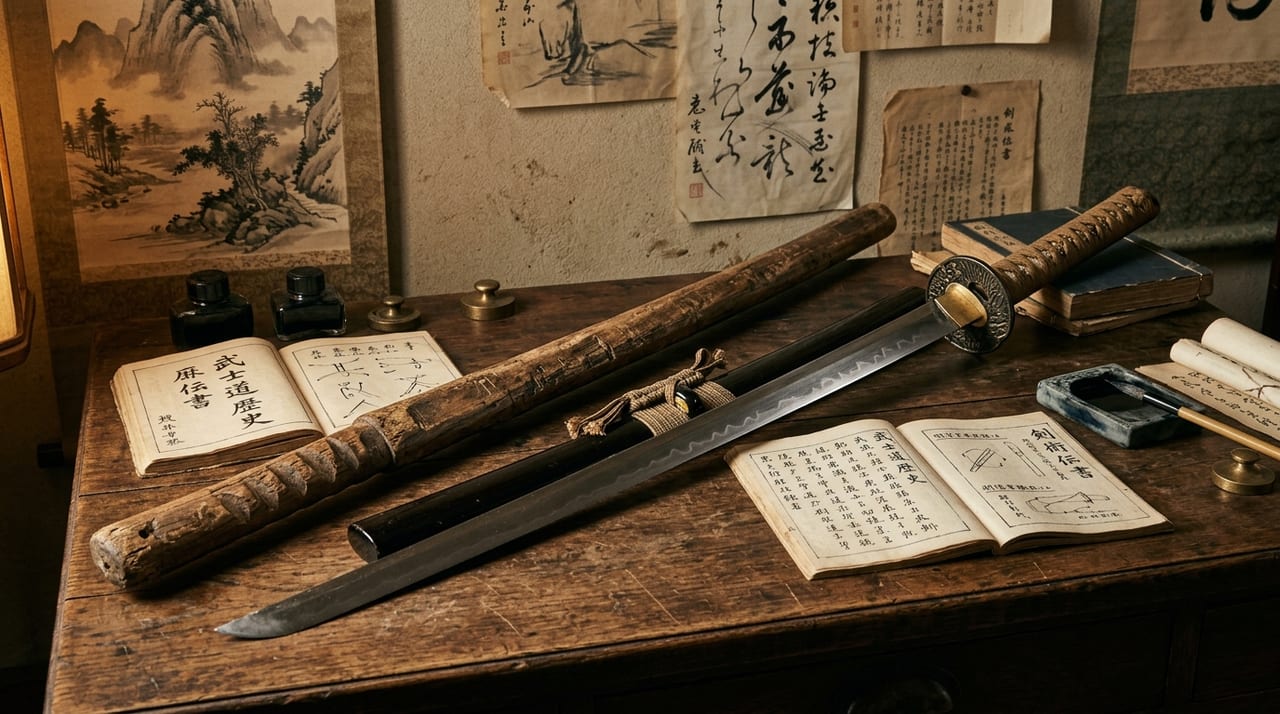
 * Image is for illustrative purposes only.
Gintama
銀魂
A gag-action manga by Sorachi Hideaki serialized in Weekly Shonen Jump (2003–2019) and adapted into a long-running anime. Set in a fictional Edo period where alien 'Amanto' have conquered Japan and banned swords, freelancer Sakata Gintoki wields his wooden (and sometimes real) sword through comedy and genuinely moving swordfight arcs. A rare work that fuses parody and deep reverence for Japanese sword culture.
Description
Sorachi Hideaki and the World of Gintama
Gintama, created by Sorachi Hideaki, is a unique manga work that follows the protagonist Sakata Gintoki—a slovenly-looking but supremely skilled swordsman—through a peculiar alternate-history setting of the late-Edo period conquered by aliens called "Amanto," where it freely moves between comedy and serious drama. Sorachi Hideaki is a kendō practitioner, and the sword-fighting scenes in the work reflect the techniques of actual swordsmanship throughout. Gintoki was once a swordsman called "Shiroyasha," and his current setting of wielding a wooden sword shows a rich awareness for readers with knowledge of sword history. The uniqueness of Gintama lies in the insertion of genuinely serious sword-fighting sequences amid the parody and comedy; many serious sword-fighting arcs such as the "Yoshiwara Blaze Arc" and "Crimson Cherry Arc" are remembered as among the most moving sword scenes in the history of Japanese manga. The world of Gintama, where comedic scenes using the Japanese sword as mere comedic fodder coexist with serious deathmatches, could not exist without profound understanding and affection for Japanese sword culture.
The Paradox of Sword Seizure and the Paradoxical Celebration of Sword Culture
In the world of Gintama, the shogunate, under Amanto direction, enforces the "Sword Prohibition Edict" (haitōrei), forbidding samurai from wearing swords. This setting is modeled on the historical Sword Prohibition Edict of 1876 following the Meiji Restoration, and places at the heart of the narrative the question, "What is a samurai deprived of his sword?" Gintoki's setting of actually wielding a wooden sword symbolizes the pride of a samurai who does not abandon the "spirit of the sword" even under the prohibition edict, and the dramatic moments when he draws a real blade in the story carry special weight. Through Gintama, Sorachi Hideaki repeatedly posed the questions, "What is the sword?" and "What is the samurai?" amid laughter and tears. This paradoxical structure—a work that most eloquently speaks to the value of the sword in a world stripped of swords—is suggestive when considering the significance of Japanese sword culture in the present day. Through the setting of the sword prohibition edict, readers are powerfully made aware of the lost value of a world where swords were part of daily life.
Respect for Tennen Rishin-ryū and the Shinsengumi
In Gintama, a fictional organization called the "Shinsengumi" appears, clearly modeled on the historical "Shinsengumi" of the Bakumatsu period, with characters bearing names modeled on historical figures such as Kondō Isao, Hijikata Jūshirō, and Okita Sōgo. The actual historical Shinsengumi was centered on practitioners of the "Tennen Rishin-ryū" sword school, and the swords of Kondō Isami, Hijikata Toshizō, and Okita Sōji were called the strongest of the Bakumatsu era. Gintama weaves these historical memories of Bakumatsu swordplay throughout while fusing parody with genuine sword-fighting drama. Particularly in the "Hijikata Arc," through the character of Hijikata Jūshirō, the aesthetic of a samurai's passing during the Bakumatsu period is depicted directly, showing sincere engagement with the spiritual ethos of historical samurai-hood. Gintama's sword-fighting depictions are based on a deep understanding of actual Bakumatsu–Meiji sword schools (such as Tennen Rishin-ryū, Hokushin Ittō-ryū, and Shintō Mushin-ryū), making it a richly rewarding work from the perspective of sword-martial history.
Gintama's Swordplay and the Aesthetics of the Japanese Sword
Gintoki's swordsmanship is depicted with a distinctive style combining speed praised as "divine speed" with powerful, forceful strikes. This can be understood as a fusion of the "flash of lightning" aesthetic of actual iaijutsu and the combat power of striking-type practical swordplay. The concept of "the interval of deadly single-strike swordsmanship" frequently appearing in the work reflects the actual Japanese martial concept of "ma" (interval/distance), and despite being a comedy work, it depicts the essential elements of swordplay with precision. Additionally, the distinction between the wooden sword (Lake Toya) Gintoki uses and a real blade functions as a dramatic emphasis on the "power and dignity" of the Japanese sword. In the serious sword-fighting arcs of Gintama, depictions of the Japanese sword simultaneously express both its beauty and its terror, and many readers report deepening their interest in the Japanese sword through Gintama.
Modern Influence and Toukenza
After its serialization ended in 2019, Gintama continues to expand through films and games, with passionate fan communities at home and abroad. Its unique fusion of "laughter, tears, and swords" has had a major impact on Japanese subculture, spreading the expressive technique of "sophisticated coexistence of comedy and seriousness" to many subsequent action manga. The philosophy Gintama consistently demonstrated—"the sword is an extension of the soul"—has played a major role in conveying the essence of Japanese sword culture to younger generations today. Toukenza handles a large number of swords from the Bakumatsu–Meiji period, allowing you to view the actual swords from the era in which Gintama is set. We hope that through the actual masterpiece swords of the era, you will experience the brilliance of sword culture as depicted in the paradox of the sword prohibition edict. The weight and coldness felt when holding a sword embody the actual substance of what Gintoki and his companions fought to preserve. Through the works of swordsmiths whom Kondō, Hijikata, and Okita actually used—Nagasone Kotetsu, Izumi no Kami Kanesada, and Kashū Kiyomitsu—it is Toukenza's mission to convey to the present day the Bakumatsu spirit and the pride of the soul in swords as depicted in Gintama.
Real Swords Featured
Nagasone Kotetsu (The Shinsengumi's Supreme Blade)
Nagasone Kotetsu (Okisato) was an early-to-mid Edo period Edo swordsmith whose extraordinary cutting performance made him the most prized sword-maker among warriors. Most famously associated with Shinsengumi commander Kondō Isami — who claimed to own a genuine Kotetsu, though historians debate whether it was authentic. Gintama references this sword tradition through the Shinsengumi parody at its core.
Izumi no Kami Kanesada (Hijikata Toshizō's Sword)
The Aizu swordsmith Izumi no Kami Kanesada is known as the maker of the sword carried by Shinsengumi vice-commander Hijikata Toshizō. Gintama's 'Hijikata arc' draws directly on this historical figure's aesthetic, and Kanesada's robust blades — favored for their practical cutting geometry — represent the ideal weapon for a late-Edo period combat swordsman.
Kashū Kiyomitsu (Okita Sōji's Sword)
Kashū Kiyomitsu was a Kaga Province (modern Ishikawa) swordsmith associated with Shinsengumi first unit captain Okita Sōji, the prodigy whose 'three-stage thrust' technique became legendary. Gintama's Okita Sōgo character is modeled on the historical Okita, making Kashū Kiyomitsu blades directly relevant to the sword culture the manga depicts.
Nankaitatō Asataka (Bakumatsu Tosa Excellence)
Nankaitatō Asataka was the leading swordsmith of Tosa (modern Kōchi Prefecture) during the Bakumatsu period, associated with Restoration-era patriots including Sakamoto Ryōma. As a swordsmith active during the turbulent era Gintama depicts, his blades embody the spirit of late-Edo sword culture with regional character and dramatic historical resonance.
Katayama Munetsugu (Bakumatsu Combat Sword)
Katayama Munetsugu was a highly active Edo-based swordsmith of the late Edo period, whose practical blade geometry and striking hamon made him a favorite among Bakumatsu-era warriors who actually fought with their swords. His blades represent the real cutting weapons of the turbulent era Gintama fictionalizes — direct, powerful, and uncompromising in their martial purpose.
See authentic Japanese swords
See authentic Japanese swordsThis page is intended to introduce Japanese sword culture and is not affiliated with any of the works mentioned.