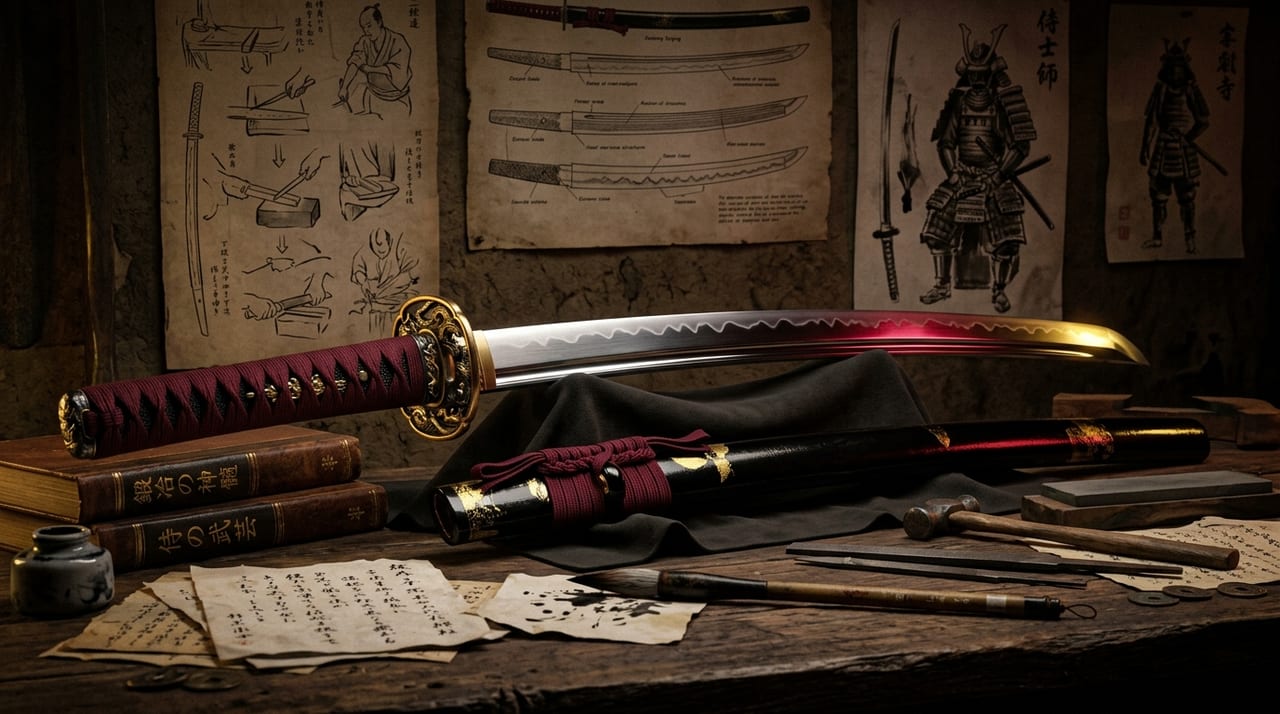
 * Image is for illustrative purposes only.
Gifudodo!! Kanetsugu to Keiji
義風堂々!! 兼続と慶次
A manga by Hara Tetsuo and Horie Nobuhiko, illustrated by Takemura Yuuji (serialized in Weekly Comic Bunch, 2008–2010). A grand historical manga depicting the friendship between Maeda Keiji (protagonist of Hana no Keiji) and Naoe Kanetsugu, along with their sense of chivalry in the Sengoku era, rendered alongside vivid sword imagery. Hara Tetsuo's bold gekiga-style sword depictions and references to real historical blades have made this work beloved by sword enthusiasts.
Description
Gifudodo!! Kanetsugu to Keiji — The World of Sengoku "Righteousness" and Famous Swords Through Hara Tetsuo's Original Story
Gifudodo!! Kanetsugu to Keiji (a television anime broadcast in 2013, 25 episodes, produced by Studio Deen for TV Tokyo and AT-X networks. An anime adaptation originating from the manga "Gifudodo Naoe Kanetsugu - Maeda Keiji Tsuki no Katari" [serialized in Weekly Comic Bunch 2008–2010, art by Takemura Yuuji], based on original story and script by Hara Tetsuo and Horie Nobuhiko) is a grand historical epic that repositions Maeda Keiji — the protagonist of the previous work "Hana no Keiji: Beyond the Clouds" (1990–1993) — as the lead character once more, with the friendship between Keiji and Naoe Kanetsugu and the "righteousness (gi)" of the late Sengoku period as its central themes.
### Maeda Keiji and the Sword Aesthetics of the "Kabuki-Mono"
Maeda Keijiro Toshimasu was a real historical warrior of the late Sengoku period, and his life as a "kabuki-mono" (a warrior adopting eccentric dress and conduct transcending conventional norms) forms a central theme in both "Hana no Keiji" and "Gifudodo." The kabuki-mono's view of the sword differs from that of the ordinary warrior, encompassing the philosophy that "the sword is not merely a weapon of combat but a medium of self-expression."
The swords that Keiji uses and possesses in the work are depicted to reflect his bold and eccentric character. The dramatic visual style inherited from the original manga expresses "the weight, sharpness, and instantaneous movement of the drawn blade" at a high level. The sword depictions threading through Hara Tetsuo's original work — from "the claws and weapon renderings of Fist of the North Star," through the Japanese swords he himself drew in "Hana no Keiji," to the Japanese swords in "Gifudodo" based on his original story — develop under a consistent vision of depicting "the overwhelming presence of weapons wielded by the powerful," while pursuing "historical and cultural accuracy of swords" as a Sengoku historical manga.
### Naoe Kanetsugu and the "Ai" (Love) Helmet — Warrior Aesthetics and the Sword
Naoe Kanetsugu (1560–1619) is a warrior famous for armor bearing the character "ai (love)" as a front crest (maedate, helmet decoration), and is also known as the protagonist of the NHK Taiga Drama "Tenchijin" (2009). Prior to this anime's broadcast in 2013, that Taiga Drama aired in 2009, and the original manga series developed under a synergistic multimedia effect.
Kanetsugu is depicted as embodying "righteousness (gi) — justice and loyalty" as a retainer of Uesugi Kenshin and Kagekatsu. The "culture of righteousness" of the Uesugi clan — Kenshin's philosophy of "faith in Bishamonten and warfare conducted through righteousness" — is directly reflected in the title "Gifudodo," forming the cultural context in which the sword is depicted as "a weapon embodying righteousness."
### Real Swords — Famous Blades of the Uesugi and Maeda Clans
The real historical warriors appearing in this work are each known as possessors of historically famous swords. Uesugi Kenshin is said to have owned famous swords including "Yamabushi Kunihiro" and "Azuki Nagamitsu," and the Maeda family (Keiji's clan) also transmits famous swords including "Maeda Tōshirō." The work inherits the dramatic world created by Hara Tetsuo in his original work and visually expresses "the impact of the moment when these warriors actually took swords in hand," with the presence of historically famous swords complementing the narrative's "weight of righteousness."
### Continuity with Hana no Keiji — The Lineage of Hara Tetsuo's Sengoku Sword Manga
Hana no Keiji (1990–1993) remains highly regarded as a landmark of Sengoku manga and sword manga, and Gifudodo inherits its "bold sword aesthetics" as a successor work. Hara Tetsuo's sword depictions throughout his career — from "the claws and weapon renderings of Fist of the North Star," through the Japanese swords he himself drew in "Hana no Keiji," to the Japanese swords of "Gifudodo" based on his original work — develop under a consistent vision of depicting "the overwhelming presence of weapons wielded by the powerful," forming a body of representative works through which sword collectors experience "the impact and imposing presence of the Japanese sword" via manga expression.
### A Collector's Perspective
Gifudodo!! Kanetsugu to Keiji is a work that allows sword collectors to experience "the relationship between late Sengoku warlords and their swords" visually and narratively from four perspectives: "real warriors of the late Sengoku period and their swords," "the self-expressive meaning of the sword in kabuki-mono culture," "the famous sword culture of the Uesugi and Maeda clans," and "the overwhelming impact of dramatic sword depictions originating from Hara Tetsuo's original work."
Real Swords Featured
Yamabushi Kunihiro
A sword by Horikawa Kunihiro said to have been owned by Uesugi Kenshin. Designated an Important Cultural Property.
Azuki Nagamitsu
A tachi by Nagamitsu handed down in the Uesugi clan. The name derives from an azuki bean-shaped flaw near the habaki.
Maeda Tōshirō
A tantō by Awataguchi Tōshirō Yoshimitsu handed down in the Maeda clan. Designated a National Treasure.
See authentic Japanese swords
See authentic Japanese swordsThis page is intended to introduce Japanese sword culture and is not affiliated with any of the works mentioned.