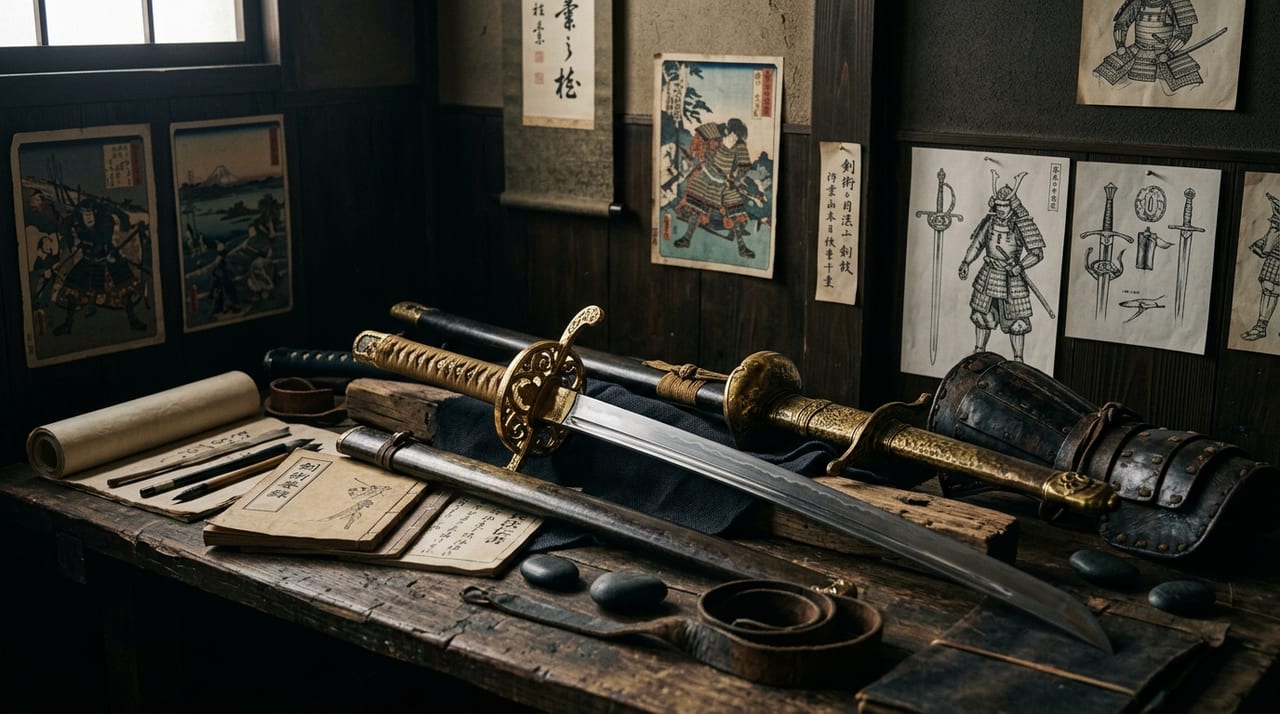
 * Image is for illustrative purposes only.
GARO
牙狼〈GARO〉
A tokusatsu series created by Yoshikatsu Amemiya beginning in 2005. The Garo Sword, a golden greatsword wielded by the Golden Knight Garo, is a massive weapon modeled on Japanese swords and exceeding 2 meters in total length, symbolizing the lineage of the Makai Knights who bear a sacred mission once each hundred years. Throughout the series, fundamental themes of Japanese sword culture—blade succession, spirit, and mission—are profoundly explored.
Description
Garo's World and the Lineage of Swords
Garo is an original tokusatsu series created by director Yoshikatsu Amemiya. Since its television broadcast on TV Tokyo beginning in 2005, it has developed into a long-running franchise encompassing television series, theatrical films, anime, and international remakes. Grounded in the narrative of special knights called "Makai Knights" who battle monsters called "Horrors" born from human negative emotions—a dark-hero story—the bloodline and sword lineage of the protagonist Kōya Saeshima (and his successors) who inherit the "Golden Armor of Garo" lies at the heart of the narrative.
The Garo Sword—The Sacred Blade Passed Down
The Garo Sword that appears after transformation is a greatsword gleaming in golden color, exceeding 2 meters in total length. While its form incorporates elements of the Japanese sword—the sori (curve), monouchi (striking area), and shinogi (ridge)—it also carries the gravitas of a Western knight's greatsword, embodying a unique design. Rather than a personal weapon, the sword is depicted as a sacred blade passed down alongside the title of "Golden Knight." The setting establishes that the souls and memories of successive Golden Knights dwell within it. Just as the Japanese sword served as a symbol of family status and spiritual inheritance in samurai society, the Garo Sword functions as a blade embodying the transmission of mission and bloodline. This motif of "the blade passed down" is one of the most fundamental themes of Japanese sword culture, and Garo reintroduces it in contemporary entertainment in modern form.
Swordplay Depiction and the Aesthetics of Tate
The Garo series is renowned for its high-quality tate (stage swordplay choreography) and martial arts action. Refined sword-fight sequences result from director Yoshikatsu Amemiya's artistic sensibility combined with the actors' dedication to mastering swordplay. In scenes where protagonists wield the "Makai Sword," a full-scale Japanese-sword-type blade, movements drawn from iaijutsu (quick-draw), kendō, and classical martial arts are incorporated, achieving remarkable authenticity in sword technique for a tokusatsu production. The portrayal of one's stance toward the blade, the spatial interval of engagement (ma-ai), and the will concentrated in the moment of drawing (battō) visually embodies the "stillness of beauty" and "the instant of release" inherent to the Japanese sword.
Light in Darkness—Human Negative Emotion and the Will of the Blade
The consistent theme depicted throughout the Garo series is "the conflict between human negative emotion and the will of light." The protagonist constantly wields the blade while resisting the temptation to be consumed by darkness. This resonates deeply with the metaphysics of the blade as expressed in Zen and bushidō: "the sword is a mirror reflecting the heart." The recognition that the story of the blade cannot be separated from the story of human interiority is the essence of Japanese sword culture. Garo conveys this philosophy to the present day in the form of mass entertainment.
Anime Expansion and International Recognition
The anime series "Garo -Flame of Stigma-" and "Garo -Crimson Moon-," which aired beginning in 2014 and produced by MAPPA, gained international acclaim through their high-quality animation and music, bringing Garo's world to overseas audiences unfamiliar with tokusatsu. "Flame of Stigma," set in a medieval European-style world, and "Crimson Moon," set in the Heian period of Japan (Heian-kyō), both express the shared theme of "the succession of blade and spirit" against differing cultural contexts, serving as a compelling example of the universality of Japanese sword culture within an international framework.
Real Swords Featured
Makai Sword Model: Edo-Period Shinto Uchi-gatana
In the Garo series, the Makai Sword wielded by the Makai Knights is configured as a full-scale sword-type weapon closely modeled on the uchi-gatana. The uchi-gatana of the Edo period established itself as the standard blade worn by samurai, with blade lengths of approximately 2 shaku 3 sun (roughly 70 cm). The harmony between its practical form and the beauty of its hamon exemplifies the culmination of Edo sword culture. The Makai Sword, functioning as the daily weapon in Garo, inherits this Edo-period uchi-gatana style and serves to bring the fundamental beauty of the Japanese sword to contemporary entertainment.
The Lineage of Divine Swords: Tsurumaru Kuninaga, Mikazuki Munekika, and Others
The concept of 'sacred swords passed down,' exemplified by the Garo Sword, is deeply rooted in Japanese legendary famous swords. National Treasure blades such as Tsurumaru Kuninaga and Mikazuki Munekika, transmitted since the Heian period, have been inherited across generations within the Imperial Household, the Tokugawa shogunate, and daimyo families. These blades embodied the spiritual and status inheritance of their owners, exemplifying the traditional Japanese principle that 'the worth of a sword reflects the worth of its bearer.' Garo's 'Golden Knight's Sword' represents the continuation of this tradition in contemporary pop culture.
See authentic Japanese swords
See authentic Japanese swordsThis page is intended to introduce Japanese sword culture and is not affiliated with any of the works mentioned.