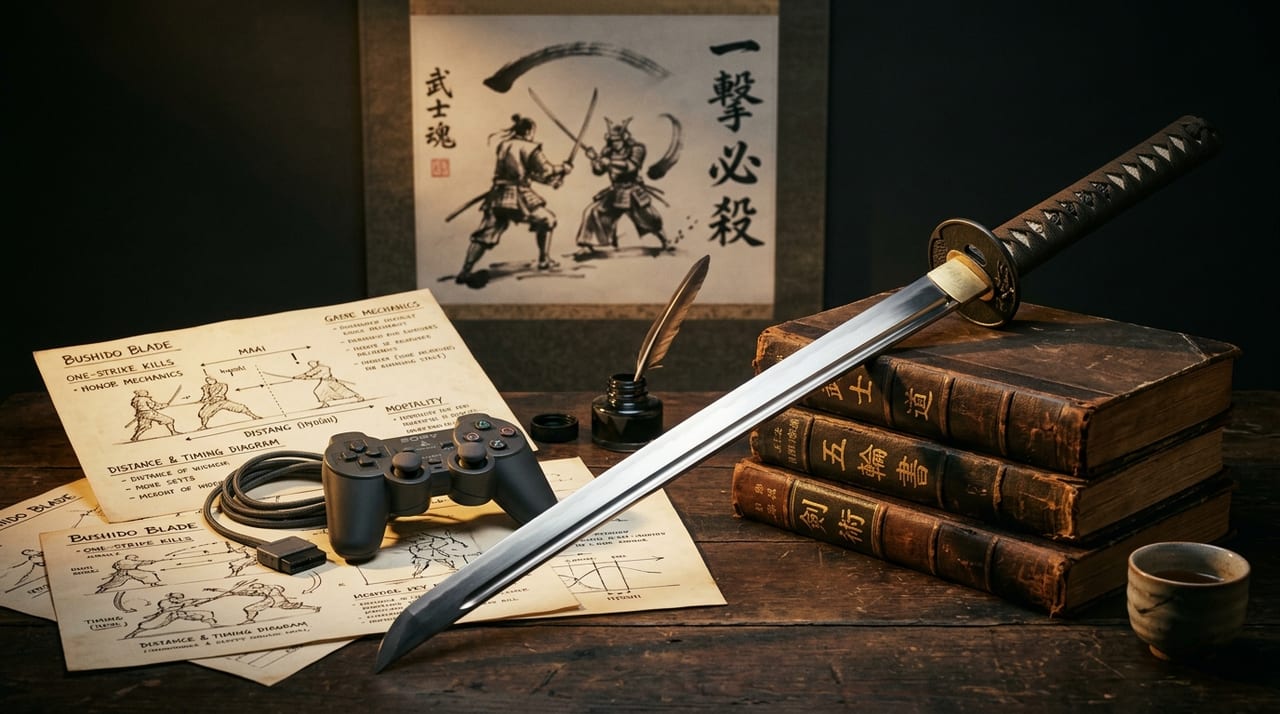
 * Image is for illustrative purposes only.
Bushido Blade
ブシドーブレード
A 3D sword-fighting action game released by Square (now Square Enix) in 1997 for PlayStation. It is distinguished by a system incorporating realistic martial philosophy with the concept of "no HP gauge—victory decided by a single strike to a vital point." Eight types of weapons are available for selection, including Japanese sword, naginata, nodachi, kanabō, rapier, and Western sword, with hit detection based on the actual vital points of swordsmen (neck, torso, arms, and legs). Evaluated by sword enthusiasts as a rare action game embodying the bushido principles of "the weight of a single strike" and "fair and honorable combat."
Description
Bushido Blade—The Martial Philosophy of the Japanese Sword Embodied in "No HP Gauge—One Strike, One Kill"
Bushido Blade is a 3D sword-fighting action game released by Square (now Square Enix) for the PlayStation in 1997. A sequel, "Bushido Blade 2" (1998), was also released on PlayStation. The reason this work occupies a singular position in the history of fighting games is that it completely abolished the "HP gauge (health bar)," which was the "common sense" of fighting games at the time, and introduced the realistic logic of martial arts: "victory is decided by a single strike to a vital point." This design philosophy is recognized today as the most faithful attempt to reproduce, as a game, the essential characteristic of the Japanese sword—"one strike, one kill," and continues to receive unique evaluation.
### No HP Gauge—The Tension of "True Duel"
The defining characteristic of Bushido Blade is the "abolition of the HP gauge (health bar)." The HP bar, adopted by nearly all fighting games, is predicated on the premise of "weakening gradually through repeated attacks," and demands from players that they "endure multiple attacks in order to survive." This is fundamentally different from the actual logic of sword combat—a single sharp blade striking a fatal point once kills a person.
Bushido Blade adopted this "realistic logic of sword combat." A hit to the neck (carotid artery severing) or torso (striking the heart, lungs, internal organs) results in instant death. A hit to the arms or legs leaves that part disabled and combat can continue. Through this design, each strike becomes a "matter of life and death," and the game allows players to experience the essence of actual sword combat: the control of distance, timing, and spacing.
### Weapon Diversity and the Characteristics of Blades
In Bushido Blade, eight types of weapons are selectable, each with characteristics based on actual weapon culture. The Japanese sword (katana)—a basic weapon embodying balanced attack and defense, mid-range spacing, and the "versatility" of the Japanese sword. The naginata—has long reach and excels at attacks on the legs. The naginata, true to its name meaning "to mow the legs" (nagi-ru), was historically used as a weapon to sweep an opponent's legs. The nodachi (long sword)—possesses extremely long reach but has large motions and many openings. It embodies the "power and opening tradeoff" of the ōdachi and nodachi. The kanabō—a weapon specialized in striking, with short range but significant impact per strike. Additionally, weapons such as rapier, Western blade, Western sword, and knightly sword can be selected, allowing players to enjoy the differences in spacing and tactics compared to the Japanese sword. The characteristics of each weapon are recreated in gameplay to reflect the actual strengths and weaknesses of those weapons as real arms, and players naturally learn "the favorable and unfavorable distances for each weapon."
### "Bushido" as a Way of Fighting—Rules and Honor
Another distinctive feature of this work is the existence of "bushido rules." At the start of a match, both combatants bow to each other (greet), and within the game, "attacks from behind" and "attacks on a fallen opponent" are prohibited (attacks from behind incur a moral penalty in the game, immediately creating a disadvantageous situation). This incorporates into game mechanics the concept of "fair and square combat" in actual bushido—the moral imperative against employing cowardly tactics.
Players who do not follow the "bushido rules" experience "shame" for their character in Story Mode (Arcade Mode), and some endings change. This design—where "ethical choices alter the game's conclusion"—is an attempt to allow players to experience through play the weight of "death with honor" and "victory with honor" in bushido.
### Limitations as a Game and Cultural Value
Bushido Blade cannot be said to have achieved major commercial success as a game (the fighting game market at that time was dominated by Tecmo's "Dead or Alive," Namco's "Tekken," and SNK's "King of Fighters"). However, its unique design philosophy—"abolishing the HP bar and incorporating the realism of one strike, one kill"—is still discussed as an experiment in fighting game design, and has become a work repeatedly cited in the discourse that "commercial success of games and the innovativeness of game design are separate matters."
From the perspective of sword enthusiasts, Bushido Blade is evaluated as "the work that most sincerely expresses the essential characteristics of the Japanese sword—lethality, the weight of a single strike, the command of distance—as game mechanics." This sincerity stems from a production decision to prioritize logical accuracy to martial arts over flashiness as entertainment, and conveys a deep respect for the essence of sword culture.
### Perspective for Sword Collectors
Bushido Blade is one piece of content that sword enthusiasts should know about as the game that most honestly allows players to experience "the weight of a single strike of the Japanese sword" within interactive media. The fact that "a single blade ends a person's life in an instant" is the core of the theme of the Japanese sword—"the coexistence of beauty and lethality"—and Bushido Blade made this fact experienceable as a game. The fact that, before modern gamers sought the pleasure of sword combat in "SEKIRO" or "Ghost of Tsushima," Square in 1997 reconsidered this question in a purer form deserves to be remembered as a point of intersection between Japanese game design and sword culture.
See authentic Japanese swords
See authentic Japanese swordsThis page is intended to introduce Japanese sword culture and is not affiliated with any of the works mentioned.