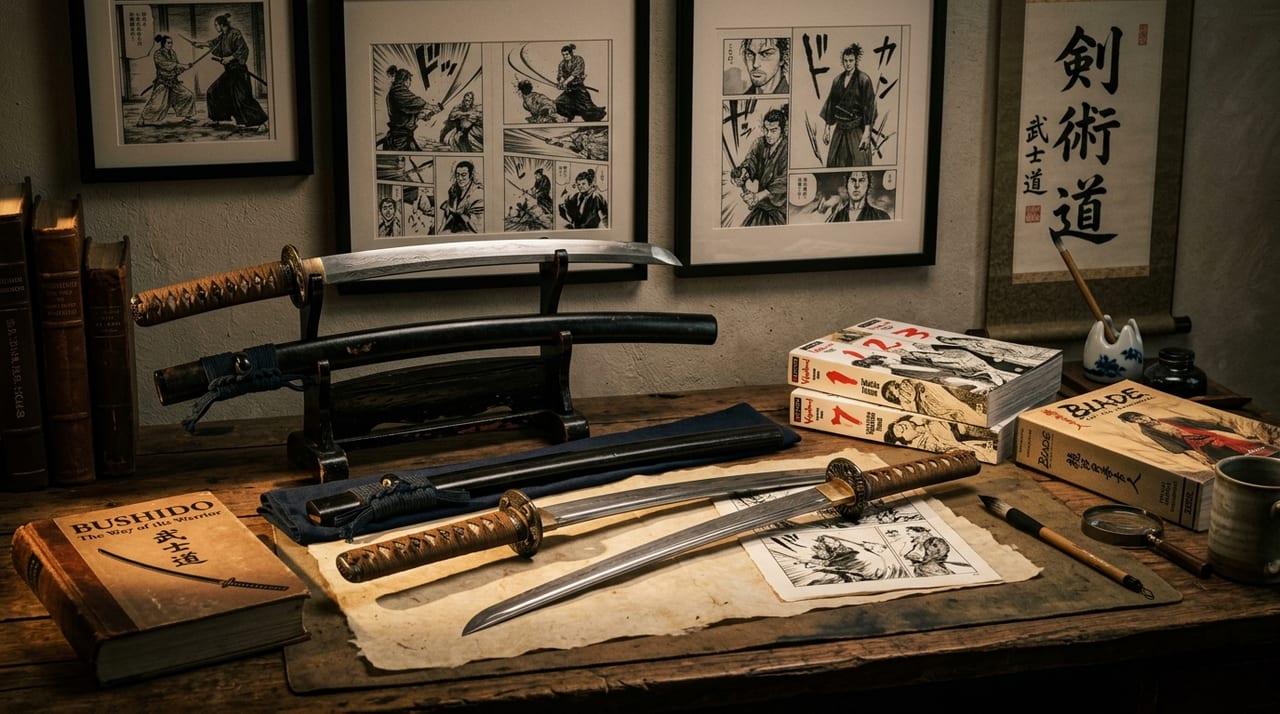
 * Image is for illustrative purposes only.
Blade of the Immortal
無限の住人
A historical drama manga by Hiroyuki Samura (serialized in Kodansha's Monthly Afternoon, 1993–2012). The immortal assassin Manji is hired by the young girl Asano Rin and engages in mortal combat with the swordsman group Ittō-ryū. 30 volumes total; English edition published by Dark Horse. First anime adaptation in 2008; a complete 24-episode anime by Raiden Film concluded in 2019. A live-action film (directed by Takashi Miike) was also released in 2017.
Description
The Paradox of Immortality and Death—The Overwhelming Narrative World Created by the Blade
Blade of the Immortal is a masterpiece of historical drama manga serialized in Kodansha's Monthly Afternoon from 1993 to 2012. Creator Hiroyuki Samura crafted a unique narrative world through overwhelming artistic prowess and distinctive aesthetic sensibility, in which the pleasure of swordplay coexists with the cruelty of violence. In 2000, it received the Eisner Award for Outstanding U.S. Edition of Foreign Language Work, establishing itself as one of the pioneering Japanese manga works to gain high acclaim in the English-speaking world.
### The Narrative Structure and the Protagonist: Manji
The protagonist Manji is a former rogue who once served as a shogunate assassin. In the course of avenging his sister Dorin, he slew over 300 people. He possesses an immortal body granted by the sacred "Holy Blood"—parasitic immortal worms implanted by Yaobikuni, a thousand-year-old female immortal. Yet this power carries a curse: "Liberation only after slaying a thousand virtuous people." When he encounters the young girl Asano Rin, Manji embarks on a journey to aid her revenge while continually questioning his own sins and the meaning of his immortality. Rin's father, Asano Masabyoe, is a master of the Yagyū Shinkagetsu-ryū sword school, and conflict with this tradition forms the narrative's core.
### Ittō-ryū and the Revolution in Swordplay Depiction
The work's defining feature lies in the creation of Ittō-ryū ('Single-Sword School'), a fictional sword tradition where each practitioner wields entirely different weapons and combat styles. Some wielders handle multiple broad swords simultaneously; others employ chain-scythes to control distance; still others combine extraordinary physical prowess with blindness. Samura designs each character's combat with meticulous precision, depicting the fundamental principles of Japanese sword technique—distance, blade trajectory, and footwork—alongside manga's dramatic exaggeration. The school's leader, Amatsukage Hisao, employs swordcraft that evokes real historical schools such as Mugen-ryū and Jigen-ryū, possessing a systematic depth that grants fictional techniques genuine credibility.
### The Deep Relationship with Japanese Swords
The depiction of blades in Blade of the Immortal transcends fiction through rigorous historical research. Manji's favorite weapons consist of multiple shikomi-tō (concealable swords) combined into specialized configurations—shorter and more portable than standard blades. Wakizashi, kodachi (medium swords), and shikomi-zue (cane-swords) appear throughout combat sequences. Set in the mid-Edo period (from the Genroku through Hōreki eras), the narrative authentically reflects the sword culture of that era—specifically the late Shintō and early Shinshintō periods. Both samurai and commoners, ronin and assassins alike carried blades as daily necessity, accurately mirroring the weapon culture of the time.
The manga is one of the few works that meticulously depicts practical sword aspects: blade maintenance, scabbard construction, notch damage from combat, and proper blood removal techniques. Ittō-ryū practitioners' weapons similarly reflect the historical diversity of Edo-period martial arts and concealed weapons, demonstrating profound respect for authentic weapon culture.
### Artistic Style and the Beauty of Swordplay
Hiroyuki Samura's artistic approach fuses Western comic technique with Japanese dramatic illustration. Meticulous character rendering contrasts with bold compositional economy in backgrounds; dynamic action sequences in combat establish new territory for sword-fighting manga. The depiction of the moment a blade tears through flesh achieves simultaneous brutality and beauty, visually embodying Japanese sword culture's theme of 'beauty and danger coexisting.' Each panel achieves the completeness of a woodblock print, yet the sequence generates overwhelming motion—resonating with the katana's own character: 'explosive power emerging from stillness.'
### History of Animation and Film Adaptation
An initial anime adaptation (13 episodes) premiered in 2008, but technical and budgetary constraints prevented full realization of the source's density. The 2019 Raiden Film adaptation—a complete 24-episode series—achieved high standards across animation quality, music, and direction, earning international recognition. Director Takashi Miike's 2017 live-action film ambitiously compressed 30 volumes into two and a half hours, with Takuya Kimura delivering a notable performance as Manji.
### A Perspective for Sword Collectors
For Japanese sword enthusiasts and researchers, Blade of the Immortal is a rare work detailing the practical use of wakizashi and kodachi. While most manga and anime center on the uchigatana (long blade), this series demonstrates 'the strength of shorter swords,' revealing blade diversity. Its unflinching depiction of cutting effectiveness and impact on human anatomy deepens understanding of swords' essential function. The work's 30-volume span of extensive blade imagery contributes significantly to sword-culture education. Globally, countless readers discovered Edo-period sword culture and martial tradition through this series, making its international cultural influence incalculable. Dark Horse Comics, publisher of the English edition, positions the work as 'an international ambassador for blade culture,' crediting it as foundational to the Western Japanese sword renaissance.
Real Swords Featured
Edo-Period Wakizashi and Kodachi
During the mid-to-late Edo period, the wakizashi served as the 'short blade' in the samurai's two-sword tradition (daishō). With blade lengths of approximately 30–60 cm, the wakizashi suited close-quarters combat and narrow indoor spaces, and was employed in ritual suicide (seppuku). The kodachi, with blade length around 60 cm, occupied a middle ground between wakizashi and katana. Manji's combat style—employing combinations of short blades—reflects authentic Edo-period weapon culture.
Shikomi-zue and Shikomi-tō (Hidden Weapons)
The shikomi-zue ('hidden staff'), prevalent from the mid-Edo period onward, concealed blades within everyday objects: walking sticks, tobacco pipes, and umbrellas. As sword hunts and restrictions on blade-carrying intensified, non-samurai classes adopted these hidden weapons for self-defense. Manji's shikomi-type arsenal draws from this cultural foundation, exemplifying Edo-period weapon ingenuity and diversity.
See authentic Japanese swords
See authentic Japanese swordsThis page is intended to introduce Japanese sword culture and is not affiliated with any of the works mentioned.