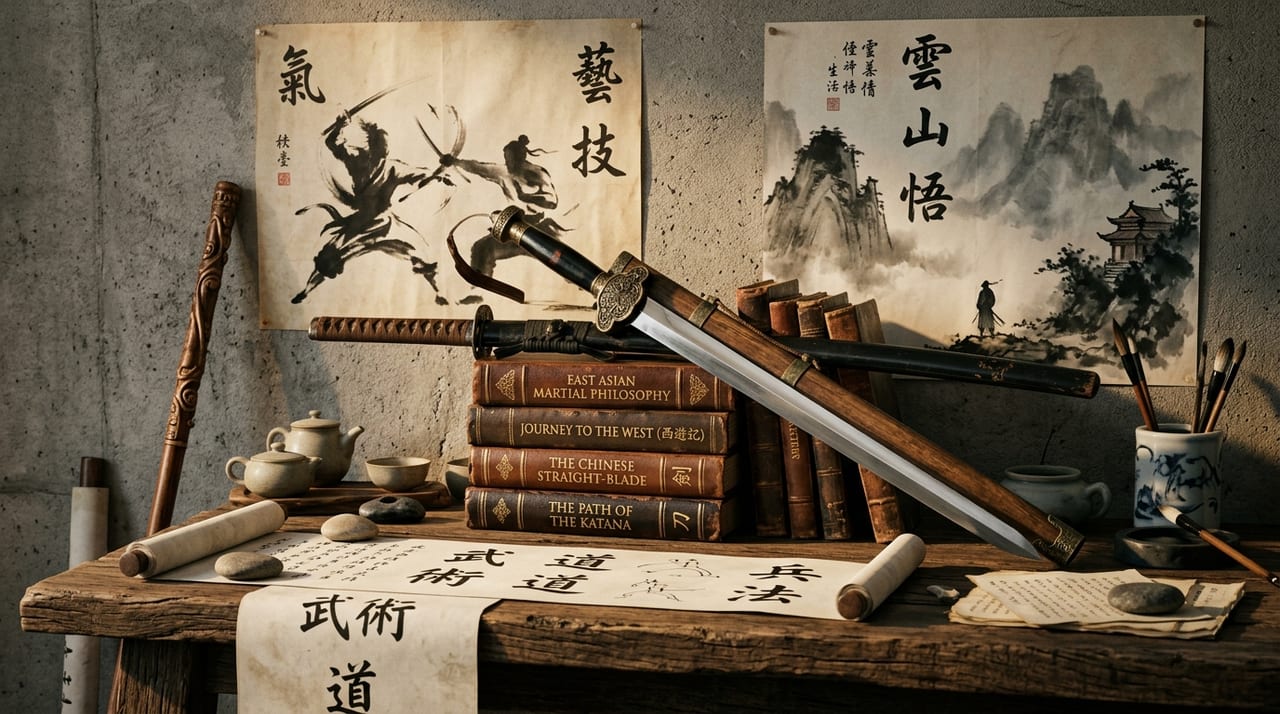
 * Image is for illustrative purposes only.
Black Myth: Wukong
黒神話:悟空
An action RPG released by Chinese game studio Game Science in August 2024. Based on the classic Chinese literary work "Journey to the West," it reinterprets the mythology of Sun Wukong (the Great Sage Equal to Heaven). It sold over 15 million copies in its opening week, establishing a new milestone for the Asian game industry. Centering on Sun Wukong's Ruyi Jingu Bang staff, playable weapons are unified as staffs (with 2 types of spears as exceptions), while expressing the intersection of Chinese and Japanese blade cultures as its cultural backdrop. From the perspective of historical and cultural exchange with Japanese sword culture, it is also a significant work.
Description
Black Myth: Wukong — The Blade of Journey to the West Bridges Chinese and Japanese Sword Cultures
Black Myth: Wukong (August 2024, Game Science) is a groundbreaking work that reinterprets the mythological journey of Sun Wukong (the Great Sage Equal to Heaven) from the Chinese novel Journey to the West (Ming Dynasty, 16th century) as a modern action game. Setting a record of over 10 million copies sold within three days of launch and 20 million within one month, it drew worldwide attention as the title that proved the Chinese game industry possesses global-scale commercial and cultural influence.
Discussing Black Myth: Wukong from the perspective of Japanese sword culture might initially appear to conflate "blade cultures of two different cultural spheres — Japan and China." In reality, however, Chinese sword culture (jian, dao, ge, mao) and Japanese sword culture (tachi, uchigatana, naginata) are historically deeply interrelated, and this work embodies that intersection in contemporary form.
### The Ruyi Jingu Bang — The Cultural Lineage of the "Staff" as a Weapon
Sun Wukong's iconic weapon, the Ruyi Jingu Bang (the Compliant Golden-Hooped Rod), is a staff — an elongated striking and thrusting weapon — and thus differs in classification from swords. However, the cultural lineage of the Ruyi Jingu Bang deeply intersects with the history of Japanese swords, naginata, and bo-jutsu. Japanese bo-jutsu (staff martial arts) is a core pillar of martial practice alongside swordsmanship, and "confrontations between staff and sword (bo vs. blade)" are established as traditional kata (forms) in Japanese martial arts and kendo practice. The combat motions of the Ruyi Jingu Bang in Black Myth: Wukong are designed to resonate with the operational principles of Japanese kenjutsu and bo-jutsu — "control of distance (maai)," "the weight of a single strike," and "zanshin (maintaining mental tension after a strike)" — expressing the "common language of East Asian weapon aesthetics" as modern game action.
### Chinese Sword Culture — A Comparison of Jian, Tachi, and Polearm
All player weapons in Black Myth: Wukong are unified as staffs (with spears being the exception, numbering two types), and sword-type weapons such as blades are not implemented. This is an intentional design choice derived from Journey to the West's iconic staff. At the same time, the cultural background of this work — China — possesses a rich sword culture. The Chinese straight sword (double-edged jian) possesses a structure distinct from Japanese naginata and tachi, yet as part of East Asian blade culture, it shares an aesthetic that resonates with Japanese swordsmanship.
The Chinese "jian" and the Japanese "tachi," while differing in appearance, structure, and usage, share a common cultural foundation from the perspective of "the aesthetics of martial arts using blades." Both emphasize "blade sharpness and the certainty of a single decisive strike" and share the swordsmanship philosophy of "control of distance and seizing the initiative (sen no sen)." Black Myth: Wukong, through Journey to the West as a shared cultural source, has awakened international interest in East Asian blade culture, offering players a moment to turn their attention toward East Asian weapon aesthetics.
### Historical Exchange Between Journey to the West and Japanese Sword and Blade Culture
Journey to the West was transmitted to Japan during the Edo period (17th–18th centuries) and subsequently became deeply rooted in Japanese culture. As exemplified by Utagawa Kuniyoshi's ukiyo-e prints such as "Popular Water Margin: Gallant Heroes One Hundred Eight" and the Miyamoto Musashi series, Edo-period Japan witnessed a fusion of Chinese hero legends and Japanese sword culture in the visual arts.
The character of Sun Wukong is also widely known in Japan, with Toriyama Akira's Dragon Ball (serialized from 1984 onward) establishing Sun Wukong as a fixture in Japanese pop culture. Black Myth: Wukong, as the latest chapter in this "context of Sino-Japanese cultural exchange," has re-presented the Chinese Sun Wukong mythology to the international market, thereby awakening in a new generation an interest in the mutual influence between Sino-Japanese weapon culture and martial culture.
### The Cultural Background of Journey to the West — Contemporary Interpretation of Chinese Sword Culture
The cultural background of Black Myth: Wukong's world is informed by China, which possesses the following traditions of sword culture. Note that these blades serve only as cultural context outside the game and are not implemented as playable weapons in this work.
The "Green Dragon Crescent Blade (qīng lóng yǎn yuè dāo)" — known as the weapon of Guan Yu in the Romance of the Three Kingdoms — is a large crescent moon blade (yan yue dao). It is a long-handled blade similar to the Japanese naginata, sharing a common design language of "combining reach and power."
"Dual blades (shuang jian)" — the combat style of wielding two blades simultaneously shares an aesthetic with Japan's "Niten Ichi-ryu (two-sword school)" established by Miyamoto Musashi, embodying the martial theme of "balance and coordination of two blades."
These elements of Chinese sword culture form a lineage of East Asian blade culture that resonates with Japanese swordsmanship culture. By re-presenting Journey to the West, its cultural source, to an international audience, Black Myth: Wukong has become a work of cultural significance, awakening "contemporary interest in East Asian blade culture."
### A Perspective for Sword Collectors
Black Myth: Wukong is, from the perspective of "historical exchange between Chinese sword culture and Japanese sword culture," an important cultural reference point for Japanese sword collectors. The interest in "East Asian weapon aesthetics" that this work awakens provides an opportunity to reframe "the uniqueness of the Japanese sword" within a context of "comparison with blade cultures of China, Korea, and Southeast Asia." By understanding the differences and commonalities in form, manufacturing method, and aesthetics between the Chinese jian and the Japanese tachi and uchigatana, one can gain a deep understanding of how the distinctive characteristics of the Japanese sword — its curvature (sori), ridged cross-section construction (shinogi-zukuri), and temper pattern (hamon) — achieved unique development within the broader blade culture of East Asia.
Real Swords Featured
Jian (Chinese straight double-edged sword, thrusting emphasis)
Dao (Chinese single-edged curved sword, slashing emphasis)
Naginata / O-naginata (long-handled curved blade, shared Sino-Japanese long-weapon culture)
See authentic Japanese swords
See authentic Japanese swordsThis page is intended to introduce Japanese sword culture and is not affiliated with any of the works mentioned.