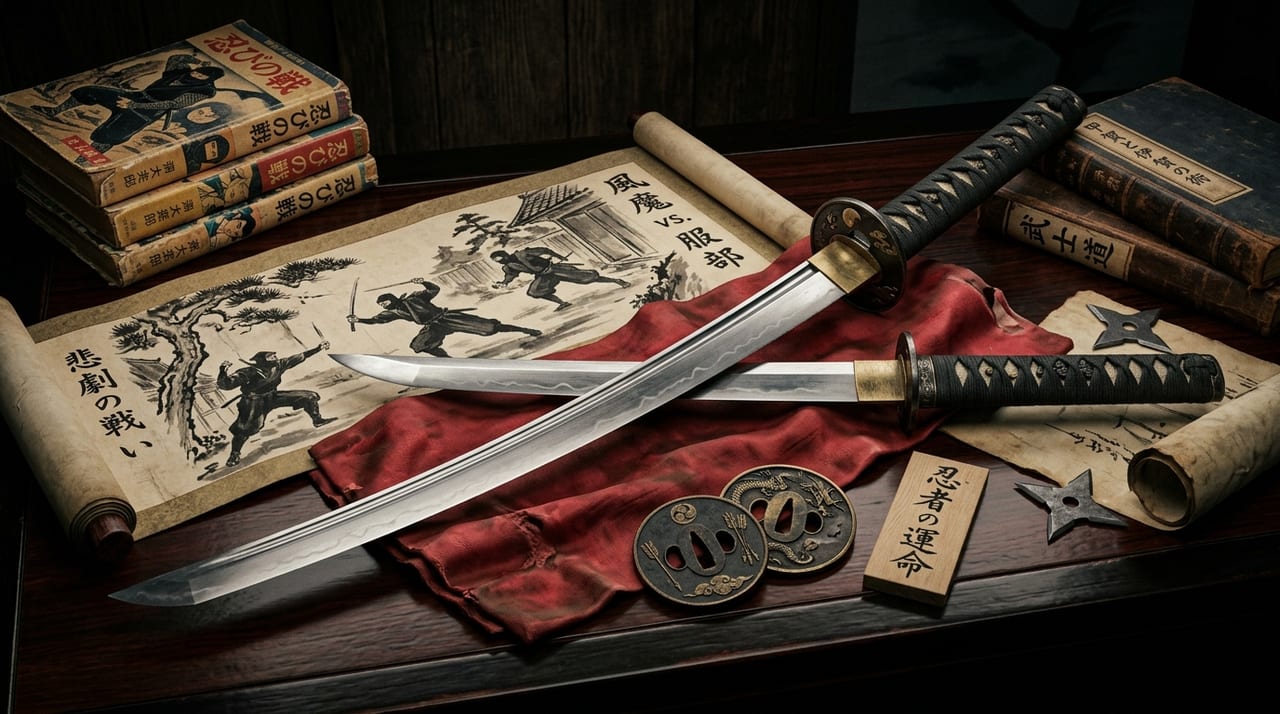
 * Image is for illustrative purposes only.
Basilisk: The Kouga Ninja Scrolls
バジリスク〜甲賀忍法帖〜
Based on Yamada Futaro's Ninpōchō (Ninja Scroll) series, adapted into manga by Segawa Masaki (2003–2004) and animated in 2005. The story depicts the confrontation between the Iga and Kouga ninja clans over the succession of the Tokugawa shogun, with detailed portrayals of extraordinary sword techniques employed by blade-wielding shinobi. Through its unique world view that fuses katana with the secret arts of the ninja, it profoundly influenced modern depictions of shinobi and sword masters.
Description
Yamada Futaro and the World of Ninpōchō
The original work of Basilisk is "The Kouga Ninja Scrolls," the first in Yamada Futaro's Ninpōchō series, published in 1958. During the Showa 30–40s (1950s–1960s), Yamada Futaro published numerous works in the Ninpōchō series, reframing shinobi not as mere assassins but as "ultimate embodiments of martial arts" possessed of superhuman special abilities. Each ninja's unique "ninjutsu" (supernormal special techniques) are exaggerations and refinements of actual ninjutsu and martial arts techniques, grounded in deep understanding of Japanese martial culture. The tragic love story of Gennosuke of Kouga and Oboro of Iga, star-crossed lovers torn apart by fate, evokes the classical tragic structure of Romeo and Juliet while being colored by a distinctly Japanese aesthetic. Beginning with "The Kouga Ninja Scrolls," Yamada Futaro's Ninpōchō series continued with works such as "The Swastika of Shinobi," "Makai Tenshō," and "The Yagyū Ninja Scrolls," establishing the "ninja story" genre in Japanese entertainment fiction. His body of work is arguably the source of all subsequent ninja depictions in manga, anime, and games; Yamada's imagination is deeply inscribed in the skeleton of contemporary entertainment culture. In particular, his fusion of swordsmanship and ninjutsu created a unique genre blending katana culture with the culture of the shinobi.
Segawa Masaki's Manga and Sword Depiction
Segawa Masaki's manga adaptation (serialized in Young Magazine Uppers, 2003–2004) remains faithful to Yamada Futaro's original while adding new appeal through overwhelming artistic skill and meticulous action choreography. The depiction of sword techniques wielded by blade-using shinobi is particularly striking, expressing both the beauty of the blade's movement and its lethal force simultaneously, captivating many katana enthusiasts. Segawa's depiction of swords and blades accurately reflects the actual morphology of nodachi, wakizashi, and tantō; the rendering of wind-cutting sounds and slash trajectories accompanying blade movement is extraordinarily realistic. The 2005 anime adaptation, produced by GONZO, likewise boasts high quality and has won many fans overseas.
The Historical Relationship Between Shinobi and Japanese Swords
In actual historical ninjutsu, the question of how shinobi employed katana is a fascinating research topic. The swords used by ninja were reportedly shorter than standard samurai nodachi (called shinobito), featured edges approaching the straight blade form (suguha) with angular guards, and were purpose-built weapons prioritizing function. The short, linear shinobito was designed emphasizing maneuverability in confined spaces and versatility, such as using the scabbard as "climbing assistance" for ascending ledges. Though the unique sword techniques depicted for each ninja in Basilisk are exaggerations of actual ninjutsu and swordsmanship practices, they stimulate the imagination regarding the diverse technical systems embodied in Japanese martial arts. Today, ninjutsu and martial arts dojos continue to exist in the Kouga and Iga regions (now Shiga and Mie Prefectures), preserving the lineages of actual ninjutsu practice.
Tokugawa Shogun Succession and Early Bakufu Political Context
The succession problem forming the story's backdrop reflects actual history: intense power struggles existed during the reigns of the second and third shoguns. The premise of Iga and Kouga ninja clans being used as pieces in the bakufu's power struggle is grounded in historical fact—actual ninja clans served regional daimyo and the shogunate, gathering intelligence and conducting assassinations. In particular, Iga shinobi forged a special bond with the Tokugawa house when they risked their lives protecting Tokugawa Ieyasu during the Iga-goe (1582), and were subsequently organized as "Iga dōshin" in the Edo bakufu. Kouga shinobi also served many daimyo during the Sengoku and early Edo periods; the actual history of Iga and Kouga ninja is more dramatic than one might imagine. By incorporating this political reality as the backbone of the narrative, Basilisk grounds its supernormal ninjutsu depictions in historical authenticity. The sword culture of early Edo was an era in which shinkatsu (new-sword period) smiths blossomed with new aesthetics and techniques, and many blades appropriate to Basilisk's setting were forged during this period. It was also the era when the masterworks of celebrated smiths such as Horikawa Kunihiro and Echizen Yasutsugi were distributed into the hands of regional lords controlling the territories where Iga and Kouga shinobi operated.
Contemporary Influence and Tōkenza
Basilisk wielded significant influence over subsequent ninja and sword-master manga and anime such as NARUTO and BLEACH, and is positioned as one of the works that established the standard for depictions of ninjutsu and sword techniques in contemporary manga. Additionally, a sequel, "Basilisk: The Cherry Blossom Ninja Scrolls," was animated in 2018, and the series continues to acquire new fans in the modern era. Tōkenza handles a wide range of blades from the early Edo period (Keichō–Kanei eras), the setting of Basilisk, providing authentic period katana to those interested in the historical background of shinobi and sword-master culture. We occasionally handle short practical blades resembling shinobito and straight-edged wakizashi, offering collections approachable to collectors new to Basilisk's aesthetic. Swords are cultural heritage transcending mere weapons, and it is Tōkenza's mission to deliver to those who have encountered the world of katana through Basilisk both the beauty of genuine artifacts and their historical weight.
Real Swords Featured
Shinobito / Short Uchidao (Early Edo-Period Ninja Blade)
The "shinobito" appearing in authentic ninjutsu treatises is a function-focused blade with a short blade length of two shaku or less (under 60 cm) and either a straight edge or shallow wavy hamon. The scabbard was made proportionally long and reportedly served as an auxiliary tool for ascending footholds and underwater movement. The blades wielded by shinobi in Basilisk are based on the shinobito tradition, lending historical grounding to depictions of the blade's multifunctional use in actual ninjutsu practice. Tōkenza handles numerous fine examples of tantō and wakizashi from the early Edo period, offering patrons the opportunity to view authentic artifacts approximating the shinobito concept.
Echizen Yasutsugi (Master Blade of the Tokugawa Shogun's Official Smith)
Echizen Yasutsugi was a celebrated smith of the Keichō–Genna period authorized by Tokugawa Ieyasu to use the aoi mon (hollyhock crest), a contemporary of the early Tokugawa shogunate that forms the backdrop to Basilisk's narrative. Yasutsugi's blades—coveted by the most formidable figures of the era, whether shinobi or professional sword masters, as the finest available—embody the sword culture of Basilisk's setting. Displaying robust hamon influenced by the Soshu tradition and practical proportions, his works command high regard among modern collectors.
Horikawa Kunihiro (Pioneer of the Shinkatsu Period)
Horikawa Kunihiro, active during the Tenshō–Keichō period, is revered as the founder of the shinkatsu (new-sword) tradition, with his students forming the core of the sword world in early Edo. The Kyoto of the Keichō–Genna years, Basilisk's setting, was precisely the era and location where Kunihiro and his disciples were active, and the cultural center of Kansai sword craftsmanship where Iga and Kouga shinobi operated. While inheriting the techniques of koto (old-sword) smithing, Kunihiro's blades embody the aesthetic sensibilities of a new age; extant examples command premium prices in the blade market, representing masterworks throughout.
Tantō and Wakizashi (Practical Weapons of the Shinobi)
Among the weapons actually employed by shinobi, tantō and wakizashi were the most critical bladed instruments. The tantō, easily concealed within clothing, was ideal for assassination and self-defense, while the wakizashi was adapted by shinobi from the two-sword configuration that samurai habitually carried alongside the nodachi. Numerous fine examples of tantō and wakizashi crafted by celebrated smiths survive from early Edo; as a category of blade retaining aspects of authentic historical ninja weaponry, they are essential artifacts for understanding the shinobi world depicted in Basilisk.
Suishinshi Masahide (Theoretical Perfection of Swordsmanship and Blade)
Suishinshi Masahide, a celebrated late-Edo smith and sword theorist, was the leader of the shinshintō (new-new-sword) movement advocating "revival of koto aesthetics." Though he postdates Basilisk's era, his works and theories redefined the historical evaluation criteria for katana, reconsidering the aesthetic and functional ideals of Japanese swords broadly, including shinobito. The "simple, functional beauty" of the shinobi's blade depicted in Basilisk resonates with the "direct, unadorned beauty of koto blades" that Masahide championed.
See authentic Japanese swords
See authentic Japanese swordsThis page is intended to introduce Japanese sword culture and is not affiliated with any of the works mentioned.