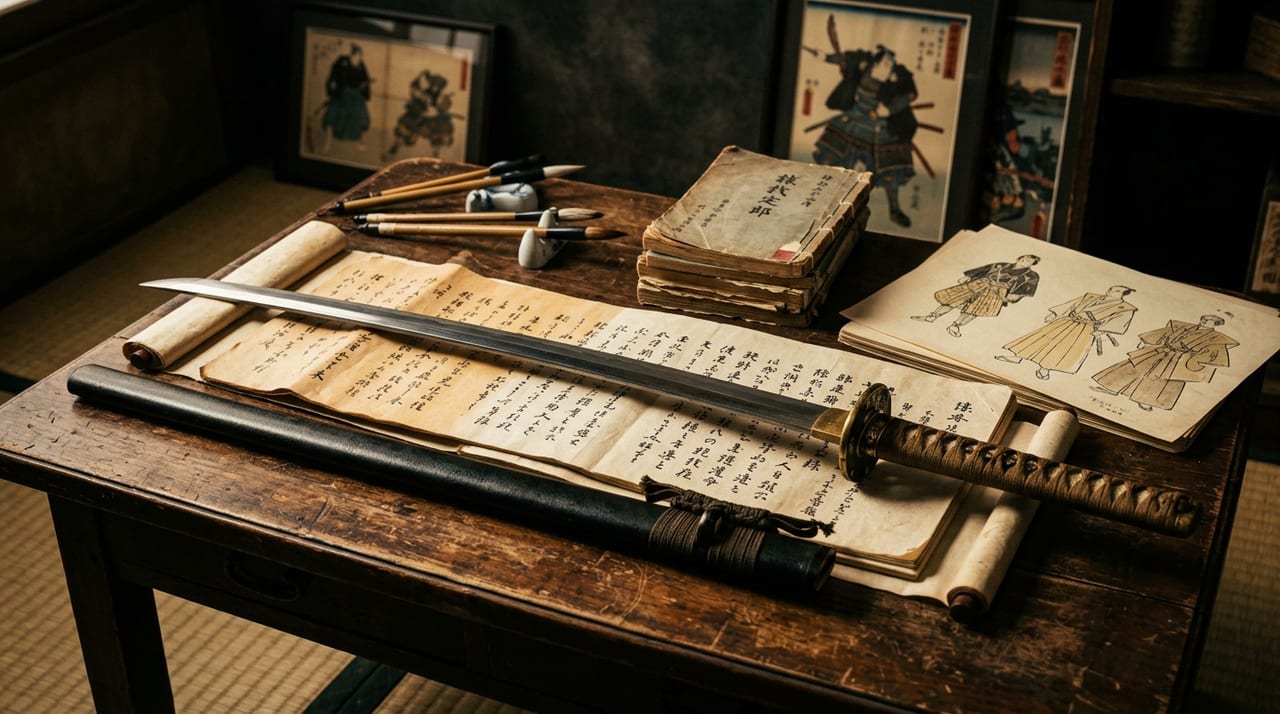
 * Image is for illustrative purposes only.
Abarenbou Shogun (The Rowdy Shogun)
暴れん坊将軍
A long-running jidaigeki broadcast on TV Asahi from 1978 to 2002 (12 series, over 830 episodes). The eighth Tokugawa shogun Yoshimune disguises himself as a commoner named 'Tokuda Shinnosuke' to cut down villains in Edo. Matsudaira Ken's portrayal of Yoshimune features a two-stage sword style — transitioning from a commoner disguise's swordsmanship to authentic Itto-ryu as his true identity is revealed. The climactic sword-battle sequence "Tenka Gomen no Mukō-kizu" became one of Japanese jidaigeki's most iconic cultural templates alongside Mito Komon.
Description
Abarenbou Shogun — Justice Embodied Through the Shogun's Sword
Abarenbou Shogun (TV Asahi, 1978–2002) stands as one of the longest-running jidaigeki in Japanese television history, commanding 12 series and 831 episodes deeply embedded in Showa and Heisei cultural memory. Matsudaira Ken's commanding presence and the sword-battle (tate) sequences climaxing each episode—particularly the iconic image of "Yoshimune's sword" cutting down villains in backlit silhouette—established a paradigmatic "aesthetic of sword drama" in Japanese period television.
### Historical Tokugawa Yoshimune and Swords
The protagonist Tokugawa Yoshimune (1684–1751) was the eighth Tokugawa shogun and a significant historical figure known for the Kyoho Reforms. Historical records document Yoshimune as a shogun who valued martial arts, excelling particularly in swordsmanship and archery. During the Kyoho period (1716–1736), he implemented policies promoting warrior martial training. The Kyoho era marked a critical turning point in Japanese sword history: as prolonged peace shifted swords toward ceremonial and decorative function, Yoshimune's encouragement of martial arts rekindled interest in practical, cutting-capable blades and the revival of sword dojos.
### Itto-ryu and Yoshimune's Sword — The Shogun's Sword School
Abarenbou Shogun adopts Itto-ryu (One-Sword School) as Yoshimune's sword style. Itto-ryu, founded by Ito Ittosai, was one of the Edo period's greatest sword schools, producing throughout the era as "the unrivaled swordsmanship under heaven" and establishing numerous dojos. Itto-ryu's defining characteristics are precise control of combative distance (maai) and the certainty of a single decisive strike (ikkitsu-hissatsu). In the series, Yoshimune's sword unfolds in two distinct phases. While disguised as the commoner Tokuda Shinnosuke, he deliberately exhibits a simple, "townsman-style" swordsmanship to conceal his identity. Upon revelation as the true Shogun Yoshimune dispensing justice, Itto-ryu's authentic "single decisive strike commanding distance" is unleashed. This simultaneous disguise of identity and sword style expresses a fundamental principle of Japanese sword culture: the school (ryu) embodies the practitioner's identity.
### The Aesthetics of Tate (Stage Swordsmanship) — Matsudaira Ken's Sword Drama
Abarenbou Shogun's tate is renowned as the "grand sword drama" (dai-kengeki) style developed under Ichikawa Danpei, a master of period-drama choreography. Specific characteristics include: the "one-against-many" framework—Yoshimune single-handedly facing dozens of villains, embodied through Matsudaira Ken's large frame and overwhelming presence; "broad sweeping strokes"—prioritizing dynamically expansive sword movements over small, sharp motions to emphasize the weight and power of each cut; the "backlit silhouette"—a visual signature established as a period-drama convention through climactic backlighting; and synchronized musical accompaniment—the Abarenbou Shogun theme propelling the sword action creates a visual-musical synchronization engraved in Japanese period-drama culture. These combined elements establish "Abarenbou Shogun tate" as one of the most recognizable sword-drama aesthetics in Japanese period television, alongside the iai of Kakunoshin in Mito Komon.
### "Heaven's Permission—The Forward-Facing Scar" — Justice Through the Shogun's Sword
The climactic formula of Abarenbou Shogun—"Tenka-gomen no mukokizu" (heaven's permission, forward-facing scar)—unfolds as Yoshimune reveals his identity by displaying the scar on his forehead, then immediately executes judgment upon the villains. This dramatic archetype stands alongside Mito Komon's "Does this crest not register?" as one of the most celebrated climactic formulas in Japanese television jidaigeki. The "mukokizu"—a scar resulting from unflinching forward advance against a frontal attack—symbolizes a warrior's courage to fight face-to-face. Yoshimune's forehead scar functions as "proof that the shogun stood on the front line alongside commoners," not a symbol of power but evidence of actual combat. This embodies a fundamental philosophical aspect of Japanese sword culture: the concept of "responsibility through the blade"—that the sword imposes upon its bearer the duty to protect and the responsibility to fight.
### The Shogun's Sword — Yoshimune's Uchigatana and Historical Context
The historical setting of Abarenbou Shogun (Kyoho period, 1716–1736) falls within a pivotal transition in Edo-period sword culture: the shift from the Shinto (new-sword) period to the Shinshinto (new-new-sword) period. The swords worn routinely by warriors of this era were the uchigatana (worn-edge sword)—a pair consisting of the daitou (long sword, blade length two shaku or greater) and wakizashi (short sword, blade length one to two shaku)—representing the standard configuration. Yoshimune's sword, following historical accuracy for the Kyoho period, would fall within the "uchigatana" classification, with likely candidates being works by mid-Edo-period swordsmiths such as Echizen Yasutugu and Harima Daijō Fujiwara Tadakuni—smiths of the "three great houses" tradition. Furthermore, as a shogun who actively promoted martial arts, Yoshimune likely held famous blades forged by swordsmiths of the Three Houses (Owari, Kii, Mito), making the historical relationship between shogun and swordsmith a fascinating dimension of this era.
### For Sword Collectors
Abarenbou Shogun serves as an important cultural reference point for Japanese sword collectors from two perspectives: the aesthetic embodiment of Itto-ryu as a real historical sword school, and the uchigatana culture of the Kyoho period (mid-Edo). The "single-strike" aesthetic embodied in each episode's climactic sword drama sits at the intersection of iaido's draw-to-strike philosophy and Itto-ryu's ikkitsu-hissatsu ideology, making it exemplary visual experience of the "philosophy of the single strike" in Japanese sword culture. Moreover, the image of "the shogun's sword" imprinted on Japanese viewers across a quarter-century of broadcasts serves as ideal teaching material for understanding a crucial aspect of sword culture: the social function of the Japanese blade as the unified embodiment of political and martial authority.
Real Swords Featured
Uchigatana (Kyoho-period shin-to)
Itto-ryu shinai and bokken (practice weapons)
Blades by Go-Sanke (Three Lord Branches) swordsmiths
See authentic Japanese swords
See authentic Japanese swordsThis page is intended to introduce Japanese sword culture and is not affiliated with any of the works mentioned.