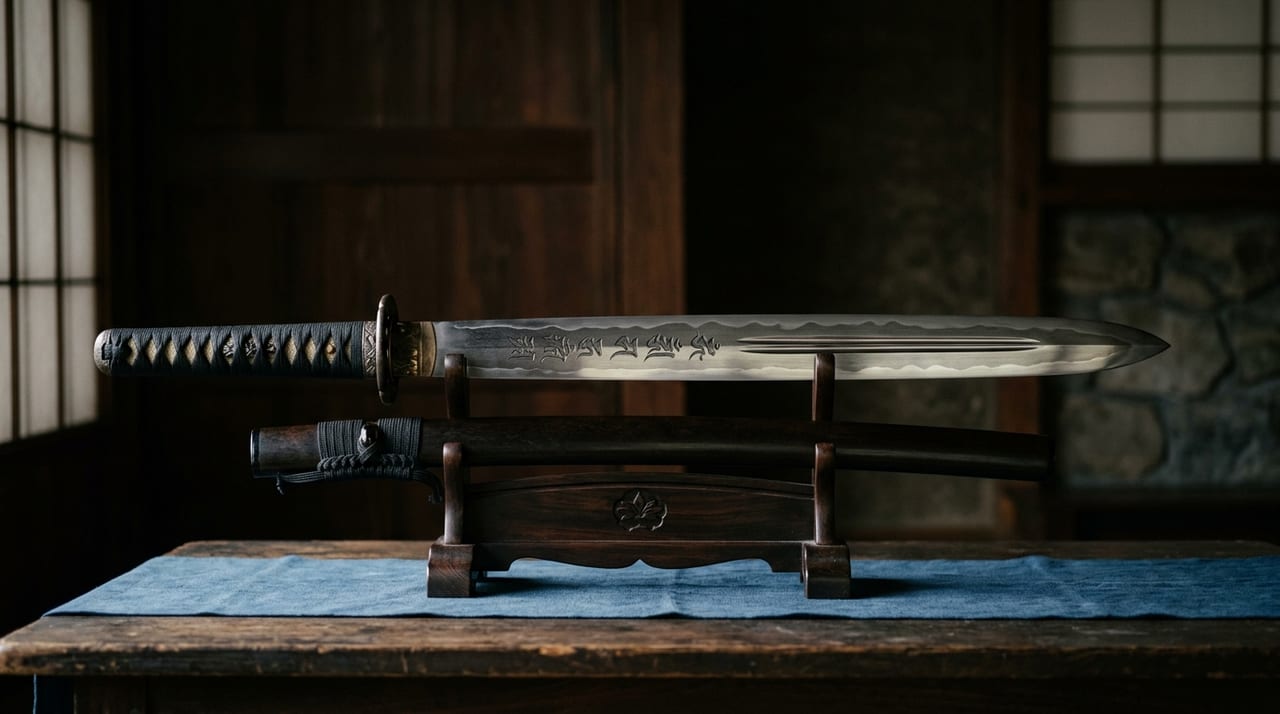
 * Image is for illustrative purposes only.
Tonbokiri
蜻蛉切
Also known as: Dragonfly Cutter
Description
Overview of the Blade
A legendary large sasaho (bamboo-leaf) spear counted among the Three Great Spears of Japan and known as the favored spear of Honda Tadakatsu, renowned as the strongest warrior of the Sengoku period. The blade is about 43.7 cm (1 shaku 4 sun) long. While it traces a graceful curve reminiscent of a bamboo leaf, its broad, thick point is a practical design that excels not only at thrusting but also at slashing and sweeping. The blade is finely engraved with a sanko-ken (three-pronged vajra sword) and Sanskrit characters (bonji), combining the functional beauty of a weapon with religious solemnity.
The Blade's Maker
The maker, Fujiwara Masazane, was a swordsmith of Mikawa Province (present-day eastern Aichi Prefecture), and there is a tradition that he was a disciple of Sengo Muramasa, a master smith of Kuwana in Ise Province. He is said to have inherited Muramasa's practical, sharp cutting edge while establishing a bold, distinctive style of his own.
Manufacture and Characteristics
The steel of the Tonbokiri shows well-refined itame-hada with thick ji-nie, and its hamon is a lively work combining notare with gunome. The name Tonbokiri derives from the anecdote that a dragonfly alighting on the point was instantly cut in two. The legend of its tremendous sharpness, that it could split a living creature merely by touching it, plainly tells of the spear's power. Honda Tadakatsu (1548–1610) was a Sengoku warrior who served Tokugawa Ieyasu and is known as a leading member of the Four Heavenly Kings of the Tokugawa and the Sixteen Generals of the Tokugawa. He is said to have taken the field in fifty-seven battles in his lifetime without ever receiving so much as a scratch, and his valor was revered by friend and foe alike. Toyotomi Hideyoshi praised Tadakatsu as "the foremost warrior in Japan, unrivaled across all ages," and Oda Nobunaga is said to have described him as "a commander who possessed both flower and fruit." Tonbokiri was always with Tadakatsu and was a symbol that spread his martial fame throughout the realm. It is currently in a private collection and is on deposit at the Sano Art Museum in Mishima, where there are occasions when it is displayed.
Legends & Stories
Legends and Anecdotes
The legends surrounding Tonbokiri are inseparably tied to the superhuman martial prowess of the warrior Honda Tadakatsu. Tadakatsu's first battle, in which he distinguished himself, was the supplying of provisions to Ōtaka Castle in Eiroku 3 (1560), when he was just thirteen years old. From then on, he took part in nearly all of the major battles of the Sengoku period, including the Battle of Anegawa (1570), the Battle of Mikatagahara (1572), the Battle of Nagashino (1575), the Battle of Komaki and Nagakute (1584), and the Battle of Sekigahara (1600), and the number of his campaigns reached fifty-seven. Remarkably, it is said that in all of these battles he never received so much as a scratch. Tonbokiri remained in Tadakatsu's hands throughout all of these campaigns, and it is said to have felled numerous enemy soldiers. As for the anecdote that gave the spear its name, in which it cut a dragonfly in two the moment the insect alighted on its point, no specific time or place has been handed down; it is, however, also told that a dragonfly that flew into the spear as it stood on the battlefield was cut in two. Dragonflies have long been called "kachimushi" (victory insects) and were favored by warriors as auspicious creatures, and the implication of a spear sharp enough to cut even such a victory insect adds to the menace of the name Tonbokiri. The most famous anecdote symbolizing Tadakatsu's martial prowess concerns the Battle of Komaki and Nagakute. Before the vast army led by Toyotomi Hideyoshi, Tadakatsu rushed to the scene with only 500 men and stood his ground without flinching in the face of Hideyoshi's great host. Impressed by this fearless conduct, Hideyoshi is said to have praised Tadakatsu as "the foremost warrior of the eastern provinces." At the time of the Battle of Sekigahara (1600), Tadakatsu had entered his twilight years at the age of fifty-three. Aware of his declining physical strength, Tadakatsu is said to have shortened the shaft of Tonbokiri by more than three shaku, yet its majesty did not diminish in the least. Even in the main engagement at Sekigahara, Tadakatsu is said to have shown lion-like ferocity, racing across the battlefield wielding Tonbokiri. In Keichō 15 (1610), Tadakatsu died at Kuwana domain at the age of sixty-three. A few days before his death, while he was carving his name onto one of his belongings with a small knife, his hand slipped and he cut his left hand, and he is said to have muttered, "If even Honda Tadakatsu gets wounded, it is the end." After Tadakatsu's death, Tonbokiri was handed down for generations as a treasure of the Honda family, later passed into private hands, and has come down to the present day. The strongest warrior of the Sengoku period and his beloved spear: Tonbokiri embodies the very legend of Honda Tadakatsu, the undefeated warrior.