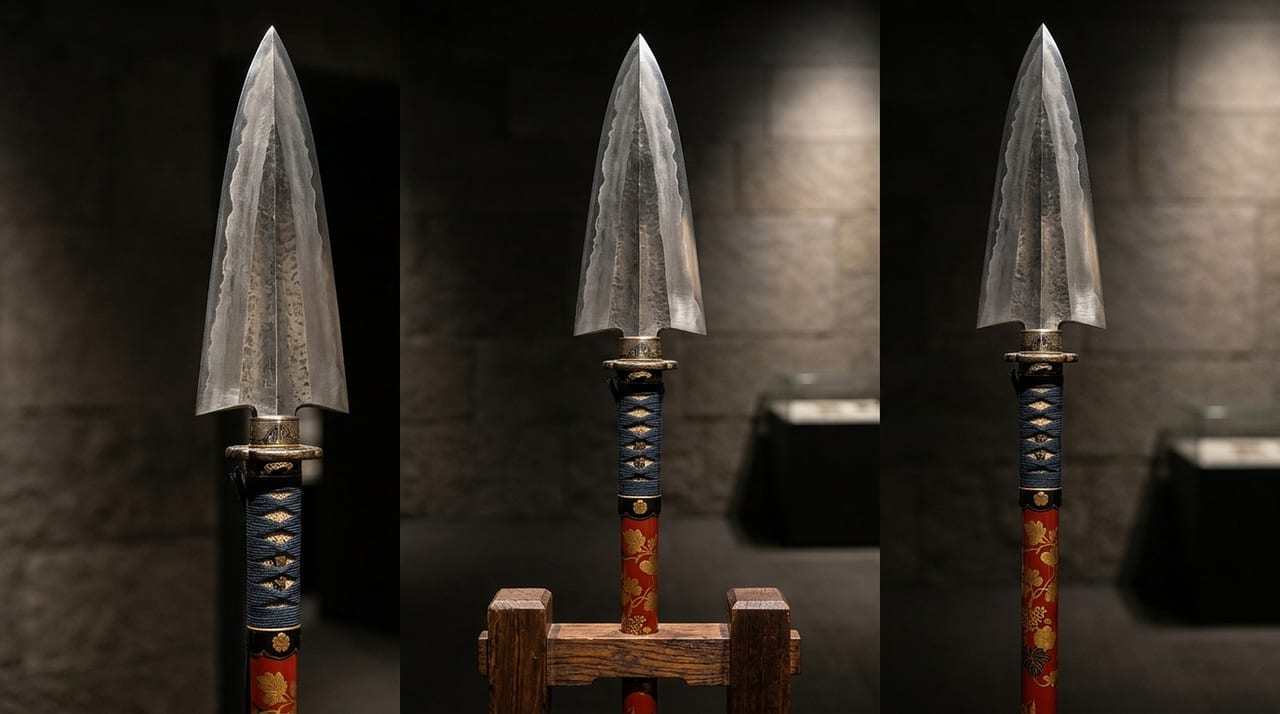
 * Image is for illustrative purposes only.
Otegine
御手杵
Also known as: One of the Three Greatest Spears Under Heaven · The Great Spear of the Yuuki Clan · The Legendary Spear Lost in the Tokyo Air Raids
Description
Overview of the Blade
Counted among the Three Great Spears of Japan, yet a tragic famous spear that was destroyed in the 1945 Great Tokyo Air Raid and no longer exists. Its blade measured about 138 cm (four shaku six sun), an oversized length that far surpassed Tonbokiri and Nihongō among the Three Great Spears of Japan, and its overall length from tip to ishizuki, including koshirae, is said to have reached about 3.8 m. The blade was in the form of an ōmi-yari, with a near-triangular cross-section, and is said to have been a practical build specialized for thrusting. The name "Otegine" derives from the shape of its scabbard, which resembled a tegine (hand pestle; a pestle used for pounding mochi).
The Swordsmith
The maker is said to be Gojō Yoshisuke, but many details are unknown. It is said to have been commissioned by Yūki Harutomo (1534–1614) in Yūki in Shimōsa Province (present-day Yūki, Ibaraki Prefecture), and it was a symbol for displaying the martial prestige of the Yūki family to the realm. The Yūki family was a famous house since the medieval period, a martial family known for the Yūki War (1441). Yūki Hideyasu (the second son of Tokugawa Ieyasu), who succeeded the Yūki family as Harutomo's adopted son, later changed his surname to Matsudaira and became the founder of the Echizen Matsudaira family. Otegine was passed down to the Matsudaira Yamato-no-kami family (the Maebashi and Kawagoe Matsudaira family), descendants of Matsudaira Naomoto, the fifth son of Hideyasu who succeeded to the Yūki family name, and was carefully preserved as a daimyo heirloom throughout the Edo period. During sankin-kōtai (alternate attendance), a huge bear-fur scabbard in the shape of a tegine, named after the spear, was reportedly placed beside the domain lord's palanquin as an umajirushi (battle standard). However, in the 1945 Great Tokyo Air Raid, the storehouse of the Matsudaira residence in Ōkubo, Tokyo, took a direct hit from an incendiary bomb, and Otegine was destroyed by fire. It is the only one of the Three Great Spears of Japan that no longer exists, and its loss is considered one of the greatest tragedies in the history of Japanese swords. Today, a replica that volunteers from Shimada, Shizuoka Prefecture, reconstructed and presented to Yūki City in 2003 is displayed at Yūki Kuramikan, conveying its appearance in former days.
Legends & Stories
Legends and Anecdotes
Stories about Otegine are told along two axes: its extraordinary size and its tragic end. Considering that the blade of an ordinary ōmi-yari is roughly 30–80 cm, the oversized length of 138 cm for the blade alone shows how abnormally large it was. Its overall length from tip to ishizuki, including koshirae, reaches about 3.8 m, a height that far exceeds the height of a single story of a modern building. Wielding such a huge spear in actual combat would have been nearly impossible with human strength, and it is said that it was in fact strongly characterized as a ceremonial and intimidation piece. As for why Yūki Harutomo had such a great spear made, the most prominent theory is that it was to proudly display the martial prestige of the Yūki family to the realm.
Into the Hands of Samurai
The Yūki family was a distinguished house since the Kamakura period, and in the Muromachi period it was known as a house of martial valor that fought the shogunate's forces in the Yūki War. Harutomo inherited this martial tradition, and must have had an unprecedented great spear made to make the family name resound throughout the realm.
Preservation by the Matsudaira Family
In the Edo period, when the sankin-kōtai (alternate attendance) system had become established, a huge bear-fur scabbard in the shape of a tegine, named after Otegine, was placed beside the domain lord's palanquin as the Matsudaira family's umajirushi (battle standard), and the scabbard is said to have weighed as much as 6 kanme (about 22.5 kg). However, the fate of this famous spear took a dark turn in 1945. In the Great Tokyo Air Raid of Shōwa 20 (1945), near the end of the Pacific War, the storehouse of the Matsudaira residence in Ōkubo, Tokyo, took a direct hit from an incendiary bomb. Otegine vanished in the flames and never returned. While both Tonbokiri and Nihongō still survive, the fact that Otegine alone was lost forever is passed down as a symbol of the cultural loss brought about by war. In 2002, volunteers from Shimada, Shizuoka Prefecture, began a restoration based on the few surviving materials, and the replica completed in 2003 was presented from Shimada to Yūki, Ibaraki Prefecture. Today, this reconstruction is displayed at Yūki Kuramikan, passing on the memory of the lost famous spear to future generations. In the game Touken Ranbu, it appears as a character imbued with the pathos of a "lost spear," and it captured the hearts of many fans. The story of Otegine is also a mirror reflecting modern and contemporary Japanese history, where the glory of a famous spear, the tragedy of war, and the efforts of people trying to protect memory intersect.