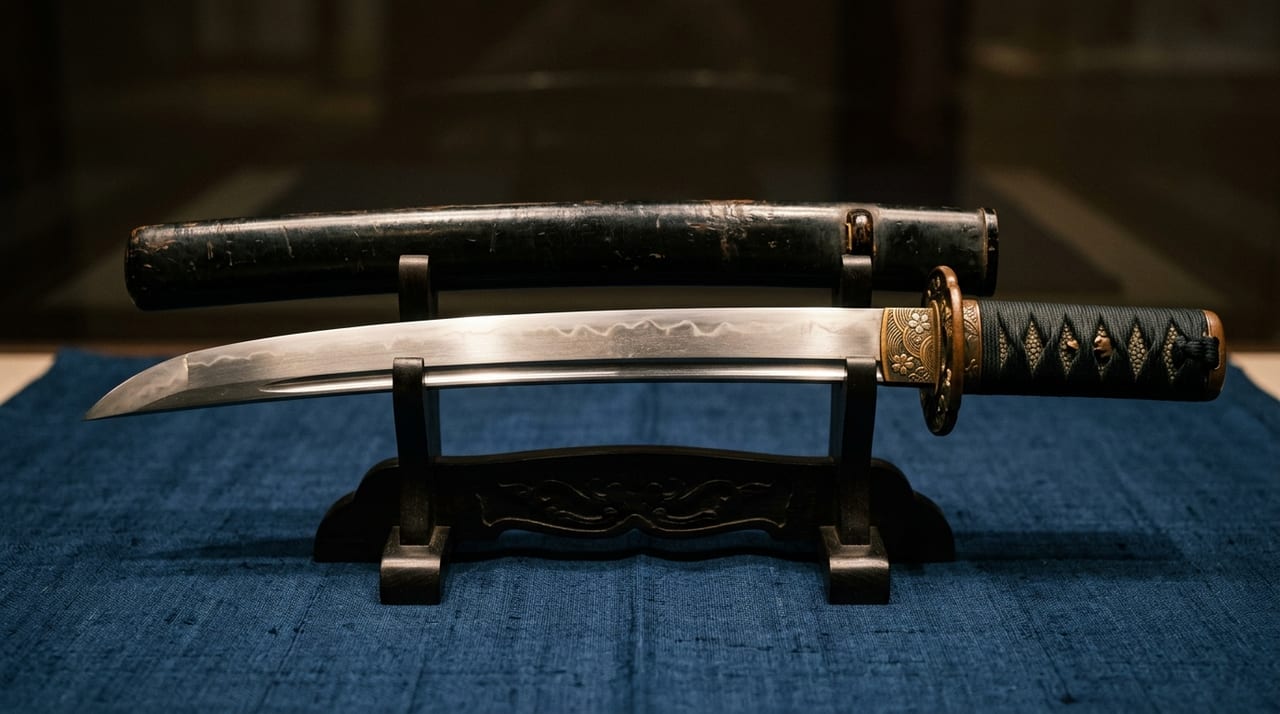
 * Image is for illustrative purposes only.
Kingin Denso no Karatachi
金銀鈿荘唐大刀
Also known as: Kingin Denso no Karatachi; Shosoin Treasure; ceremonial tachi recorded in the Kokka Chinhocho
Description
A Tang-Style Sword Preserved at the Shosoin
Kingin Denso no Karatachi is a Nara-period ceremonial sword preserved at the Shosoin Treasure Repository in Nara. It is one of the thirteen tang-style swords among forty-four listed in the Kokka Chinhocho, the inventory recording the treasures Empress Komyo dedicated to the Rushana Buddha of Todai-ji in 756 in memory of her late husband, Emperor Shomu; in that inventory it is recorded as the fourth item.
Construction
The blade is of kiriha-zukuri construction with a kissaki-moroha-zukuri point, a distinctive shape in which the body is single-edged but the tip alone is double-edged. It has only a slight curvature and a suguha temper. The hilt is wrapped in rayskin fitted with openwork metal mounts of arabesque design, and the scabbard is finished in black lacquer decorated with gilt silver fittings. The scabbard's ornamentation employs a technique called suekinru, in which floral, cloud and running-beast motifs are drawn in lacquer, dusted with gold powder, coated again with lacquer, and then polished out — a technique regarded as one of the origins of later maki-e lacquerwork. Two crescent-shaped hanging fittings are set on the back of the scabbard, through which cords of differing length are passed so that the sword could be worn diagonally at the waist.
One of the Rare Survivors
The Kokka Chinhocho lists roughly one hundred tachi, but records of items removed from the Shosoin show that on 11 September of Tenpyo-hoji 8 (764) many of them were taken out. Only seven tachi are known to remain in the Shosoin today, and Kingin Denso no Karatachi is one of these rare survivors.
A Debate over Where It Was Made
Scholars have long debated the origin of the scabbard's decoration. In the Meiji era, Kurokawa Mayori read "karatachi" as meaning the blade itself was of Chinese manufacture, and argued that suekinru, the forerunner of maki-e, was a distinctly Japanese technique. Rokkaku Shisui countered that the term karatachi referred only to the origin of the blade and not to the mountings as a whole. Recent scholarship holds that the great majority of Shosoin treasures are Japanese-made pieces finished in a foreign-inspired style, yet the place of manufacture of this sword's scabbard remains unsettled.
Legends & Stories
Kingin Denso no Karatachi is one of the tachi recorded in the Kokka Chinhocho, the inventory through which Empress Komyo dedicated Emperor Shomu's cherished possessions to the Rushana Buddha of Todai-ji. Of the roughly one hundred tachi listed in that inventory, only seven are known to have remained at the Shosoin after the removals recorded in Tenpyo-hoji 8 (764), and this sword survives as one of those rare examples, conveying the courtly culture of the Nara period to the present day.