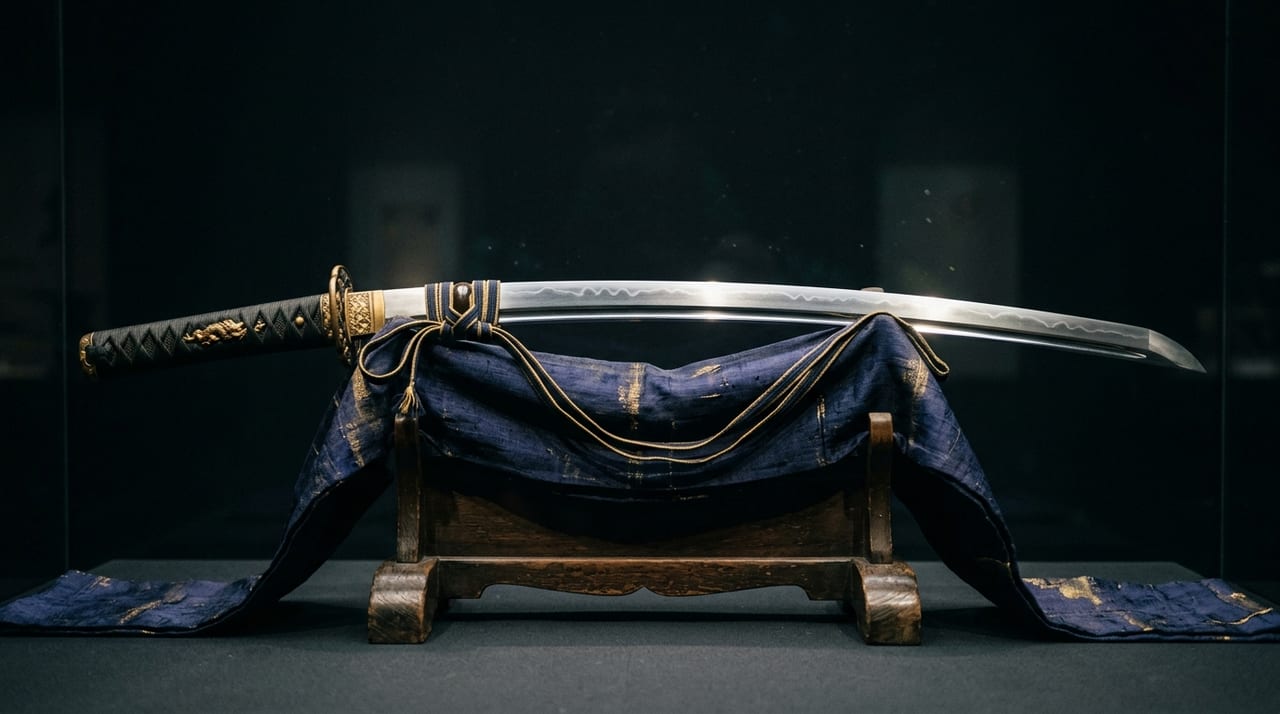
 * Image is for illustrative purposes only.
Tachi by Sanjo Yoshiie
三条吉家の太刀
Also known as: Tachi signed Yoshiie-saku; Sanjo Yoshiie
Description
Yoshiie of the Sanjo School
Yoshiie was a swordsmith active in Sanjo, Kyoto, in the late Heian period, said to have belonged to the Sanjo school, one of the schools representative of the earliest era of Japanese swordmaking. The Sanjo school traces its origin to Sanjo Munechika, said to have lived on Sanjo street in Kyoto around the Eien era (987-989), and is known as one of the earliest groups of smiths to establish the basic shinogi-zukuri, iori-mune form of the Japanese sword. Yoshiie is counted among the smiths carrying on this Sanjo lineage, and few of his works survive today.
The Tachi Signed "Yoshiie-saku"
Held by the Kyoto National Museum, this tachi bears the three-character signature "Yoshiie-saku" on its tang, and measures 74.5 cm in blade length with a curvature of 2.3 cm. It displays the graceful form typical of Heian-period tachi, with a high waist curvature and strong taper, and is known as one of the best-preserved of Yoshiie's surviving works. It is held by the Kyoto National Museum.
The Sanjo School and the Formation of the Japanese Sword
Sanjo school work is typified by a ko-itame ground with ji-nie, a temper pattern based on ko-midare mixed with small choji and small gunome — the classic profile of a Heian tachi in which utsuri rises within the fine ko-itame grain. Alongside Mikazuki Munechika, Sanjo Munechika's representative work and one of the Five Greatest Swords of Japan, the Sanjo school is highly valued as a precious body of surviving examples documenting the process by which the form of the Japanese sword was established, and Yoshiie's tachi plays its part within that group.
Designation and Present Status
This blade was designated an Important Cultural Property on 29 August 1950. Signed Heian-period works from the earliest era of Japanese swordmaking survive in extremely limited numbers, and this tachi occupies an important place in the study of sword history as a benchmark work conveying the style and technical level of the Sanjo school.
Kyoto's Beginnings as a Center of Swordmaking
Beginning with the Sanjo school in the Heian period, Kyoto became a major center of sword production, going on to produce, in the Kamakura period, the illustrious Yamashiro schools of Awataguchi and Rai in succession. The Sanjo school represents the earliest stage of that lineage and forms the starting point for a Yamashiro style that would be refined in Kyoto over the following centuries. Many Heian-period tachi were lost to fire, warfare, or simple attrition through repeated polishing over the centuries, so signed works that retain their original form in good condition are rare nationwide. That this blade is held by the Kyoto National Museum is itself a fitting turn of fate, a sword born in Sanjo having, in a sense, found its way back to Kyoto.
Legends & Stories
The Sanjo school was one of the earliest groups of swordsmiths, arising in Sanjo, Kyoto, in the Heian period, and reveres as its founder Sanjo Munechika, who forged Mikazuki Munechika, one of the Five Greatest Swords of Japan. Yoshiie is counted among the smiths of this Sanjo lineage, and his tachi conveys to the present the technical level of an age when the very form of the Japanese sword was still taking shape.