 * Image is for illustrative purposes only.
Ōkanemitsu
大兼光
Also known as: Ōkanemitsu; Katana with gold-inlaid signature Bizen no Kuni Kanemitsu (attributed by Honami)
Description
The Smith Kanemitsu of Bizen Osafune
Kanemitsu was a swordsmith representative of Osafune in Bizen Province (present-day Setouchi, Okayama Prefecture) during the Nanbokuchō period, said to have been the son of Kagemitsu and great-grandson of Mitsutada, founder of the Bizen Osafune school. Inheriting the style of his forebears, he excelled at the robust tachi shapes characteristic of the Nanbokuchō period, tempering a brilliant hamon of gunome mixed with choji. Renowned for a cutting ability ranked among the saijo-o-wazamono, he was a master in high demand among Bizen smiths, and a comparatively large number of his works survive today.
The Name "Ōkanemitsu"
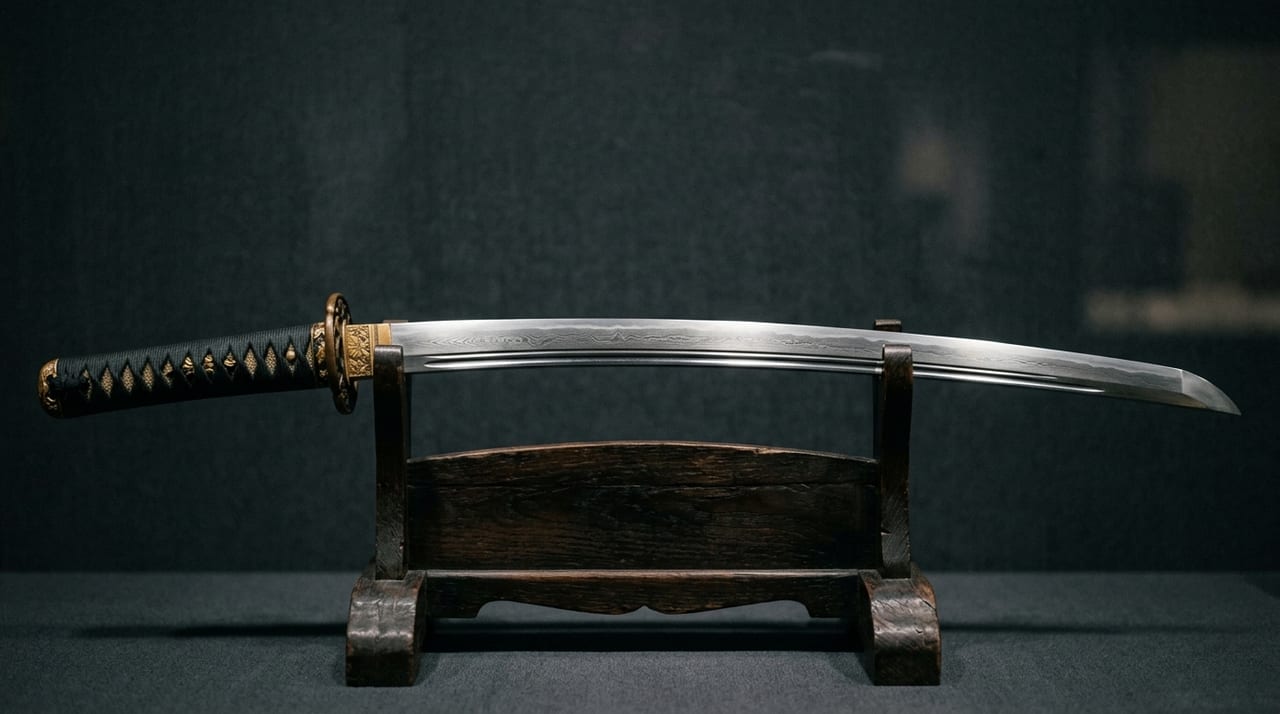
This blade was originally forged as one of the long ōdachi that came into fashion during the Nanbokuchō period, but was shortened to a more practical length during the Edo period. The original signature was lost in the process, but the Honami family, official sword appraisers to the Edo shogunate, judged it to be the work of Kanemitsu and inlaid the tang in gold with the attribution "Bizen no Kuni Kanemitsu" together with the Honami seal. In its present form the blade measures 83.4 cm in length with a curvature of 2.2 cm, still retaining much of the robust Nanbokuchō-period shape. It was from this great length that the blade came to be called Ōkanemitsu, "Great Kanemitsu."
The Kyōhō Meibutsu-chō and Descent to the Shogunal House
Ōkanemitsu is one of the famous swords recorded in the Kyōhō Meibutsu-chō, compiled by the Honami family. According to that register, the blade was given as a keepsake of Toyotomi Hideyoshi to Tōdō Sado no Kami Takanori, a member of the Tōdō Takatora family, and later came into the possession of the Tokugawa shogunal house. This pattern — a keepsake of a great unifier bestowed upon a daimyo and subsequently entering the shogunal collection — is a provenance frequently seen among blades recorded in the meibutsu register.
Designation and Present Status
This blade was designated an Important Cultural Property on 27 June 1959. It is today held by the Sano Art Museum in Mishima, Shizuoka Prefecture, where it is made available for public exhibition and research as a work conveying both the Nanbokuchō-period style of Kanemitsu of Bizen Osafune and a provenance among early modern daimyo houses recorded in the meibutsu register.
Kanemitsu and the Flourishing of the Bizen Osafune School
Kanemitsu is regarded as one of the most prolific smiths of the Bizen Osafune school during the Nanbokuchō period, and besides Ōkanemitsu he left behind numerous other tachi and katana designated Important Cultural Properties or Important Art Objects. His style, combining a robust overall shape with a brilliant hamon of gunome and choji, is valued as a synthesis of the combat-oriented spirit of the Nanbokuchō period with the flamboyant aesthetic cultivated by the Bizen tradition. Among surviving works conveying Kanemitsu's skill, Ōkanemitsu stands as a representative example combining both the great length inherited from its origin as an ōdachi and a firm attribution by the Honami family.
Legends & Stories
Originally a great ōdachi of the Nanbokuchō period, this blade was shortened during the Edo period and judged by the Honami family to be the work of Kanemitsu, who inlaid it with a gold attribution signature. According to the Kyōhō Meibutsu-chō it was given as a keepsake of Toyotomi Hideyoshi to the Tōdō family before entering the collection of the Tokugawa shogunal house, a provenance that still conveys its connection to the great unifiers of Japan.