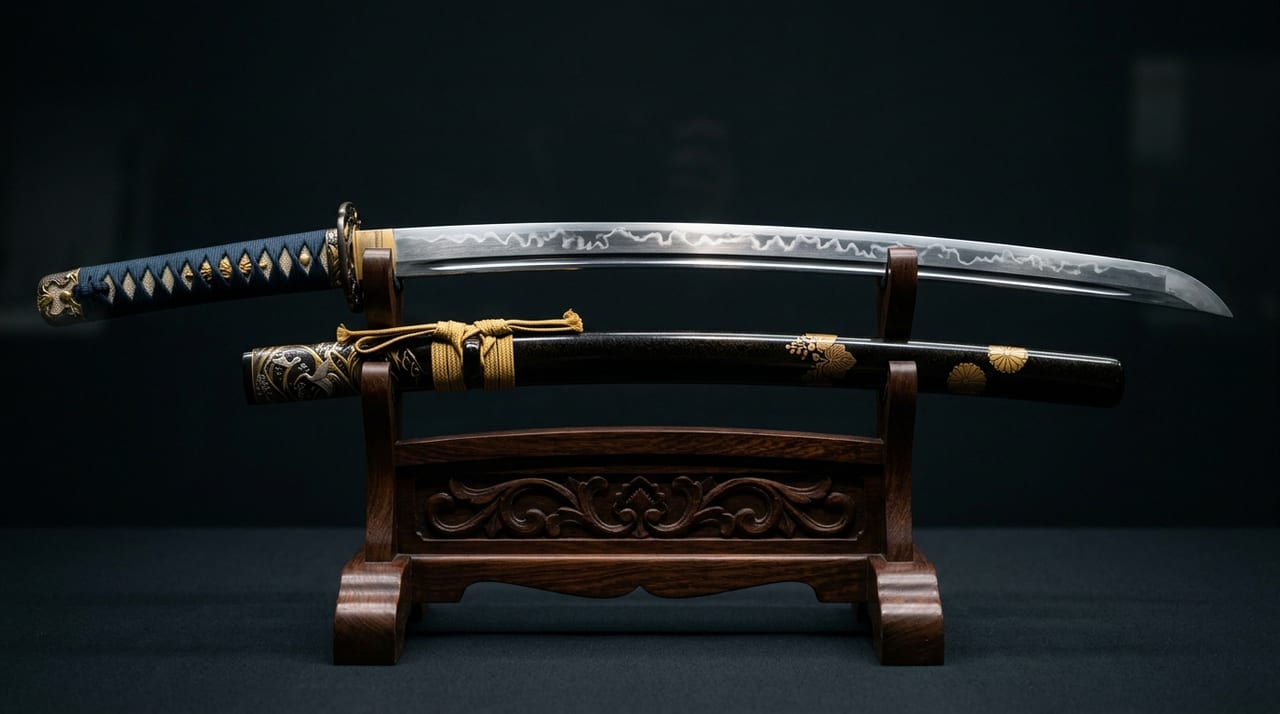
 * Image is for illustrative purposes only.
Ko-Ichimonji Yoshifusa
古一文字吉房
Also known as: Yoshifusa; Crown of Ko-Ichimonji; Progenitor of Fukuoka Ichimonji
Description
Overview of the Blade
Ko-Ichimonji Yoshifusa refers to the tachi produced by the master smith Yoshifusa, who flourished in the Fukuoka Ichimonji school during the early Kamakura period (first half of the 13th century) in Bizen Province (present-day Okayama Prefecture). Representing the pinnacle of the Bizen tradition from the Kamakura period known as "Ichimonji pieces," these masterworks shine brilliantly in the history of the Japanese sword. The Ichimonji school was a group of swordsmiths based in Fukuoka, Bizen Province (present-day Setouchi City, Okayama Prefecture), and took their name from the single-character signature "Ichi (一)." Among the smiths of this school, Yoshifusa was the foremost master who left the greatest number of superior works, renowned for his bold yet elegant style characterized by the large chōji-midare hamon. Only Yoshifusa among the Ichimonji school smiths holds multiple designations as National Treasures, and he is held in special regard by sword enthusiasts and researchers as a figure who embodied the beauty of early Kamakura Bizen swordcraft at the highest level.
Ichimonji School Techniques and Yoshifusa's Style
The most distinctive feature of the Ichimonji school lies in the large chōji-midare hamon of the blade, also called "Ichimonji chōji." Chōji refers to a hamon pattern in which the edge curves into the shape of the character "chō" or the form of a clove flower, a form of hamon pursued by Bizen-tradition swordsmiths from the late Heian period onward. The smiths of the Ichimonji school enlarged and complexified this chōji pattern, developing it into the "large chōji-midare." Yoshifusa's large chōji is particularly renowned as an oily-textured, nie-laden chōji, where the nie-mouth descends deeply and exhibits complex undulations—a unique beauty without parallel in other schools. The jigane combines a koromé-grained ground with intersecting wood-grain patterns, and the utsuri stands out vividly. The utsuri of the ground and the large chōji of the blade mutually enhance one another, creating within a single blade a visual richness as if a symphony of light were being performed. The overall curvature follows the standard graceful koshi-zori of early Kamakura tachi, and the robust profile with a well-developed monouchi exhibits both practical strength and artistic impact.
Yoshifusa's Representative Transmitted Works
Among the most celebrated works by Yoshifusa are the National Treasure tachi housed in the Tokyo National Museum (signature: Yoshifusa, designated "Fukuoka Ichimonji Yoshifusa," blade length approximately 70.6 cm) and the National Treasure "Okada-kiri Yoshifusa" (blade length approximately 69.0 cm), both of which display the stately form of Kamakura tachi. The vivid utsuri of the jigane and the elegant hamon of the large chōji harmonize magnificently, renowned as the apex of early Kamakura Bizen beauty. The Kyoto National Museum also preserves works by Yoshifusa designated as Important Cultural Properties, demonstrating the breadth of his workshop's production and the consistent high quality of his work.
Historical Significance of the Fukuoka Ichimonji School
The early Kamakura period, when the Fukuoka Ichimonji school flourished, represents in a sense a "golden age" in the history of the Japanese sword. Evolving from the elegant tachi of the Heian period, the Bizen blades of this era achieved a sophisticated fusion of practical utility with high artistic merit in response to the demands of warrior society, and the Ichimonji school with Yoshifusa stood at the forefront of this development. In subsequent sword appraisal traditions, the "Ichimonji large chōji-midare" became one of the highest evaluation standards, and the phrase "chōji as fine as Ichimonji" is still used today as the highest form of praise. The large chōji beauty embodied in Yoshifusa's blades continued to be referenced as an apex of Japanese sword hamon aesthetics through the subsequent Osafune school, Aoe school, and Soshu tradition.
The Fusion of Kamakura Culture and Sword Beauty
The early Kamakura period was an era when warrior culture matured rapidly alongside the establishment of samurai politics. Under the rule of the Minamoto shoguns and the Hōjō regents, samurai transformed from mere warriors into political and cultural rulers. Within this transformation, the artistic value of swords rose rapidly, and commissions to the finest swordsmiths were competed for among shoguns and influential gokenin. Yoshifusa's tachi were born as supreme masterpieces against this backdrop of flourishing warrior culture, embodying the finest expression of an age—the early Kamakura period—when the "beauty of warriors" and "beauty of craftsmanship" merged as one. The grand chōji-midare of Yoshifusa's blades expressed most directly the inner world of samurai of the age—aspirations toward strength, sensitivity to beauty, awareness of propriety—as a supreme artistic achievement that continues to impart never-ending awe to all who view it. The name Ko-Ichimonji Yoshifusa, as the first brilliance in the thousand-year history of Bizen swordcraft, remains eternally inscribed in the foundation of Japanese sword culture.
Preservation and Research of Yoshifusa's Works
In the present day, Yoshifusa's works are strictly managed and preserved as National Treasures and Important Cultural Properties, and are widely made public through regular exhibitions at various national museums. Sword researchers have meticulously recorded and analyzed Yoshifusa's large chōji-midare, accumulating research from metallurgical and technical-historical perspectives on the mechanism of its formation. Yet the complete mystery of Yoshifusa's chōji technique remains unraveled, and "perfect reproduction" has not been achieved even by contemporary swordsmiths. This mystery continues to endow Yoshifusa's tachi with inexhaustible fascination, making it an eternal object of inquiry for both enthusiasts and researchers alike. To engage with Yoshifusa's blades is to gaze upon the extreme possibilities of Japanese sword-making technology and to open a door to a world of rich and profound beauty. Museums housing Yoshifusa's masterpieces bear the responsibility to position them not merely as exhibition objects but as the spiritual core of Japanese culture, and to transmit them to future generations. Spanning some eight hundred years from the early Kamakura period to the present—Yoshifusa's tachi, transmitted across this long span of time, will continue to stand as one of the most vivid cultural heritages demonstrating the continuity and fundamental strength of Japanese civilization.
Legends & Stories
## "The Mystery of 'Ichimonji'" There are several theories regarding why swordsmiths of the Ichimonji school used only a single character—"ichi" (一, meaning 'one' or 'first')—as their signature. The most widely known explanation is the legend that these smiths, while serving as imperial forge smiths (go-ban kaji) for the retired Emperor Go-Toba, inscribed the character "ichi" on imperial blades. Retired Emperor Go-Toba (1180–1239) was deeply devoted to swordcraft and is said to have summoned master smiths from throughout the realm to serve as court-appointed smiths, even participating personally in blade forging. The tradition that blades forged in the presence of this emperor were granted the honor of bearing the "ichi" signature—a mark of prestige—continues to be recounted today as testament to the exalted status of Ichimonji blades. Yoshifusa may well have been among these honored imperial smiths, and this is considered the background to why his tachi received the highest evaluations from both the imperial court and the shogunate. ## "The Jōkyū Rebellion and Bizen Blades" The Jōkyū Rebellion in the 3rd year of Jōkyū (1221) was a total confrontation between the imperial court and the shogunate, initiated by the retired Emperor Go-Toba to overthrow Hōjō Yoshitoki. In this rebellion, the warrior clans of Bizen Province sided with the shogunate and fought to victory. Following the conflict, the samurai of Bizen were awarded positions as local governors throughout the realm. Within this political context, the swordsmiths of Bizen occupied a unique position where they could enjoy vigorous demand from the shogunate's leading figures and simultaneously benefit from the cultural refinement of the imperial court. It was precisely in this era that Yoshifusa flourished, and the demand from both the eastern shogunate (Kamakura) and the western imperial court (Kyoto) became the crucible in which Yoshifusa's technical mastery was forged. ## "The Mystery of Great Chōji—Why Only Bizen Blades Possess It" The question of why only Bizen swordsmiths could master the chōji-midare (chōji temper pattern) remains incompletely resolved even among modern sword researchers. The chōji of the Bizen tradition is believed to arise from the combined interaction of multiple factors: carbon content in the base metal, cooling rate during quenching, and the origin of the iron sand—yet the ultimate answer can only be expressed as "the land, water, and iron sand of Bizen, combined with the sensibility of Bizen smiths," a complexity that defies simple explanation. Yoshifusa's great chōji embodies this Bizen mystery in its most extreme form. Modern smiths who attempt to recreate Yoshifusa's chōji are said to approach but never fully achieve the original. The chōji that Yoshifusa created—a fusion of a thousand years of accumulated technical knowledge and genius-level intuition—stands at the very frontier of Japanese blade-making's technical mysteries. ## "Influence on Later Generations and Relationship with the Osafune School" The Ichimonji school, in which Yoshifusa flourished, exerted profound influence on the later development of the Osafune school (masters Osafune Mitsutada, Osafune Nagatoki, Osafune Kagemitsu, and Osafune Kanemitsu). The Osafune school likewise pursued the great chōji of the Bizen tradition while adding refinement and elevated elegance distinct from the bold grandeur of the Ichimonji school. Sword scholars often contrast the two schools: the Ichimonji school as "the perfected form of great chōji" and the Osafune school as "the refined form of great chōji." When we stand before Yoshifusa's tachi, we sense that we are witnessing both the earliest radiance of Bizen's thousand-year sword heritage and the point of departure for the long spiritual pursuit that followed. The "beauty of great chōji" that Yoshifusa pioneered became the archetypal ideal that subsequent Bizen smiths pursued without end. In contemporary sword appreciation, the standard for "the finest chōji-temper blade" is still spoken of in conjunction with Yoshifusa's name. ## "The Significance of National Treasure Designation" The fact that multiple works by Yoshifusa have been designated as National Treasures carries profound meaning. A National Treasure (Kokuhoū) represents the highest designation in Japan's Cultural Properties Protection Law, defined as "that which possesses value of world-cultural significance and stands as an incomparable national treasure." Few individual swordsmiths in Japanese blade-making history have had multiple works designated as National Treasures, and Yoshifusa's inclusion in this rank formally attests to the extraordinary artistic and historical value of his works. The National Treasure tachi by Yoshifusa held in the Tokyo National Museum and Kyoto National Museum continue to convey to domestic and international visitors the apex of Bizen blade beauty as a work representing the pinnacle of Japanese culture. ## "The Kamakura Spirit Told by Yoshifusa's Blades" When we stand before Yoshifusa's tachi, we can directly sense the atmosphere of the early Kamakura era. It was the dawn of samurai-clan governance, a time when warriors sought cultural identity in their blades. The bold and magnificent beauty embodied in Yoshifusa's great chōji admirably reflects the spirit of that age's samurai—at once resolute and refined, powerful and elegant. Transmitted across more than seven centuries, Yoshifusa's tachi transcends the category of mere ancient blades to speak to modern people as a spiritual legacy of Japanese culture. The "beauty of great chōji" born from the fusion of Bizen iron sand, water, and flame with the soul of a master craftsman will continue to stir human hearts for ages to come as one of humanity's highest technical and artistic achievements. When viewers stand before Yoshifusa's tachi at a sword exhibition, they are struck breathless by its overwhelming presence. The "undulation of great chōji" found in no other blade is an art form woven from the crystalline structures of metal—a fusion of chance and necessity—and simultaneously the total crystallization of countless hours and refined sensibility that the genius Yoshifusa poured into his forging. Ichimonji Yoshifusa—this name is one of the highest proper nouns that awakens reverence and longing in the hearts of all who love the Japanese blade. The Yoshifusa tachi transmitted to posterity as a National Treasure stands as one of the finest works of art that Japanese culture offers to the world, and its very existence is the most complete answer to the question "What is a sword?"