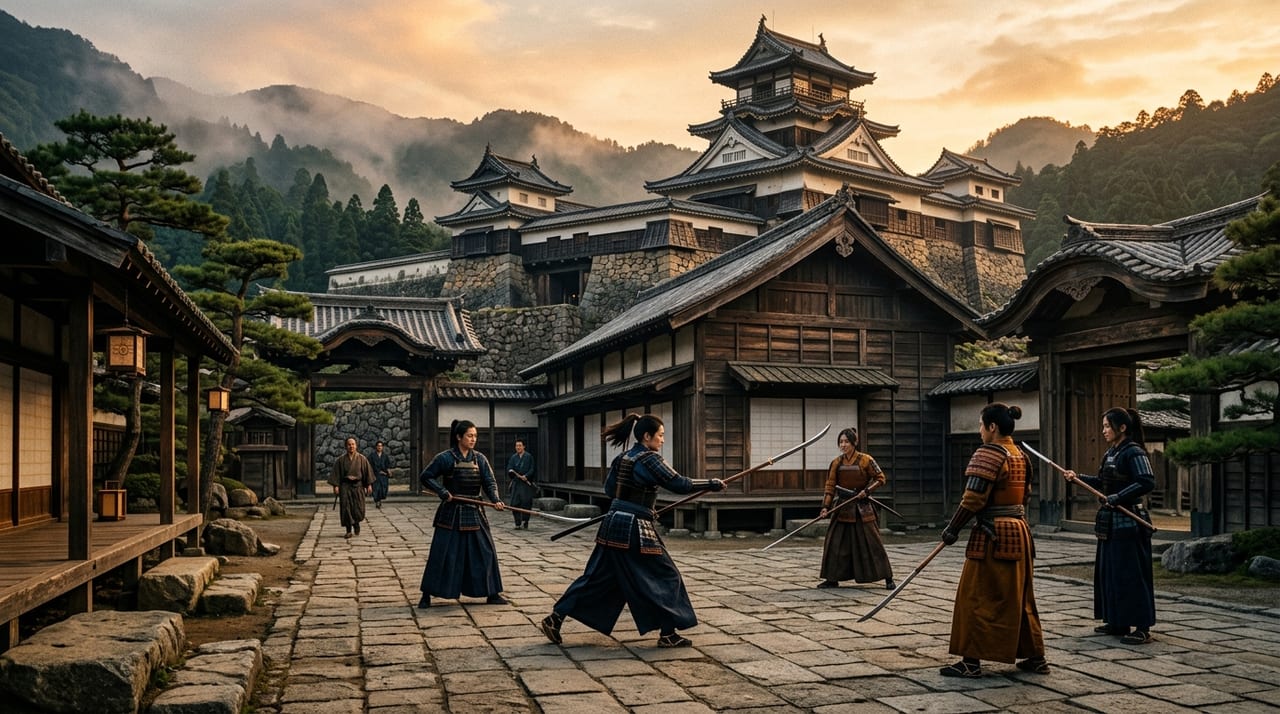
 * Image is for illustrative purposes only.
Women and Swords: Naginata and Kaiken
女性と刀——薙刀・懐剣の文化
The relationship between Japanese women and swords deepened with the rise of the warrior class. Naginata became the emblematic weapon of female warriors and noble ladies, while the kaiken served as both protective tool and symbol of feminine honor in the bridal trousseau.
Description
Samurai Women and the Naginata: Another Sword Culture
In the history of Japanese swords, the relationship between women and blades has long been treated as peripheral, but in fact it has a very deep and rich history. Especially in samurai society, women were also bearers of sword culture and its spiritual inheritors. The naginata is a long-shafted weapon widely used by warrior monks and samurai from the late Heian period into the Kamakura period. During the Edo period, however, it was also adopted as a cultural accomplishment and means of self-defense for samurai daughters, and its character as a 'weapon for women' grew stronger. This is because the naginata is a weapon that values body movement, distance, and technique rather than sheer strength alone, giving women, who were physically smaller, a practical advantage in confronting male warriors. During the Sengoku period, many samurai women trained in the naginata, and records remain of them taking part in actual combat in the defense of castles. A particularly famous female warrior is Tomoe Gozen. Known as a concubine of Kiso Yoshinaka, Tomoe Gozen is said to have fought shoulder to shoulder with male warriors in the Genpei War, and her bold and fearless fighting was repeatedly depicted in later war chronicles and paintings. Accounts of Tomoe Gozen recorded in the Heike Monogatari and the Genpei Seisuiki deeply impressed the image of the female warrior wielding a naginata into Japanese culture.
Naginata Forging and Smiths
The blade of a naginata was made by the same smiths who made tachi and uchigatana. In particular, the Yamato-den smith groups tied to the great temples and shrines of Nara and Yamato (the Tegai, Taima, and Senju-in schools, among others) are known for producing many naginata for warrior monks. Naginata of the Kamakura period were called 'ko-naginata' (old naginata) and generally had a large curvature. In the Nanboku-chō period, the 'ō-naginata' (great naginata), with even longer and wider blades, appeared. Most surviving ko-naginata were later shortened as 'naginata-naoshi' (naginata remade): the blade was cut down and remade into tachi or uchigatana. Works that retain their original form as naginata are therefore extremely rare. Naginata-naoshi were made by reducing the fullness of the tip to lessen the overall curve and trimming the tang to make a sword. Some cannot be identified without transmission records or inscriptions. Naginata that had been handed down for many years are said to be often of high quality, which led to the saying 'there are no dull blades among naginata-naoshi,' and this has become one of the pleasures of sword appraisal.
Kaiken: The Bride's Protective Blade
The kaiken, meaning 'sword carried in the bosom,' refers to a short blade, a form of tantō that women in particular carried for self-protection. From the Heian period, court women customarily carried short blades in their robes for protection. With the establishment of samurai society, this custom spread to samurai women and came to be used also as an accessory of women's wedding attire. In samurai marriages, a kaiken was sometimes included among the furnishings a bride brought to her husband's household. This kaiken served as a 'protective blade' (mamorigatana), a means of self-defense in the husband's absence or in times of danger, and was also positioned as a final means of preserving chastity. The fittings of kaiken given to court and samurai brides were extremely lavish. They were kept in 'kaiken bags' (kaiken-bukuro) decorated with crested crepe silk, gold maki-e, cloisonné and the like, and were treated as especially prestigious items among the set of bridal trousseau.
Kaiken Smiths and Artistic Value
The blade of a kaiken is usually made by the same smiths who made ordinary tantō, but particularly fine kaiken used works by famous smiths. Tantō forms in hira-zukuri (flat-sided construction) or kanmuri-otoshi-zukuri (crown-dropped construction) are common. Blades often bear carvings of bonji (Sanskrit seed characters), Fudō Myōō, or Kurikara dragons invoking protection, which is an interesting fusion of the smith's forging skill and religious symbolism. The artistic value of the mountings is also extremely high. Especially fine kaiken handed down to court families, the shogunal house, and daimyō families include pieces designated as National Treasures or Important Cultural Properties as integrated works of art combining blade and mountings. The Tokyo National Museum, the Kyoto National Museum, and museums at former samurai residence sites across the country hold excellent kaiken, which are displayed as important materials showing the intersection of Japanese women's culture and sword culture.
The Modern Development of the Naginata as a Women's Martial Art
From the Taishō period through the period after the Pacific War, the naginata spread mainly as a martial art cultivated by women, partly influenced by government policy, and was reorganized as a modern martial art. Women were encouraged to practice the naginata, and naginata lessons in particular spread nationwide at girls' higher schools and women's teacher training schools. This is a phenomenon in which the female warrior culture of the medieval period was reinterpreted in the context of modern women's education, and it shows that the relationship between Japanese women and swords is a living tradition that continues across the ages. Even today, the All Japan Naginata Federation promotes the naginata as a martial art, sport, and educational practice. Through naginata club activities in junior high schools, high schools, and universities, the spirit of medieval Japanese sword culture is passed on to young women today.
Perspectives for Collectors
Kaiken are a special collecting category, valued by combining the artistic value of the blade with the craft value of the mountings. For kaiken handed down through famous samurai and court families, the reliability of provenance is the greatest added value. There are cases where, even when the blade is of ordinary workmanship, pieces sell at high prices because of the lavishness of the mountings and the reliability of their provenance. On the other hand, ko-naginata (including naginata-naoshi) are relatively little known even among old swords. They can be called a hidden collecting field whose market valuation is low relative to their true merit. Yamato-den naginata-naoshi by the Tegai, Taima, and other schools are rare pieces that let collectors enjoy the masame grain and straight hamon of the Yamato tradition in the form characteristic of the naginata. This makes them especially attractive collecting targets for collectors with deep knowledge of Yamato-den.
Characteristics of This Era
- Naginata-naoshi: old naginata whose tip has been reduced in fullness and whose tang has been trimmed, then remade into uchigatana, wakizashi and the like. It is said that 'there are no dull blades among naginata-naoshi'
- Overall artistic value of the kaiken: beyond the beauty of the hamon and jihada of the blade, value as an integrated work of art combined with mountings craft such as crepe silk, maki-e and cloisonné