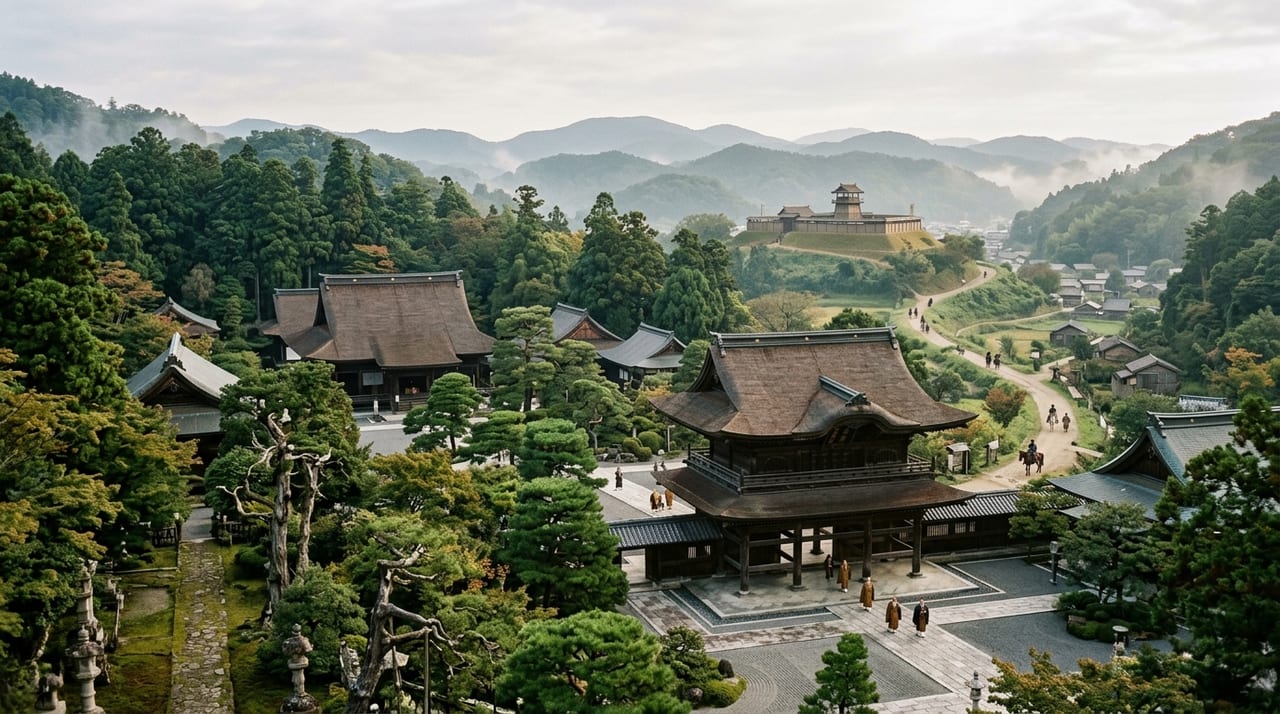
 * Image is for illustrative purposes only.
Establishment of Sagami-den
相州伝の確立
In Sagami Province (present-day Kanagawa Prefecture), at the seat of the Kamakura shogunate, Shintōgo Kunimitsu, Masamune, and Sadamune combined the techniques of Yamashiro, Yamato, and Bizen to establish the Sōshū-den, considered the most innovative tradition in the history of the Japanese sword.
Description
The Kamakura Shogunate and the Sword Environment of Sagami Province
During the Kamakura period (1185–1333), Sagami Province, where the shogunate was seated (in the area of present-day Kamakura City, Kanagawa Prefecture), became the center of Japan's politics and military affairs. In this place, to which capable warriors and craftsmen gathered from across the country, demand rose for swords that were both practically excellent and artistically refined, and skilled swordsmiths were invited from Yamashiro Province and Bizen Province. This cultural and technical exchange is the foundation on which Sōshū-den was born.
Shintōgo Kunimitsu and the Emergence of Sōshū-den
The figure regarded as the founder of Sōshū-den is "Shintōgo Kunimitsu." Kunimitsu, who was active in the late Kamakura period (late 13th to early 14th century), is said to have been a son of Awataguchi Kunitsuna. Building on the fine jigane of the Yamashiro-den and incorporating the strong activity of nie seen in the Yamato-den, he developed a distinctive technical approach in Kamakura. In particular, in the forging of the jigane and the composition of the hamon, he showed a direction different from the existing Yamashiro and Bizen traditions. Kunimitsu's blades are few and rare, but they are highly valued as the starting point of the technical innovations that led to Masamune and Sadamune.
Masamune and His Revolutionary Techniques
The figure who made Sōshū-den known to the world is "Okazaki Masamune." Masamune, said to have been active from the late Kamakura period to the early Nanboku-chō period (late 13th to early 14th century), brought revolutionary changes to all three elements: jigane, hamon, and sugata.
Masamune's greatest technical innovation lies in the pinnacle of nie-deki. Whereas the preceding Bizen-den excelled at nioi-deki, a hamon in which fine nie continue and appear like nioi, Masamune achieved a hamon of "ō-nie," in which coarse, large grains of nie blaze up intensely. This hamon becomes violently disordered from near the hamachi toward the kissaki, and displays a rich array of activity such as yubashiri, kinsuji, inazuma, and sunagashi. The jigane, too, shows ō-itame, with large-grained ji-nie evenly covering the entire surface, presenting a deep, blackly lustrous steel.
As for the sugata, the curvature tends to be shallow and the kissaki tends to be large. This foreshadowed the shift to the majestic sugata seen in the Enbun–Jōji period of the Nanboku-chō period.
Sadamune and the Refinement of Sōshū-den
Masamune's disciple "Sadamune" established a more refined and polished form of Sōshū-den, somewhat tempering the intensity of his master's ō-nie-deki. Sadamune's blades are also called "gentle Sōshū-den." Though they lack the intensity of Masamune's, they are regarded as the pinnacle in the beauty of the jigane and the richness of the activity within the hamon. In later times, an evaluation also arose that named "Masamune, Gō Yoshihiro, and Awataguchi Yoshimitsu" as the Tenka Sansaku (Meibutsu Sansaku).
The Technical Legacy of Sōshū-den
The establishment of Sōshū-den had wide-ranging influence on the subsequent history of the Japanese sword. From the Muromachi period to the early Edo period, swordsmiths across the country, in Bizen, Mino, Yamato, Echizen, and elsewhere, adopted Sōshū-den techniques and attempted "Sōshū-den utsushi." In particular, Echizen Yasutsugu of the Shintō period, on the occasion of the saiba of famous blades after the Siege of Osaka, produced utsushi (copies) of famous Sōshū-den works, beginning with Sōshū Sadamune. The name Masamune is known worldwide as "Masamune," and has become synonymous with the Japanese sword.
Characteristics of This Era
- Intense ō-nie hamon, abundant in yubashiri, kinsuji, inazuma, and sunagashi
- A deep jigane of ō-itame with large-grained ji-nie covering the entire surface
- A practical yet powerful form with shallow sori and a bold kissaki
- A unique technique pursuing nie-deki (the quality of nie formation) to its utmost limit
- Overall refinement integrating the techniques of Yamashiro, Yamato, and Bizen