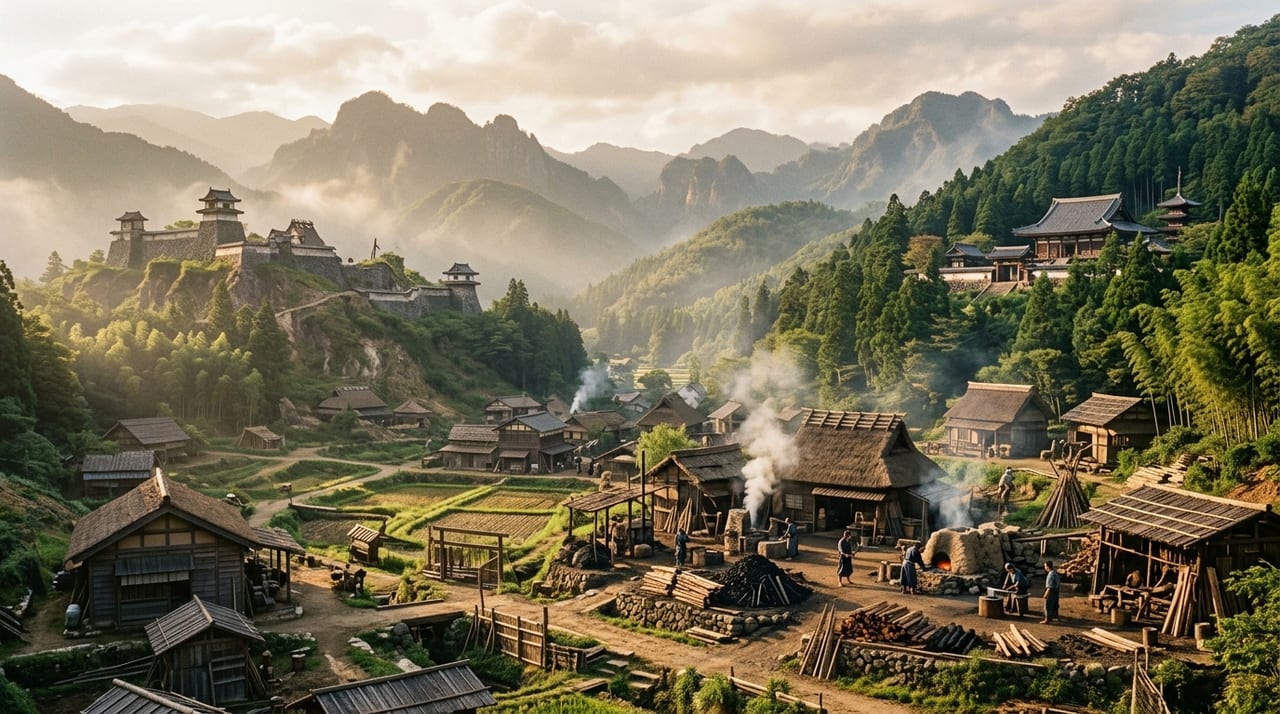
 * Image is for illustrative purposes only.
Regional Sword Culture of the Nanbokuchō Period
南北朝の地方刀剣文化
The turmoil of the Nanbokuchō period (1336–1392) and the diversification of its effects on sword culture across Japan. The mass production of ō-dachi at Bizen Osafune, the rise of regional sword-producing areas such as Etchū and Mino, and the nationwide spread of Sōshū-den techniques. This article examines the regional dimension of Nanbokuchō sword culture, in which regional production centers became independent and flourished beyond Kyoto and Kamakura, reshaping the map of Japanese sword history.
Description
The Nanbokuchō period (Kenmu 3–Meitoku 3, 1336–1392) was an era of upheaval that fundamentally transformed the geographic distribution of Japan's sword industry. The Nanbokuchō conflict, which began with the collapse of Emperor Go-Daigo's Kenmu Restoration (1333–1336), drew the entire country into warfare for 56 years. It created demand for swords in every region and dispersed nationwide the center of gravity of the sword industry, which until then had been concentrated around Kyoto and Kamakura.
One of the most striking changes in the sword industry of the Nanbokuchō period was the dramatic growth of Osafune in Bizen Province (present-day eastern Okayama Prefecture) as a center of ō-dachi production. Ō-dachi (imposing tachi with a cutting edge exceeding 3 shaku, about 91 cm) were produced in great numbers during the Nanbokuchō period. At Osafune in this period, smiths including Kanemitsu and Chōgi displayed strongly nie-based styles influenced by the Sōshū-den.
Etchū Province (present-day Toyama Prefecture) emerged during the Nanbokuchō period as a region with its own distinctive sword tradition, and Gō Yoshihiro (also written with a different character for Gō, a smith of Etchū) was active there. Gō Yoshihiro is counted among the Masamune Jittetsu (the ten leading disciples attributed to Masamune), and is traditionally said to have been a disciple of Masamune. His blades are characterized by bright, clear nie-deki in both the ji and the ha, and display a unique beauty in which the Sōshū-den and the regional character of Etchū merge. No signed (zaimei) works by Gō Yoshihiro have been confirmed, and this rarity has made his reputation legendary.
Mino Province (present-day Gifu Prefecture) rose rapidly as a sword-producing region from the Nanbokuchō to the Muromachi period, and the foundations of Mino-den were formed in this period. Mino-den took shape under Mino smiths of the Nanbokuchō period who were influenced by the Yamato-den and the Sōshū-den, and later developed into a style characterized by features such as "togari-gunome." In particular, Shizu Saburō Kaneuji was a native of the Tegai school of Yamato Province and is thought to have been a disciple of Masamune. As a master representing Mino in the Nanbokuchō period, he is regarded as one of the founders of Mino-den.
In Satsuma Province (present-day Kagoshima Prefecture), the Naminohira school carried on archaic styles resembling the Yamato-den from the late Heian period. Its main line continued until the early Meiji period, with the name Yukiyasu passed down from generation to generation.
The most important technical legacy of the Nanbokuchō period is the nationwide dissemination of Sōshū-den techniques. The techniques of the Masamune school, centered in Kamakura (ō-nie and violent midare hamon), spread to various regions, including Etchū, Mino, Bizen, Yamashiro, Chikuzen, and Iwami, where the smiths known as the Masamune Jittetsu were active. This nationwide transmission of the Sōshū-den became the fundamental cause of the regional diversity of later Japanese swords—the proliferation of traditions beyond the Gokaden.
Characteristics of This Era
- Bizen Osafune ō-dachi — Kanemitsu, Chōgi, and others showed a style with strong nie, influenced by the Sōshū-den
- Gō Yoshihiro and the smiths of Etchū — a master smith of Etchū, counted among the Masamune Jittetsu, left his name through works in the Sōshū-den style
- Formation of the Mino-den — the Mino sword tradition, founded by Shizu Saburō Kaneuji, established its stylistic foundation during the Nanbokuchō period
- The Naminohira school of Satsuma — the Naminohira school, which continued from the late Heian period, transmitted archaic sword-making resembling the Yamato-den in southern Kyūshū
- Nationwide transmission of the Sōshū-den — the nationwide diffusion of Sōshū techniques, mediated by the Masamune Jittetsu, was the fundamental cause of the later regional diversity of Japanese swords