Sword Culture in Meiji and Taisho Japan: Collectors, Preservation Movements, and Exhibition Revivals
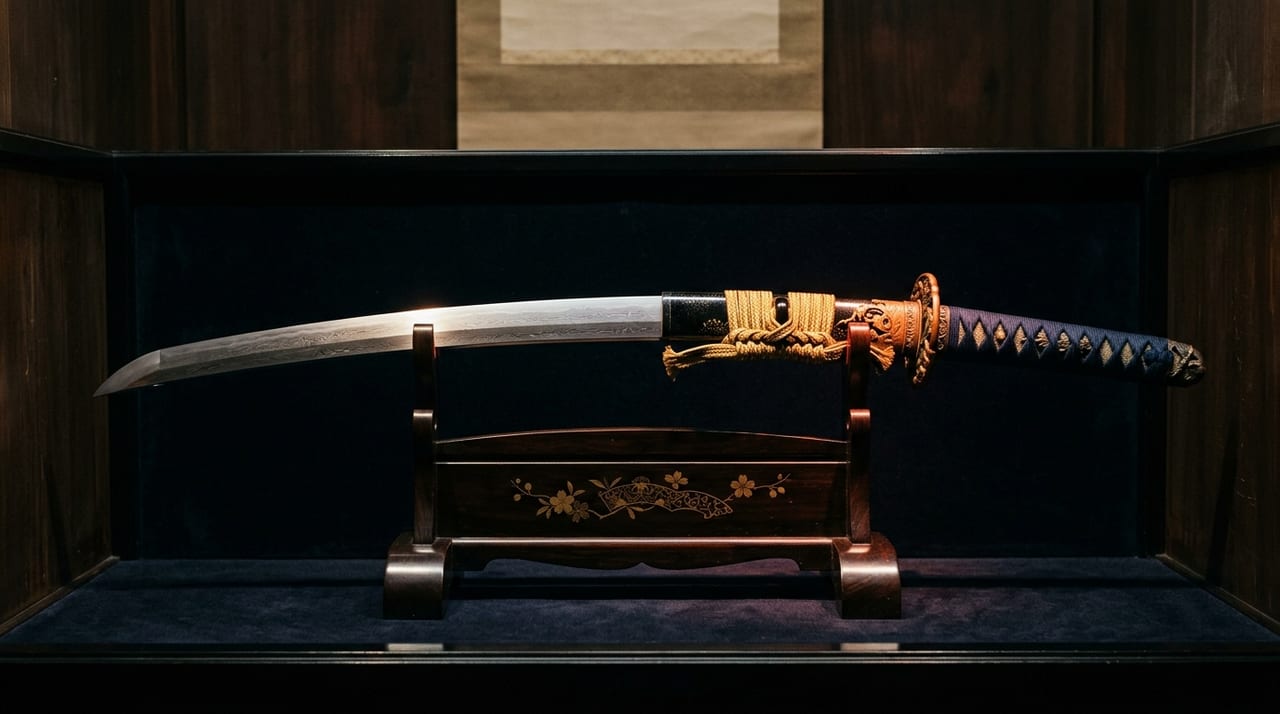 * Image is for illustrative purposes only.
Table of Contents
The Impact of the Edict of Prohibited Swords: From Weapons to Works of Art
The Edict of Prohibited Swords (1876, Meiji 9), which banned the wearing of swords, was a historic ordinance that fundamentally changed the raison d'être of Japanese swords. With the prohibition of sword-wearing, which had been central to samurai identity, the practical use of swords "as weapons" came to a legal end. Penalties were established for violations of the edict, and fierce resistance arose among the former samurai class. The sword-wearing ban caused serious rifts in society at the time, to the point that it is pointed out as one of the remote causes of Saigō Takamori's uprising during the Satsuma Rebellion (1877).
However, this ordinance did not cause Japanese swords to "disappear." Rather, paradoxically, the inability to wear swords led to rapid recognition of the "value of swords as works of art and cultural properties." With the dissolution of the samurai class, celebrated swords that had lain dormant in households began to flood the market, and a modern culture of collecting and studying swords as works of art began to emerge. The Edict did not rob swords of their "life," but rather became the catalyst for transforming their role from "weapons" to "beauty."
Meiji-Era Sword Enthusiasts and the Birth of Collection Culture
From the early to mid-Meiji period, serious collecting of Japanese swords began among former nobility, industrialists, and politicians. Among them, a particularly important figure was Honami Kouson (1879–1955). Kouson, who inherited the prestigious name of the Mito Honami family, collected and studied numerous celebrated swords during the chaotic period following the edict, and made a major contribution to the academization of sword appraisal. His work Kouyama Oshigata is a resource collection that can be considered the foundation of modern sword research, and is widely referenced by researchers of later generations.
Sword enthusiasts also emerged from the business world. The wealthy of the Meiji era competed to collect celebrated swords, viewing "Japanese swords as the king of works of art," and it was not uncommon for a single sword to be traded at prices ranging from several hundred to several thousand yen at the time (equivalent to tens of millions of yen in modern value). This market activation also helped support the technical transmission of related craftspeople such as sword restoration, polishing, and koshirae makers.
Initially, the Meiji government was not seriously concerned about the loss of sword-making techniques due to the edict. However, by the 1880s–1890s, it became clear that the aging and retirement of master swordsmiths and lack of successors had become serious problems. Driven by this sense of crisis, certain intellectuals and swordsmiths, including Tsukiyama Sadakazu, began to call for the necessity of preserving the techniques. Tsukiyama Sadakazu demonstrated sword-making before the Meiji Emperor and was appointed as a Craftsperson of the Imperial Household in 1906 (Meiji 39), becoming recognized as an official successor to sword-making techniques. These individual efforts became the foundation for later organized preservation movements.
Exhibitions and the "Rediscovery" of Japanese Swords: From Domestic to International
The "National Industrial Exhibition" (First held in 1877), sponsored by the Meiji government, was a venue for displaying and evaluating Japan's traditional crafts as resources for industrial promotion. From the first to the fifth exhibition (1903), Japanese swords continued to be exhibited as the centerpiece of the sword section, and the judges' ranking and award system contributed to raising the motivation of swordsmiths, polishers, and koshirae makers. This opportunity for the general public to view celebrated swords up close had the effect of expanding the base of sword-appreciation culture to layers beyond the former samurai class.
An even more significant turning point was the exhibition of Japanese swords at international expositions in Europe and America. Japanese swords were repeatedly exhibited at the following international expositions and appeared on the international stage.
- 1873 Vienna World's Fair
- 1878 Paris Exposition
- 1893 World's Columbian Exposition in Chicago
- 1900 Paris Exposition
In the midst of the Japonisme (Japanese taste) boom, Western art professionals and collectors were profoundly impressed by the curvature of the blade, the surface of the metalwork, and the complex beauty of the hamon. French craft critics noted that "no metalwork as refined as this exists in Europe," and major Western museums such as the Boston Museum of Fine Arts and the Metropolitan Museum of Art began actively acquiring Japanese swords.
This international evaluation paradoxically accelerated domestic reassessment. The fact that "Westerners praised it highly" resonated strongly with the Meiji Japanese elite, and the status of Japanese swords shifted from "relics of an old era" to "the finest expression of Japanese art in which the world could take pride."
The Imperial Museum and the Development of Cultural Property Protection Systems
The Imperial Museum (now Tokyo National Museum), which opened in 1889 (Meiji 22), took on the role of systematically collecting, protecting, and displaying Japanese swords as "treasures of the imperial household." Celebrated swords associated with the imperial family and swords formerly owned by renowned warrior families were successively added to the collections, and the concept of "Japanese swords as cultural properties protected by museums" was publicly established. Among the museum's collection of swords are works such as those by Masamune, Gō Yoshihiro, and Osafune Nagamitsu, considered the pinnacles of sword history, and their existence functioned as reference points for academic research.
From the late Meiji period through the Taishō era, academic research on Japanese swords became fully established through special exhibitions at the Imperial Museum. In 1929 (Showa 4), the "Law for the Preservation of National Treasures" was enacted, and a legal framework for protecting outstanding Japanese swords as "National Treasures" was established. Through this law, the designation, management, and export restrictions of national treasures gained legal grounds, and a dual positioning of "celebrated swords as both privately owned works of art and national treasures" was established. The prototype of the modern system of Important Cultural Properties and National Treasures originates in this Taishō-era legal framework.
The Taishō-Era Sword Enthusiast Community: The Establishment of Sword Studies
The Taishō era (1912–1926) was the period when academic research on Japanese swords became formally organized. "Sword Studies Societies" were successively established in major cities such as Tokyo, Osaka, and Kyoto, and the systematization of knowledge through journals and research papers progressed. The establishment during the Taishō era of basic vocabulary and classification systems for sword studies—including biographies of swordsmiths, the technical differences between various traditions (Soshu, Yamashiro, Bizen, Yamato, and Mino), and the standardization of part nomenclature—laid the foundation for contemporary Japanese sword appreciation and research.
Moreover, during the Taishō era, the "aesthetic approach to swords" by literati and artists became increasingly active. Writers of the Shirakaba school and artists who attempted to fuse Western and Eastern art showed strong interest in the formal beauty of Japanese swords, and a contemporary language of art criticism emerged, such as "a sword is a living sculpture" and "the hamon is abstract painting." These perspectives were not merely matters of taste but rather expanded the aesthetic evaluation of Japanese swords from "perfection as military equipment" to "pure sculptural art."
Conclusion: How Japanese Swords Became "Cultural Properties" in the Age of Modernization
The sword culture of the Meiji and Taishō eras is a historic example of turning a crisis—the Edict of Prohibited Swords—into an opportunity. This era saw Japanese swords, which had lost their practical value as weapons, redefined as "the world's finest works of craft art" through four forces: the passion of enthusiasts, the international stage of exhibitions, the institutional protection of museums, and the systematization of academic research.
What is particularly noteworthy is that this transformation was not imposed "from above" but rather realized through a combination of the scholarly passion of individuals such as Honami Kouson, the evaluation of Western markets, and the grassroots activities of private research societies. Without the recognition of "Japanese swords = cultural properties" established during the Meiji and Taishō eras, neither the modern system of Important Cultural Properties nor the high valuation of Japanese swords in international auction markets would exist. The efforts of these pioneers of this era were not merely nostalgia but rather an extremely contemporary practice of cultural preservation that passed on nearly lost technical and aesthetic legacies to the future. Looking back from the perspective of today, 2026, the transformation triggered by the Edict of Prohibited Swords 150 years ago can be said to have been a crystallization of the wisdom for enabling Japan's traditional culture to survive the waves of modernization.