Nouveautés — Découvrez les dernières arrivées dans notre catalogue. Voir →
23e jour du 8e mois, Jishō 4 (1180)
Ishibashiyama, province de Sagami (actuelle ville d'Odawara, préfecture de Kanagawa)
Forces
Forces de Minamoto no Yoritomo (guerriers d'Izu et de l'ouest du Sagami, récemment soulevés)
Forces alignées sur les Taira de Ōba Kagechika (guerriers provinciaux de Sagami)
Environ 17 min de lecture
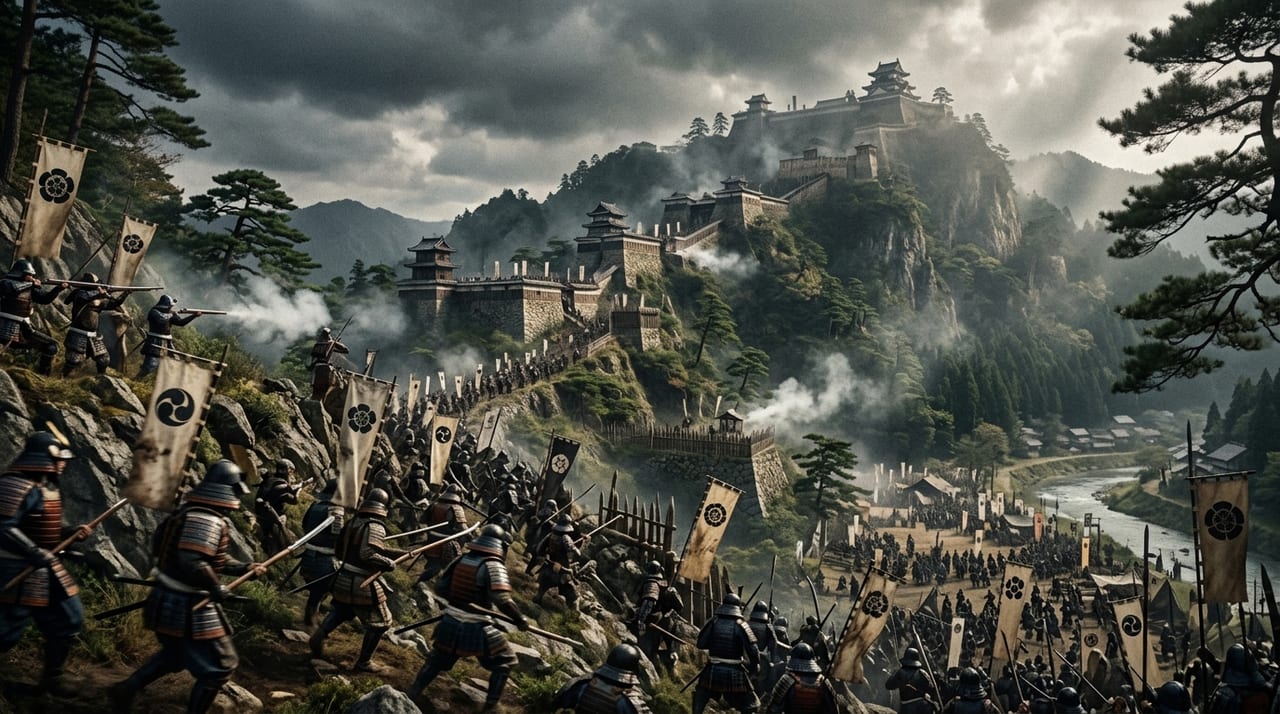
La bataille d'Ishibashiyama (Ishibashiyama no tatakai) est un combat livré le 23e jour du 8e mois de Jishō 4 (1180), au cours duquel Minamoto no Yoritomo, qui s'était soulevé à Izu, subit une lourde défaite face aux troupes des Taira, menées notamment par Ōba Kagechika, à Ishibashiyama, dans la province de Sagami (actuelle ville d'Odawara, préfecture de Kanagawa). Cette bataille, qui fut la seule défaite, dit-on, que Minamoto no Yoritomo ait connue de toute sa vie, devint paradoxalement le point de départ de l'essor de Yoritomo, qui mena à la fondation du shogunat de Kamakura.
En Jishō 4 (1180), ayant reçu le ryōji du prince Mochihito ordonnant la poursuite des Taira, Minamoto no Yoritomo fit attaquer, dans la nuit du 17e jour du 8e mois, la résidence de Yamaki Kanetaka, mokudai (gouverneur adjoint) de la province d'Izu. Il chargea de cette attaque ceux avec qui il entretenait déjà des liens, à savoir son beau-père Hōjō Tokimasa, Doi Sanehira et d'autres guerriers d'Izu et de l'ouest de Sagami, et leva ainsi les armes contre les Taira.
Le 20e jour du 8e mois, Yoritomo quitta Izu avec une petite troupe et avança jusqu'à Doi, domaine de Doi Sanehira, dans la province de Sagami (actuel bourg de Yugawara, préfecture de Kanagawa). Là, il attendit l'arrivée des guerriers des environs pour se joindre à lui tout en organisant ses troupes. Le 23e jour du 8e mois, il établit son camp à Ishibashiyama avec environ 300 cavaliers.
La première cible, Yamaki Kanetaka, avait été à l'origine un exilé envoyé à Izu. Mais grâce à sa relation étroite avec Taira no Tokitada, il était devenu mokudai et étendait rapidement son influence à Izu.
Face à cela, Ōba Kagechika, puissant guerrier de la province de Sagami chargé par les Taira de vaincre Yoritomo, établit une position d'interception à Ishibashiyama à la tête d'une armée écrasante de plus de 3000 cavaliers. Le clan Miura, puissante famille de Sagami dirigée par Miura Yoshizumi, avait quitté son fief pour rejoindre Yoritomo en renfort et s'était mis en marche. Mais le jour même de la bataille, le 23e jour du 8e mois, une forte pluie frappa la région. La rivière Maruko (rivière Sakawa), gonflée par la crue, empêcha les troupes Miura de la traverser, et celles-ci ne purent rejoindre le camp de Yoritomo.
Ōba Kagechika jugea qu'il fallait trancher avant que les Miura n'arrivent et ne renforcent les troupes de Yoritomo. Il lança donc une attaque nocturne, profitant de l'obscurité de la tempête. Les deux armées se firent face de part et d'autre d'une vallée. Après de violents combats, les partisans de Yoritomo, privés de renforts et submergés par le nombre, se débandèrent complètement.
Dans ce combat, Sanada Yoichi Yoshitada, fils d'Okazaki Yoshizane, tomba, et Kudō Shigemitsu, vaincu, se donna la mort. Les partisans de Yoritomo subirent de nombreuses pertes et connurent une grave défaite. Yoritomo lui-même quitta le champ de bataille à grand-peine et s'enfuit vers les montagnes de Hakone. Ayant reçu la nouvelle de la défaite de Yoritomo, le clan Miura rebroussa chemin vers son fief le 24e jour du 8e mois, contraint de le faire.
Yoritomo et ses compagnons, en fuite, furent poursuivis par les troupes d'Ōba. Mais grâce à Iida Ieyoshi, guerrier du camp d'Ōba qui nourrissait de la sympathie pour Yoritomo, ils purent se réfugier dans les montagnes de Sugiyama, dans le domaine de Doi Sanehira. Il est dit que Doi Sanehira conseilla que, si le groupe restait nombreux, il ne pourrait pas s'échapper, et que si Yoritomo seul venait, il le cacherait au prix de sa propre vie.
Les troupes d'Ōba fouillèrent la montagne avec acharnement, et Yoritomo et ses vassaux se cachèrent dans une grotte appelée « Shitodo no Iwaya ». Kajiwara Kagetoki, guerrier qui avait rejoint les troupes d'Ōba, aperçut Yoritomo caché, mais par clémence il le laissa partir. Il dit : « Il n'y a aucune présence humaine sur cette montagne, il faut chercher sur la montagne d'en face », et orienta Ōba Kagechika et les autres dans une autre direction, sauvant ainsi la vie de Yoritomo. Il est dit que, grâce à cette dette de reconnaissance, Kagetoki fut par la suite tenu en haute estime par Yoritomo et bâtit sa position de haut dignitaire du shogunat de Kamakura.
Ayant échappé de justesse à la mort, Yoritomo traversa en petite barque depuis le cap Manazuru jusqu'à la province d'Awa (actuelle partie sud de la préfecture de Chiba). Il y rassembla les guerriers locaux et rétablit ses forces. Avec la participation des puissants guerriers Kazusa Hirotsune et Chiba Tsunetane, de la péninsule de Bōsō, Yoritomo rassembla rapidement une armée de l'ordre de plusieurs dizaines de milliers de cavaliers. Au 10e mois de la même année, il entra à Kamakura, dans la province de Sagami. Désormais, il fit de cette ville son siège et posa les fondements d'un pouvoir militaire dans le Kantō.
La bataille d'Ishibashiyama fut, dit-on, la seule défaite de la carrière de Yoritomo en tant que chef guerrier. Mais à travers cette défaite, Yoritomo apprit de première main la réalité des guerriers de l'Est, tant les forces qui se rangeaient du côté des Taira que les forces potentielles qui soutenaient les Minamoto. Par ailleurs, la présence de guerriers comme Kajiwara Kagetoki, qui, bien qu'ennemis, ont fait preuve de clémence envers Yoritomo, fut un précédent annonciateur de la manière dont les gokenin seraient contrôlés dans le shogunat de Kamakura.
Avant l'époque Sengoku, pour les guerriers de l'Est, la question de rester fidèle à leur seigneur en portant tachi ou naginata, ou de changer de camp selon l'évolution de la situation, était toujours une décision vitale. Les hésitations et les décisions de Iida Ieyoshi et de Kajiwara Kagetoki à Ishibashiyama ont été transmises largement au fil du temps, dans l'Azuma Kagami et le Genpei Seisuiki, comme anecdotes symbolisant la conception de la fidélité des guerriers de Kamakura et la nature de leur lien de bienfaisance et de loyauté. Si cette défaite n'avait pas eu lieu, le déroulement de l'histoire, par lequel Yoritomo aurait rassemblé les guerriers de l'Est depuis Bōsō et posé les fondements du gouvernement guerrier à Kamakura, aurait aussi pu prendre une autre forme. La bataille d'Ishibashiyama est placée comme un tournant de l'histoire sociale des guerriers japonais, où un gouvernement autonome des guerriers, le futur shogunat de Kamakura, est né à l'époque de la domination des Taira, et elle occupe à ce titre une place particulièrement importante.
Ce qui décida de l'issue de la bataille d'Ishibashiyama ne fut pas seulement la différence des effectifs, mais aussi les relations antagonistes complexes entre les bandes guerrières locales de la région de Bandō. Une partie des Taira de Bandō, dont Ōba Kagechika, ne se mobilisa pas nécessairement contre Yoritomo uniquement par loyauté envers le gouvernement des Taira. Elle s'opposait plutôt aux guerriers partisans de Yoritomo, surtout dans le prolongement de leurs conflits territoriaux et de pouvoir locaux. Il est dit que le clan Miura chercha lui aussi à rejoindre les partisans de Yoritomo sur un fond semblable de rivalité entre forces locales. Ainsi, la bataille d'Ishibashiyama présenta moins le caractère d'un heurt direct entre les deux grandes puissances, Minamoto et Taira, que celui d'un conflit d'intérêts complexe au sein des bandes guerrières de Bandō, révélé dans le cadre général de l'opposition entre Minamoto et Taira.
La bataille d'Ishibashiyama fut une défaite survenue avant que Yoritomo n'établisse son autorité comme chef des guerriers, à une époque où il n'était encore qu'un exilé envoyé à Izu. Elle est décrite en détail dans l'Azuma Kagami, l'histoire du shogunat de Kamakura, comme un soulèvement dans des conditions défavorables, difficilement imaginable au vu de l'autorité absolue que Yoritomo exerça plus tard au sein du shogunat. Cette défaite initiale et le récit de son redressement spectaculaire ont été largement lus dans la société guerrière, du Moyen Âge à l'époque moderne, comme un épisode important mettant en lumière les qualités de dirigeant de Yoritomo et sa capacité de commandement sur les guerriers de l'Est.
L'ancien champ de bataille d'Ishibashiyama se situe aujourd'hui dans la ville d'Odawara, préfecture de Kanagawa, et les vestiges historiques liés à la bataille subsistent encore dans les environs. On peut citer le sanctuaire Sanada Reisha, qui honore Sanada Yoichi Yoshitada tombé au combat, et la « Shitodo no Iwaya » de la ville de Yugawara, où Yoritomo se serait caché. Ces sites sont inscrits dans le patrimoine historique local en tant que lieux commémoratifs racontant les épreuves du soulèvement de Yoritomo et le tournant spectaculaire qui mena à la fondation du shogunat de Kamakura. Le fait que Yoritomo ait pu, à peine un mois et demi après la défaite d'Ishibashiyama, entrer à Kamakura et reprendre l'avantage témoigne de l'ampleur du mécontentement potentiel des guerriers de Bandō envers le gouvernement des Taira. Cet événement a été transmis aux générations suivantes comme un exemple symbolique montrant qu'une défaite, aussi lourde soit-elle, ne détermine pas nécessairement l'avenir d'un chef guerrier. La structure narrative, faite du sauvetage du seigneur par ses vassaux dans une situation désespérée, de leur loyauté et du relèvement du vaincu, incarne l'esprit de isshokenmei et de go-on et hōkō que la société guerrière japonaise a longtemps tenu en haute estime. Elle fait de la bataille d'Ishibashiyama un épisode qui dépasse le simple échec militaire.