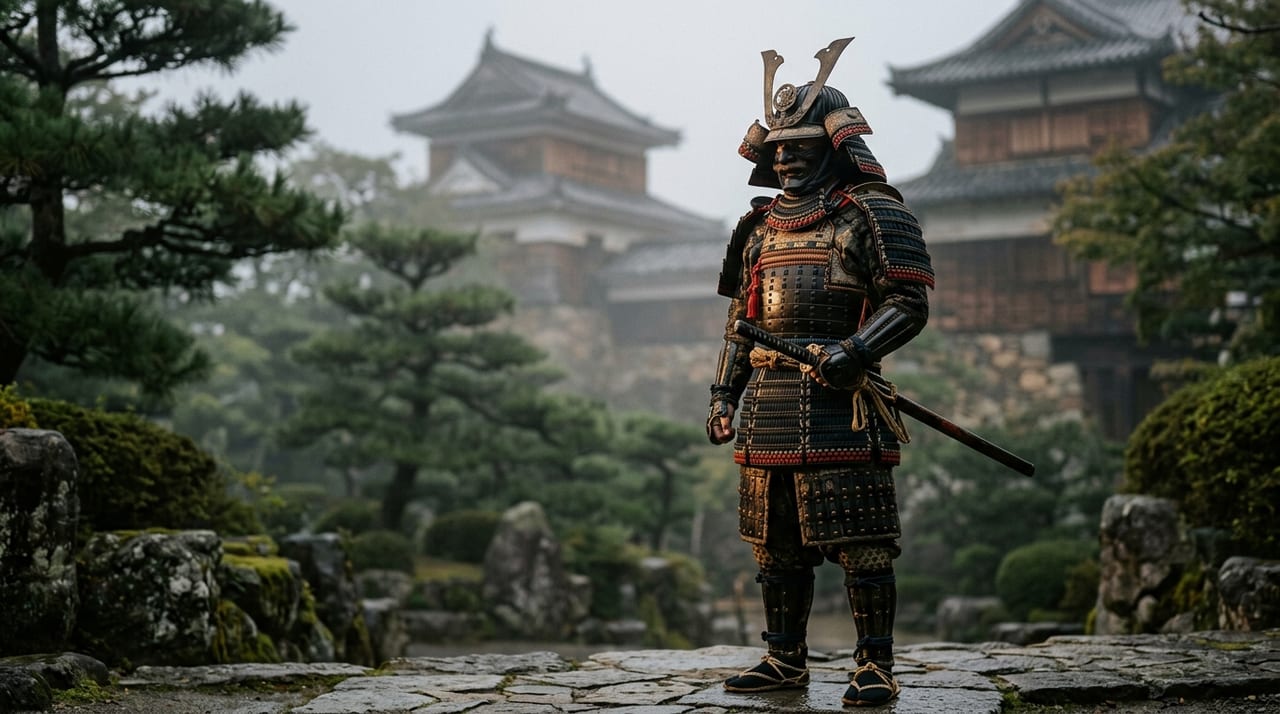
 * Image is for illustrative purposes only.
Yamaga Sokō
山鹿素行
Theorist of Bushidō and Master of Military Science
Description
The Birth of a Military Scholar
In Genna 8 (1622), Yamaga Sokō was born in Aizu in Mutsu Province. He was a scholar and thinker who left an enduring mark on Edo intellectual history, both as one who systematically theorized the Japanese samurai way (shidō, bushidō) and as the one who brought Japanese military learning (heigaku) to full maturity. Known as a child prodigy from an early age, he entered the school of Hayashi Razan, a Confucian scholar who served as an adviser to Tokugawa Ieyasu, at the age of nine to study Confucianism. He went on to pursue learning broadly and grew into a comprehensive scholar with deep expertise in many fields, including military learning, Confucianism, and Shinto.
Establishment of the Yamaga School of Military Learning
The Yamaga-ryū heigaku that Sokō established was more than a study of tactics and strategy. It was a comprehensive system of thought that theoretically explained the proper conduct of the samurai. Sokō studied Chinese military treatises in depth, including the Sunzi, the Wuzi, and the Bukyō shichisho, and then reinterpreted them to suit Japanese conditions, building his own theory of military learning. A defining feature of the Yamaga school is that it treats military rationality and moral norms as inseparable, and this view had a major influence on later samurai thought.
Systematizing the Way of the Samurai
The 'shidō' (the way of the samurai) included in Sokō's principal work, the Yamaga gorui, is a groundbreaking treatise that philosophically re-examines what a samurai (shi) is. Sokō argued that samurai had a distinct social role, different from that of farmers, artisans, and merchants. He taught that the essence of the samurai lay not merely in fighting but in serving as a model for society as an embodiment of moral principle. Yamaga Sokō's 'shidō' is sometimes positioned as one of the precursors of the modern theories of the samurai way, represented by Nitobe Inazō's 'Bushido' (written in English).
Connection with Akō
Sokō served the Asano family of the Akō domain in Harima Province from Jōō 1 (1652) to Manji 3 (1660). The Akō domain is famous for the later Akō rōnin incident. The actions of the Akō rōnin led by Ōishi Kuranosuke, the practice of righteousness (gi) in avenging their lord, can be interpreted as a concrete expression of the samurai 'shidō' that Sokō theorized. In this sense, Sokō's theory of the samurai way was not mere armchair theory but a practical philosophy that prescribed the actual conduct of samurai.
Exile and Unwavering Spirit
In Kanbun 5 (1665), Sokō wrote the work Seikyō yōroku, in which he criticized Shushigaku (Neo-Confucianism) and argued for the position of kogaku (Confucianism that returns directly to the original texts). As a result, the shogunate regarded him as dangerous, and in the following year, Kanbun 6 (1666), he was exiled to Akō in Harima Province. Even in exile, Sokō continued his scholarly work, and in Akō he wrote works including Buke jiki. When he was pardoned in Enpō 3 (1675) and permitted to return to Edo, his reputation had grown even further. Sokō's conduct, never losing his passion for learning even amid the adversity of exile, proves that his samurai theory was not merely an ideal but a way of life itself.