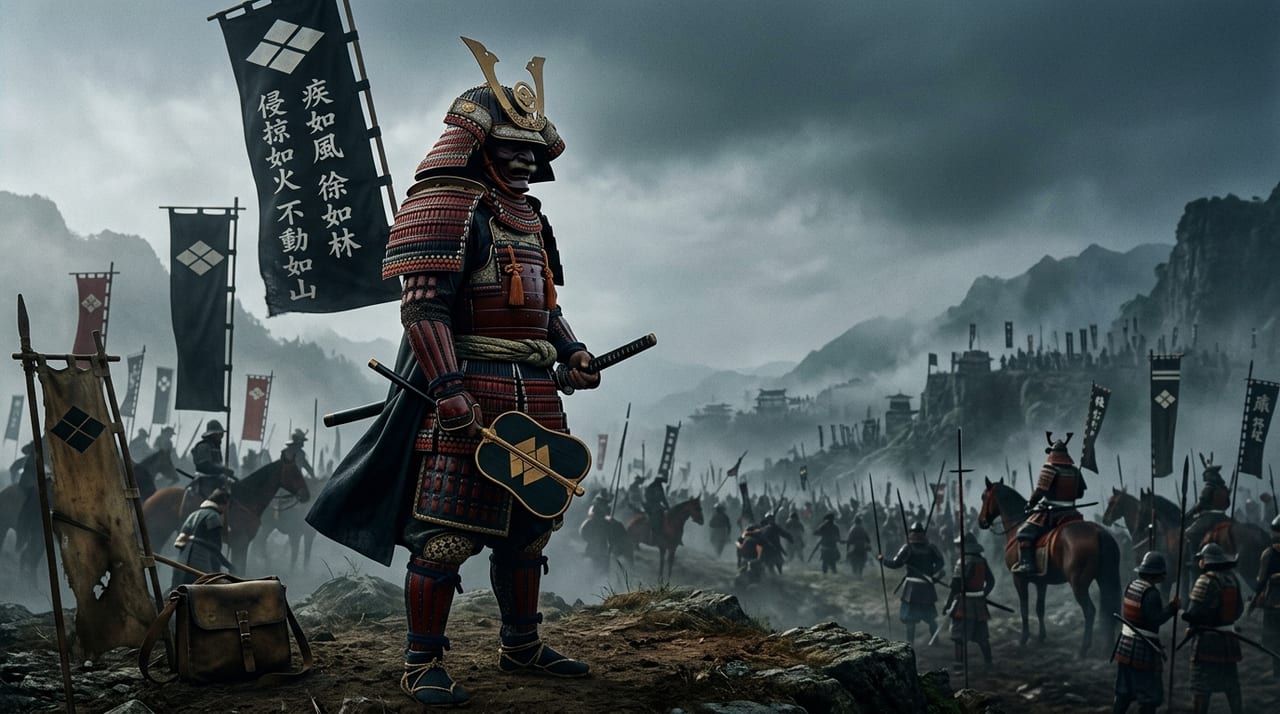
 * Image is for illustrative purposes only.
Ōkubo Tadachika
大久保忠隣
The de facto first rōjū who supported Tokugawa Ieyasu — first daimyo of Odawara domain, later stripped of his lands
Description
Origins and First Battle
Ōkubo Tadachika (1553-1628) was born in Mikawa Province in 1553, the eldest son of Ōkubo Tadayo, a senior retainer of the Matsudaira (Tokugawa) house. He entered the service of Tokugawa Ieyasu around 1563, saw his first battle at the assault on Horikawa Castle, and is said to have protected Ieyasu to the last at the Battle of Mikatagahara in 1572.
Rise in the Early Tokugawa Regime
Following the Honnōji Incident of 1582, when Ieyasu fled from Sakai in Izumi to Mikawa in the "Iga Crossing," Tadachika is said to have shielded Ieyasu at personal risk, a service credited with contributing to Ieyasu's later grant of Kai and Shinano provinces. He also took part in the 1590 Siege of Odawara, and after the pacification of the Kantō was granted 20,000 koku in Musashi Province. Appointed a chief retainer (karō) to Tokugawa Hidetada, his holdings doubled to 65,000 koku upon inheriting the family headship in 1594, and he is held to have occupied a position amounting to the shogunate's first de facto rōjū (senior councillor).
As Lord of Odawara
In the Keichō era he held Odawara domain in Sagami with 65,000 koku (some accounts give a further increase), and was closely involved at the center of shogunal government under Hidetada. He is said to have enjoyed shōgi, and an anecdote holds that when informed of his attainder he asked to be allowed to finish the game he was in the middle of playing. (This is a traditional anecdote whose historicity cannot be confirmed.)
Attainder and Later Life
In 1614, ordered to travel to Kyoto to help suppress Christianity, Tadachika was suddenly stripped of his lands and exiled to Ōmi Province after reaching the capital, in the twelfth month of that year (some accounts place it in the first month of the following year). Theories of a conspiracy by his political rivals Honda Masanobu and his son Masazumi have long circulated as the background to his attainder, though Masanobu himself is also said to have shown Tadachika goodwill, and no settled account exists. Tadachika took holy orders in Ōmi and died there in 1628 at the age of seventy-five.
Legacy
Ōkubo Tadachika is remembered for a career of striking contrasts: a senior retainer who supported the Tokugawa regime both administratively and militarily from its founding years, only to be abruptly removed from the political stage by attainder late in life. He is frequently discussed in studies of the early modern period as one of the representative figures of the founding generation of Tokugawa retainers.