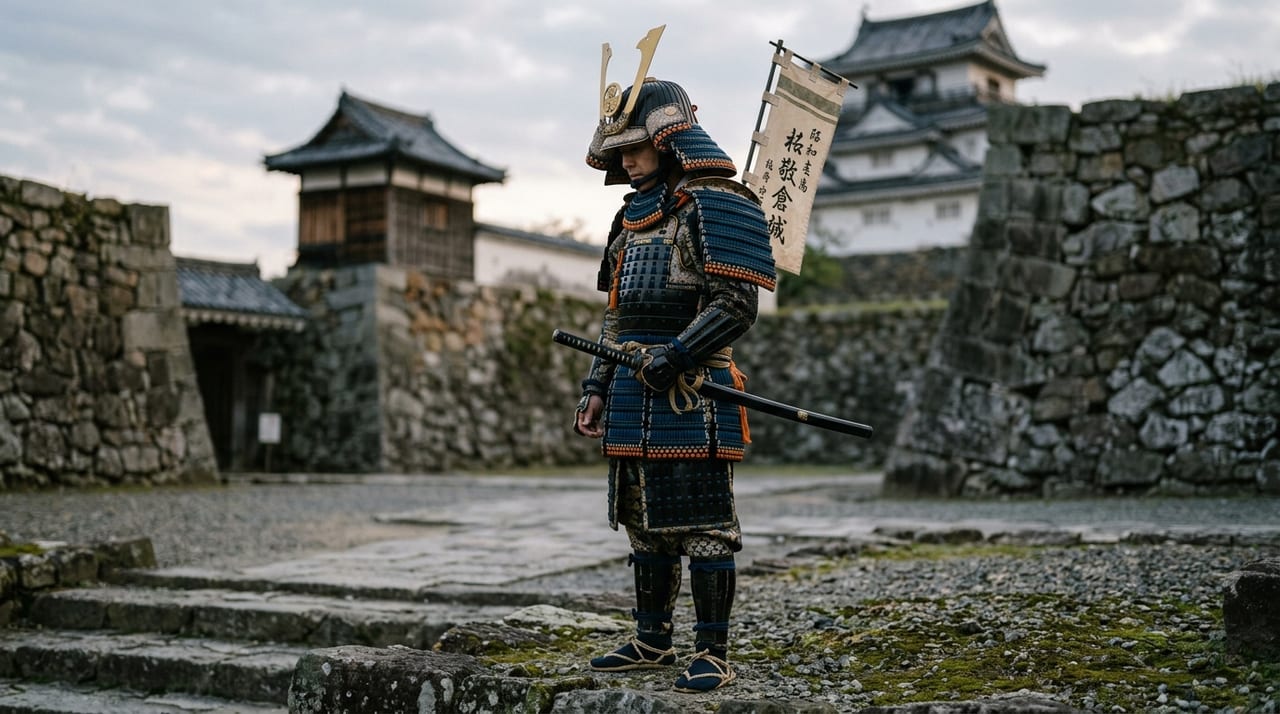
* Image is for illustrative purposes only.Natori Masazumi
名取正澄
Author of Shōninki — The Martial Theorist Who Synthesized Ninjutsu and Swordsmanship
Description
The Author of Shōninki
Natori Masazumi, said to have been born around 1624 (Kanei era) in Kii province, is known as a martial theorist and shinobi master of the early Edo period. The Shōninki, which he authored in the ninth year of Enpō (1681), is highly regarded as a masterwork among extant shinobi texts for its systematic organization and profound philosophical depth. Masazumi did not compose the Shōninki merely as a technical manual of shinobi methods; rather, he distinguished it from other shinobi texts by writing it as a treatise on martial philosophy that fused the thought of bushidō, Buddhism, and Daoism, thereby discussing the spiritual foundation of shinobi arts.
Sword and Shinobi Thought in the Shōninki
In the Shōninki, Masazumi discusses shinobi arts and swordsmanship not as opposing techniques but as an integrated whole within the comprehensive martial practice of the samurai. The principle that "the blade is the soul of the samurai, and the techniques of shinobi are an extension of the warrior's way in places beyond the reach of the sword" lies at the heart of Masazumi's martial philosophy. According to Masazumi, a superior shinobi must also be a superior swordsman, and the discipline of swordsmanship also served to cultivate the spiritual foundation of shinobi arts. This integrated view of martial training profoundly influenced later martial theorists.
Martial Culture of Kii Domain
Kii province, where Masazumi served, was ruled by the Kii Tokugawa house, one of the Three Tokugawa Houses, and martial culture was maintained at a high level. The Kii Tokugawa house was zealous in promoting various martial arts including swordsmanship, spear techniques, and shinobi arts, and an environment existed where martial theorists like Masazumi could flourish. Local swordsmiths of Kii also worked under the patronage of the Tokugawa house, and it is believed that Masazumi possessed practical knowledge of Kii-tradition blades.
Masazumi's Sword Training
Precise records of the swordsmanship that Masazumi studied have not survived, but the content of the Shōninki suggests that he underwent extensive training spanning multiple schools of swordsmanship. A passage in the Shōninki that discusses the significance and limitations of "formal practice" demonstrates profound insight into the essence of swordsmanship and clearly shows it was written from the perspective of a martial artist who combined both practical experience and theoretical reflection. The "sword of the mind" that Masazumi discusses—spiritual swordsmanship that subdues an opponent without drawing the blade—resonates deeply with the later Yagyū Shin'in-ryū concept of the "sword that does not fight."
Blade and Shinobi—The Two Faces of the Samurai
The world of shinobi arts and the world of blades appear superficially to contrast, yet they are in fact two sides of the same coin. While shinobi are known to use weapons such as the kunai and shuriken, shinobi too, as samurai, carried the blade (primarily the wakizashi) as their fundamental weapon. The Shōninki contains specific descriptions of situations in which shinobi employed the blade, revealing a distinctive philosophy of the blade wherein "the blade as a last resort" appears. For the shinobi, drawing the blade sometimes signified mission failure; therefore, the paradoxical philosophy of blade technique at the heart of Masazumi's martial theory holds that the highest art is to create circumstances in which the blade need not be drawn.
Notable Swords
- The shinobi's wakizashi — the short sword Masazumi discusses in Shōninki as the shinobi's last resort; because drawing it signals mission failure, it embodies a paradoxical philosophy: the finest technique is the one that makes the sword unnecessary; the wakizashi's compact form made it the optimal blade for covert operatives, but its highest use was to never be needed
- The sword of the mind (kokoro no ken) — Masazumi's concept of sword mastery without drawing: the ability to read, dominate, and resolve a situation through presence and perception alone; this philosophical blade, described in Shōninki, bridges ninjutsu and the Yagyū school's 'life-giving sword' and represents one of the most sophisticated ideas in early Edo martial theory