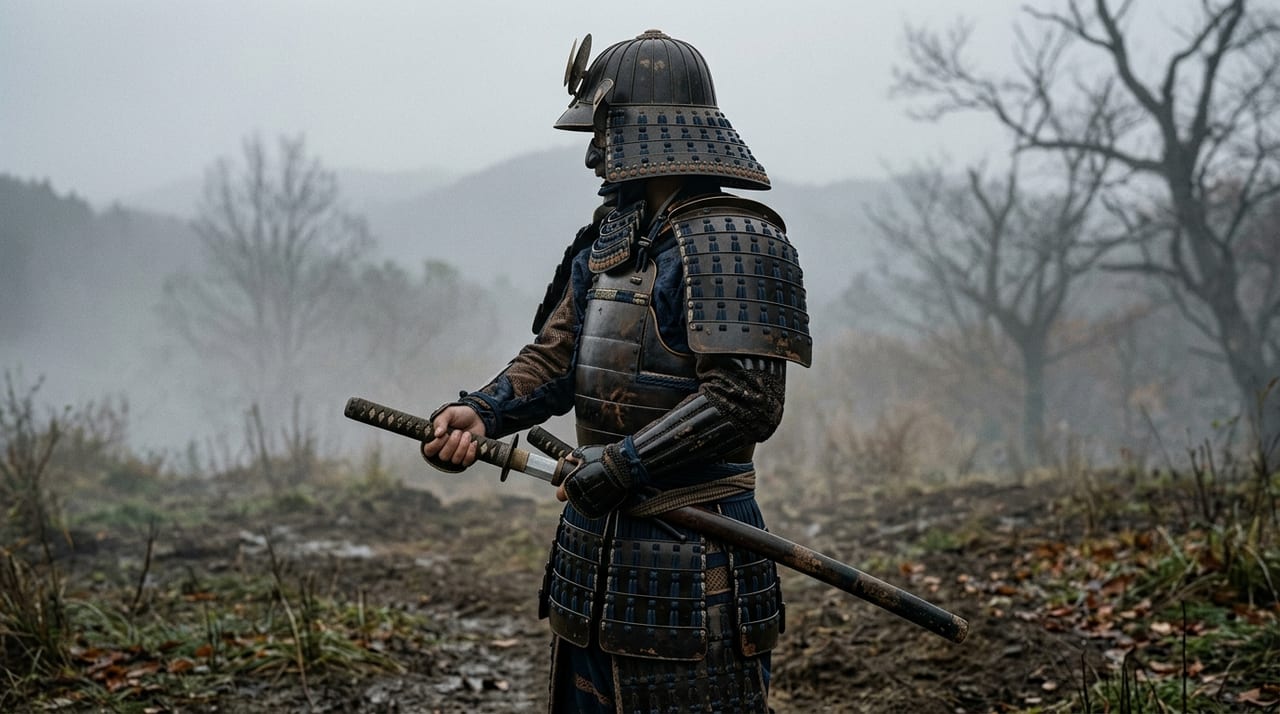
 * Image is for illustrative purposes only.
Araki Mataemon
荒木又右衛門
One of Japan's Three Great Vengeances, Duellist of Kagiya no Tsuji
Description
Araki Mataemon (1599-1638) was a swordsman of the early Edo period and a figure who inscribed his name brilliantly in the history of swordsmanship as the protagonist of the Duel at Kagiya no Tsuji (1634), which is regarded as one of Japan's three great vendettas. This duel, fought in Iga-Ueno (present-day Iga City, Mie Prefecture), was handed down throughout the Edo period as the ideal of a samurai who drew his sword for the sake of righteousness, and became the subject of many works of performing arts and literature, including kabuki, jōruri and yomihon.
Mataemon is said to have studied the Shinkage-ryū as a disciple of the father and son Yagyū Munenori and Mitsuyoshi, and he served the Yamato-Kōriyama domain as a sword instructor. His reputation with the sword was already widely known, and he was regarded as having first-rate skill even among the swordsmen of his time.
The course of the Duel at Kagiya no Tsuji was as follows. Watanabe Gendayū, the younger brother of Watanabe Kazuma, who was Mataemon's brother-in-law, was killed by Kawai Matagorō, a retainer of the Okayama domain of Bizen. Kazuma swore to avenge his younger brother, but since revenge alone was difficult, he asked his brother-in-law Mataemon for help. Mataemon accepted this appeal for the sake of righteousness without refusing. On the 7th day of the 11th month of Kan'ei 11 (26 December 1634), at Kagiya no Tsuji on the outskirts of Iga-Ueno, the party of Kazuma and Mataemon clashed with the band of Kawai Matagorō.
In this duel, Mataemon cut down two men: Kawai Jinzaemon, the uncle of Matagorō and a sword instructor of the Kōriyama domain, and Sakurai Hanbei, a spear instructor of the Amagasaki domain. In the end, it was Watanabe Kazuma who struck down Kawai Matagorō, but Mataemon's swordsmanship was the greatest factor that led this vendetta to success. Kōdan storytelling and similar accounts also speak of "thirty-six men cut down," but this is an exaggeration added by later generations.
It is said that Mataemon's sword broke during the duel when it blocked the wooden sword of a servant of the opposing side, and that this blade was made by either Iga-no-kami Kinmichi or Izumi-no-kami Kinmichi. Mataemon, who was criticized by Tonami Chikakiyo of the Tōdō house for using a shintō (new sword) that breaks easily, is said to have later become Tonami's disciple. Mataemon's fame as a swordsman did not decline throughout the Edo period, and until the end of the Edo period (Bakumatsu) he continued to be referenced as a model for swordsmen.
After the Duel at Kagiya no Tsuji, Mataemon became known to the world together with his achievement of completing the vendetta, but he died just four years later, in 1638. The story of his brief final years and his fierce duel continues to shine in the history of Japanese martial arts as a crystallization of samurai righteousness and swordsmanship. The Duel at Kagiya no Tsuji, which showed how the techniques of the Yagyū Shinkage-ryū functioned in actual combat, is evaluated as an event that symbolizes the pinnacle of Japanese swordsmanship in the early Edo period.
Notable Swords
- Iga-no-kami Kinmichi (a sword used in the Duel at Kagiya no Tsuji, said to have broken in the course of the fight; by another account, Izumi-no-kami Kinmichi)