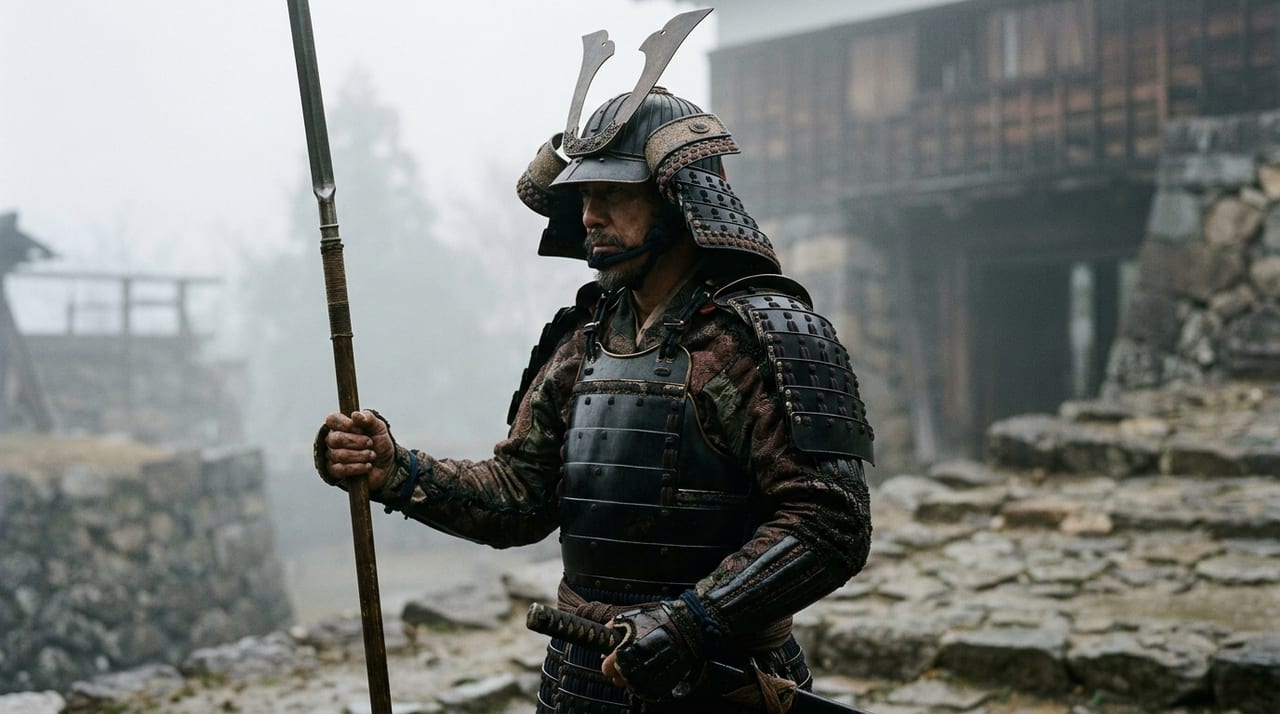
 * Image is for illustrative purposes only.
Empress Jingū
神功皇后
The Legendary Empress of the Kojiki and Nihon Shoki — The "Armed Sovereign" of the Silla Campaign Myth
Description
Empress Jingū is a legendary figure recorded in the Kojiki (712) and Nihon Shoki (720). Traditionally held to be the consort of Emperor Chūai, she is said to have received a divine oracle in her husband's place in the eighth year of Chūai's reign, and then, after his death the following year (Chūai 9, traditionally dated 200 CE), to have personally led a military campaign against the Korean peninsula (the "Conquest of the Three Han"). According to the Nihon Shoki, she disguised herself as a man, led an expedition against Silla, subdued it without battle, and brought Baekje and Goguryeo into submission as well. Tradition further holds that she campaigned while pregnant with the future Emperor Ōjin, delaying the birth by pressing stones called the "moon-delaying stone" and "pregnancy-calming stone" against her abdomen.
However, mainstream historical scholarship today holds that Jingū's historical existence cannot be confirmed, with both existence and non-existence theories coexisting; the view that she is "a legendary figure whose existence cannot be verified" carries considerable weight. Researchers have suggested that the Silla campaign legend was modeled on the historical seventh-century expedition led by Empress Saimei against Silla, with the achievements of the real female sovereigns who emerged from the reign of Empress Suiko onward projected back onto the narrative during the compilation of the chronicles in the eighth century. Even granting that a figure corresponding to Jingū may have existed, she can only be estimated to belong to roughly the 3rd to 4th century, with no reliable dating established. This entry likewise treats her not as a historically documented military commander but as a legendary figure transmitted through the Kojiki and Nihon Shoki.
As for her connection to swords, the Nanatsusaya no Tachi ("Seven-Branched Sword"), a National Treasure held at Isonokami Shrine, is well known. The Nihon Shoki records that in the 52nd year of Jingū's regency, a "seven-branched sword" was presented to the court from Baekje, and this is believed to correspond to the surviving blade. However, studies of the sword's inscription date it to the late 4th century, leaving the chronicle's dating a matter of ongoing scholarly debate. Kashii Shrine, a site associated with Jingū, also preserves a tradition that upon her return from the Korean campaign she buried a sword, a halberd, and a staff there.
The story of a female sovereign personally leading an army across the sea occupies a distinctive place within the mythology of the Kojiki and Nihon Shoki — less a record of historical fact than an idealized, later-deified image of an "armed empress."
Notable Swords
- Nanatsusaya no Tachi / Seven-Branched Sword (a National Treasure at Isonokami Shrine, traditionally identified with the sword the Nihon Shoki says was presented from Baekje in the 52nd year of Jingū's regency; inscription studies date the blade to the late 4th century, leaving the chronicle's dating a matter of ongoing scholarly debate)