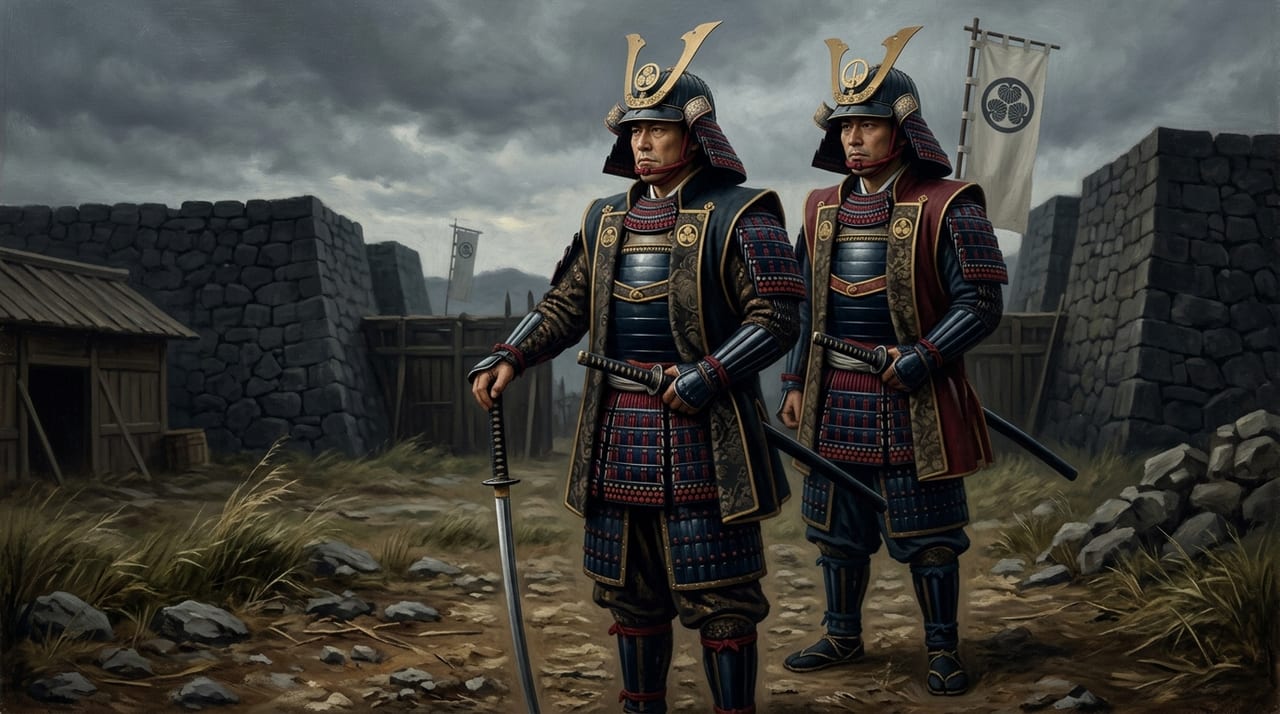
 * Image is for illustrative purposes only.
Hōjō Tsunashige
北条綱成
Description
Hōjō Tsunashige (1515–1587) was a military commander from the Sengoku through Azuchi-Momoyama periods. He served as a senior retainer of the Later Hōjō clan and as lord of Tamanawa Castle in Sagami Province. He is said to have been a son of Fukushima Masashige, a retainer of the Imagawa clan (there are other theories regarding his biological father). After his father's death, he was taken under the protection of Hōjō Ujitsuna (second head of the Hōjō family), married Ujitsuna's daughter, was granted the Hōjō surname, and was ranked among the clan's kin. He is known as a fierce general who supported the Later Hōjō clan militarily during its height.
The Brave General of "Jiki Hachiman"
Tsunashige went into battle carrying a banner of glossed silk dyed kuchiba-iro (russet, the colour of fallen leaves) bearing the two characters for "Hachiman," and from this banner he was called Jiki Hachiman. Charging at the front with this banner unfurled and shouting "We've won, we've won!", his figure left a deep impression on both friend and foe, and he was feared as a general who boasted the foremost martial prowess of the Hōjō house.
Exploits at the Night Battle of Kawagoe
The representative battle that raised Tsunashige's name was the Battle of Kawagoe Castle (the Night Battle of Kawagoe) in 1546. While Kawagoe Castle, held by the Hōjō side, was surrounded by a coalition army of both Uesugi clans and the Koga kubō, Tsunashige, as castellan, held out in siege for more than half a year. Then, through a night attack carried out in coordination with the main force led by Hōjō Ujiyasu, he won a great victory, defeating a large army despite having few troops. This battle became a turning point for the Later Hōjō clan in establishing its hegemony in the Kantō region.
Later Assessment
Tsunashige served across three generations, under Hōjō Ujitsuna, Ujiyasu, and Ujimasa, and supported the Later Hōjō clan's military affairs for a long time. Based at Tamanawa Castle, he fought in campaigns across various regions, and his martial prowess was described as "the strongest in the Hōjō house." He died in 1587, and his grave remains at Ryūhō-ji in Tamanawa. He is remembered as one of the outstanding brave generals representing the Kantō region during the Sengoku period.