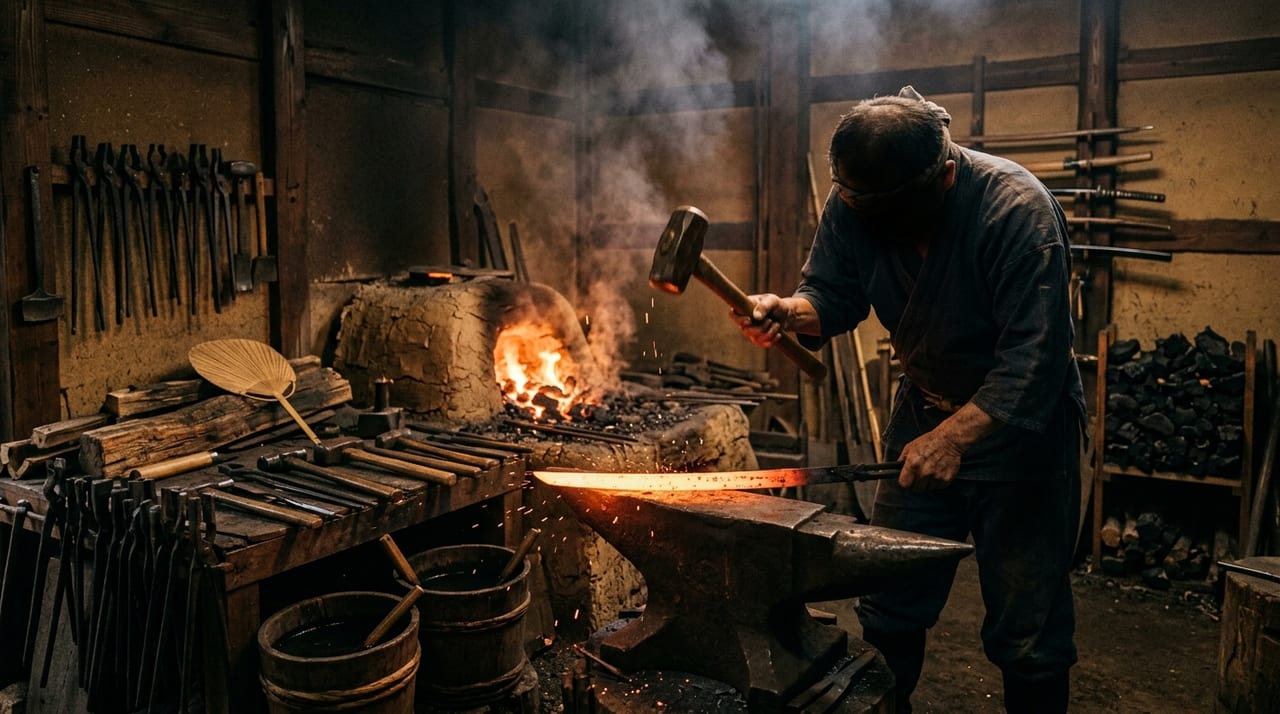
 * Image is for illustrative purposes only.
Yoshioka Ichimonji Sukemitsu
吉岡一文字助光
Description
Yoshioka Ichimonji Sukemitsu — Representative Smith of the Yoshioka Ichimonji School
Yoshioka Ichimonji Sukemitsu was a swordsmith who was active in Yoshioka in Bizen Province, north of the Fukuoka Ichimonji area, at the end of the Kamakura period, and is the representative smith of the Yoshioka Ichimonji school. His official title was Sakon-no-shōgen, his hereditary family name was Ki, and his signature reads "Ki no Sukemitsu." Works bearing the dates Gen'ō 2 (1320) and Genkō 2 (1322) have been designated National Treasures, so the period of his activity can be confirmed.
Stylistic Characteristics
Sukemitsu's swordmaking embodies the common characteristics of the Yoshioka Ichimonji school at a high level.
Sugata (shape) has deep koshi-zori, little difference between moto and saki, and is a firm tachi shape of the late Kamakura to Nanboku-chō period. The mihaba (width of the blade) is fairly broad, and the kasane (thickness of the back) is substantial.
Jigane (steel) shows well-tightened itame-hada, fine ji-nie, and raised midare-utsuri. Some jigane of the Yoshioka Ichimonji school have partly flowing hada that stands up (hadatsu), and the utsuri is said to be a step behind that of Fukuoka Ichimonji.
Hamon (temper line) is nioi-deki with a wide yakihaba, mainly chōji-midare and ō-chōji-midare. Gunome-midare mixes into the chōji, and the ashi and yō flow vividly. There are examples with reverse-curving ashi. The nioiguchi is bright and clear, and its technical level is high even within the school.
Bōshi (tip temper) is ko-maru or midare-komi, returning in a round shape.
Representative Works — National Treasure Naginata and Tachi
Naginata, inscribed "Ichi Bishū Yoshioka-jū Sakon-no-shōgen Ki no Sukemitsu, the 11th month of Gen'ō 2 (1320)" (National Treasure; blade length 56.7 cm) is a signed and dated work of Gen'ō 2 (1320), transmitted to the Maeda family of Kaga, and is regarded as one of the finest naginata of the Kamakura period. The inscription, which begins with "Ichi" and continues with the province, place of residence, official title, and name, followed by the date, is a form seen in the Yoshioka Ichimonji school.
Tachi, inscribed "Ichi Bizen-no-kuni Yoshioka-jū Sakon-no-shōgen Ki no Sukemitsu, the 3rd month of Genkō 2 (1322)" (National Treasure; blade length 82.4 cm) bears the date Genkō 2 (1322). It is said that the third shogun, Tokugawa Iemitsu, bestowed it in recognition of the achievement of Abe Tadaaki, who crossed the flooded Sumida River with his men and horses.
Evaluation and Historical Significance
Sukemitsu is regarded as the representative smith of the Yoshioka Ichimonji school, and the fact that two blades, a tachi and a naginata, are designated National Treasures supports that evaluation. Sukemitsu's works are recorded in the history of swordmaking as representative works of the Yoshioka Ichimonji school.
Famous Works
- Naginata, signed Ichibishū Yoshioka-jū Sakonshōgen Ki Sukemitsu, dated Genō 2 (kōshin), 11th month (National Treasure, blade length 56.7 cm)
- Tachi, signed Ichibizen-no-kuni Yoshioka-jū Sakonshōgen Ki Sukemitsu, dated Genkō 2, 3rd month (National Treasure, blade length 82.4 cm; bestowed by Tokugawa Iemitsu on Abe Tadaaki)