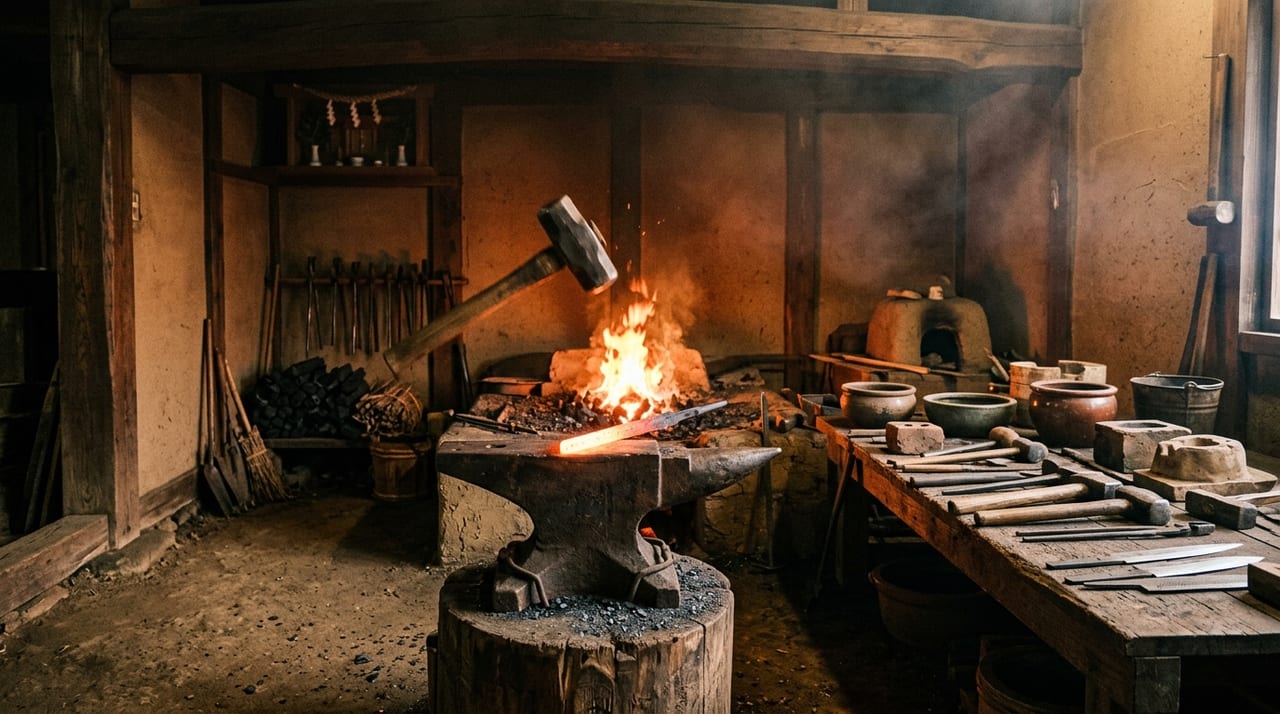
 * Image is for illustrative purposes only.
Uda Kunimitsu
宇多国光
Description
Uda Kunimitsu and the Establishment of the Etchū Uda School
Uda Kunimitsu is said to have moved from Uda District, Yamato Province, to Etchū Province (Etchū no kuni, present-day Toyama Prefecture) in the late Kamakura period, around the Bunpō era (1317–1319). Also called Ko-Nyūdō Kunimitsu, this swordsmith is recorded in the sword history of Etchū as the founder of the Uda school (Uda-ha). The name of the Uda school comes from Uda in Yamato Province, Kunimitsu's home region. It is a regional school formed by a group of swordsmiths who use the character "kuni" as a shared character (tsūji) in their names, including Kunifusa, Kunimune, Kunitsugu, and Kunihisa.
No extant works by Kunimitsu are said to have been confirmed. In terms of surviving works, his disciples Kunifusa and Kunimune, who are said to have studied under Norishige of Etchū, are often regarded as the de facto founders of the Uda school. The Uda school flourished in Etchū from the Nanbokuchō period through the Muromachi period and became a pillar supporting Etchū's sword industry.
Characteristics of Uda-mono
The jigane of the Uda school is refined and tightly forged in early works. From the Muromachi period on, however, mokume-hada mixed with masame-hada, the hada became raised (hada-dachi), and some works show ō-hada. Some works also show shirake-utsuri, and they display a regional character that differs from the fine ko-itame of the Yamashiro-den and Bizen-den traditions.
The hamon is mainly notare-midare and gunome-midare in nie-deki style, and many show affinities with the Tegai and Shikkake schools of Yamato. This somewhat rough, powerful midare gives a rustic northern character that differs from the refined hamon of Kyoto and Kamakura, and enthusiasts prize it as a distinctive trait of Uda-mono. The nie is coarse and bright, and workings such as ashi, yō, hotsure, sunagashi, and kuichigai-ba are also seen, forming a landscape full of vitality across the whole hamon.
Some blades are carved with bōhi or soebi grooves. The nakago is short, and the nakago-jiri is kurijiri or ha-agari kurijiri. Most signatures of Uda school smiths begin with the character "kuni."
Historical Significance of the Uda School and Etchū Swords
The Uda school is not included among the Gokaden (five traditions: Yamashiro, Yamato, Bizen, Sōshū, and Mino). Together with the Fujishima school of Kaga and the Chiyozuru school of Echizen, however, it is collectively called hokkoku-mono, a group of wakimono. The existence of these Hokuriku smith groups shows that the Hokuriku region had a rich sword culture.
The Hokuriku provinces of Etchū, Kaga, Noto, and Echizen carried out active sword production from the Muromachi period through the Sengoku period. In the Sengoku period especially, a distinctive martial culture developed under the influence of the Ikkō-ikki. Within this, the Uda school functioned as the core of Etchū swords and formed an important industrial group that supplied swords to local warriors and farmers.
Forge Culture of Etchū and the Succession of the Uda School
The Uda school, founded by Uda Kunimitsu, continued throughout the Muromachi period and produced many craftsmen, including Kunifusa, Kunimune, Kunitsugu, Kunihisa, Kunihiro, and Tomohiro. Kunimune and Kunihisa carried the same names across several generations. Each of these craftsmen displayed his own individuality and enriched the diversity of Etchū swords.
Although Kunimitsu's own extant works are said not to have been confirmed, the works of his lineage are extremely important as primary sources for studying the sword history of Etchū, and they attract the attention of sword researchers. Touken-za introduces Uda Kunimitsu as the establisher of a distinctive sword aesthetic born in the Hokuriku region. Its aim is to convey to present-day enthusiasts the existence of a rich regional sword culture beyond the Gokaden. The rustic, characterful qualities of Uda-mono are a different pinnacle of the beauty of the Japanese sword, with an appeal distinct from the meticulous Kyō-mono and Bizen-mono.