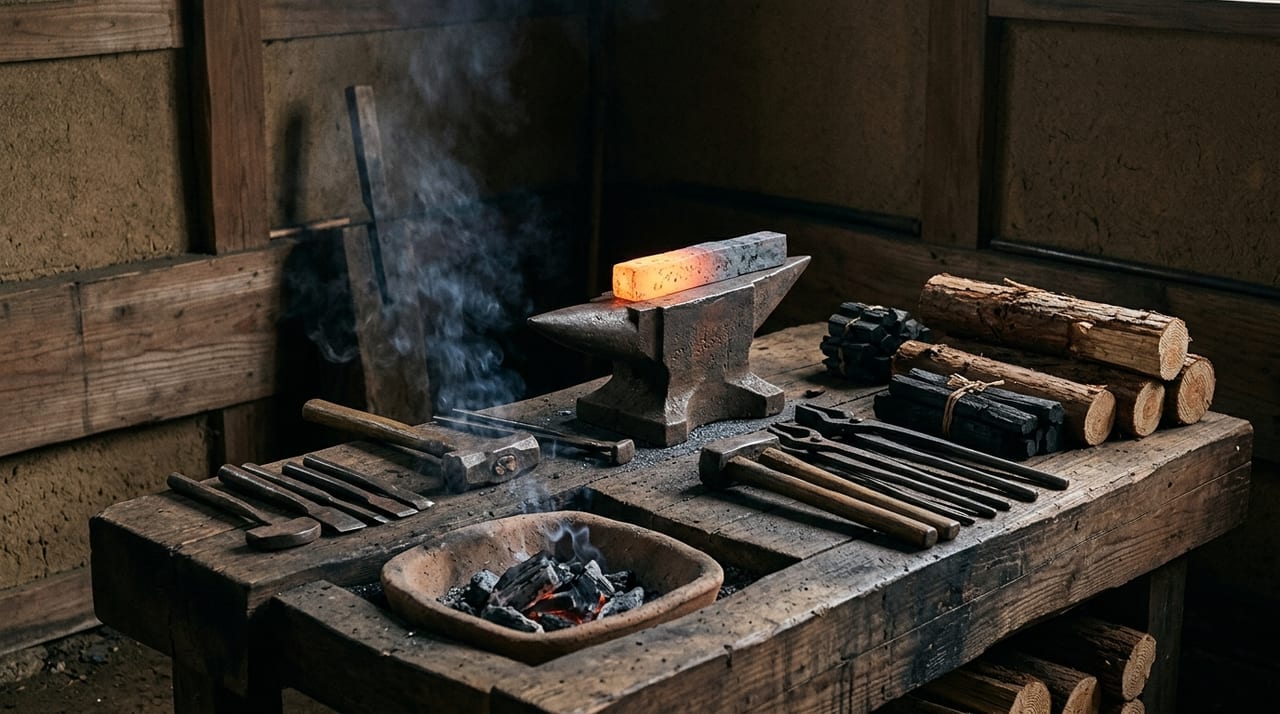
 * Image is for illustrative purposes only.
Tegai Kanenori
手掻包則
Description
Master Swordsmith Kanenori of the Yamato Tegai School
Tegai Kanenori was a renowned swordsmith of Yamato Province (present-day Nara Prefecture) who flourished from the Late Kamakura period through the early Nanboku-chō era, and stands as one of the most celebrated masters of the Tegai school, one of the five major Yamato schools. The Yamato tradition refers to the sword style developed by the collective of swordsmiths of Yamato Province centered in Nara, characterized by masame-grained jitsuji (straight-grain steel), predominantly suguha (straight-edged) hamon, and an archaic, refined aesthetic. The Tegai school is known to have been based near the Tengen Gate (also called the Tekaki Gate) of Tōdai-ji Temple, where it flourished as a distinct lineage. Kanenori ranks among the most highly regarded swordsmiths of this lineage and is remembered by posterity as a master who embodied the very essence of the Yamato tradition.
The Yamato tradition in swords originated as practical combat tachi (longswords) employed by the religious institutions of Nara, particularly the warrior-monks of Kōfuku-ji and Tōdai-ji, from the late Heian period through the Kamakura era. Yamato Province became a major center of weapon production, developing its distinctive style while responding to demand from both the imperial court and the samurai class. Among Yamato swordsmiths, the Tegai school established a unique position through its particularly orderly masame-grained steel and dignified straight-edged blades.
Kanenori's Steel—The Essence of Yamato Masame-Grain
The most remarkable aspect of Kanenori's work is the distinctive beauty of the jitsuji (steel) characteristic of the Yamato tradition. A distinguishing feature of the Tegai school is the appearance of masame (straight grain) or masame-influenced itame (wood-grain pattern) in the jitsuji. Masame grain appears as straight, parallel lines in the steel surface, resembling the annual rings of wood cut lengthwise—creating a wholly different aesthetic from the itame of the Bizen tradition or the ōhada (large grain) of the Sōshū tradition. Kanenori's masame grain is exceptionally orderly and beautiful; when viewed in light, the straight lines flow seamlessly across the surface, creating a presence that combines serene tranquility with striking visual impact.
Jinie (fine nie crystal patterns in the steel) appears finely and uniformly throughout, combining with the masame surface to create a crystal-clear, orderly beauty of the jitsuji. The steel of the Yamato tradition is sometimes praised as "jitsuji that stands out" for its distinctive presence, and in Kanenori's work, abundant jikei (steel patterning) and jinie create a powerful impression on the viewer.
The Hamon—Suguha and Archaic Beauty
Kanenori's hamon (blade pattern) is fundamentally suguha (straight-edged), possessing the archaic refinement distinctive of the Yamato tradition. The hamon is fundamentally nie-deki (composed of fine nie crystals), with fine nie distributed uniformly throughout. The nioi-guchi (scent boundary) is tightly drawn, and while the demarcation between hamon and jitsuji is clear, it displays a natural transition that reveals sophisticated mastery.
A characteristic feature of Yamato hamon is the occasional subtle notare (undulation) added to the suguha, lending variation and depth to what might otherwise be a simple straight edge. In Kanenori's hamon, while the overall form is suguha, subtle undulations appear throughout, revealing increasingly rich detail upon close examination. The hamon displays abundant kinsuji (gold streaks) and sunagashi (sand-streaking patterns), concealing complex beauty beneath a serene exterior.
Signatures and Extant Works
Kanenori's signature appears as either the two-character "Kanenori" or the four-character "Tegai Kanenori," rendered in bold, well-formed script. Several extant tachi by Kanenori are designated Important Cultural Properties or National Treasures, and are highly regarded as masterpieces of the Yamato Tegai school. Works with deep ties to Kōfuku-ji and Kasuga Taisha remain preserved, serving as precious cultural artifacts that convey the actual state of sword culture in Nara during the Kamakura period.
Kanenori's blades are frequently discovered in ancient temples and shrines of Yamato, and having been preserved as votive offerings for extended periods, they are generally in relatively good condition. The orderly beauty of the masame grain and the dignified hamon are vividly restored by modern polishing, allowing us today to directly experience the skill of this Kamakura-era master.
The Tegai School Among the Five Yamato Schools
Among the five major schools of the Yamato tradition (Sentemei, Taima, Tegai, Shikake, and Hōshō), the Tegai school is known for its particularly orderly jitsuji and refined hamon, and is frequently regarded as the lineage that most purely embodied the "formal beauty" of the Yamato tradition. Kanenori demonstrated the highest degree of perfection within the Tegai school and is remembered by posterity as the archetypal representative of the Yamato tradition as a whole.
While many Yamato swords from the late Kamakura through the Nanboku-chō period show the influence of the Sōshū tradition and stylistic change, the works of Kanenori's era preserve the pure form of the Yamato tradition before the full development of Sōshū influence, occupying an important position in the study of Yamato sword history.
Kanenori's Blades and Buddhist Culture
The fact that Yamato swordsmiths worked under the patronage of Buddhist temples and Shinto shrines symbolizes the profound connection between the Japanese sword and religious and spiritual culture. The warrior-monks of Kōfuku-ji wielded tachi in actual combat, yet they revered the blade as a sacred weapon and perceived spiritual significance in the work of accomplished swordsmiths. One might say that Kanenori's blades are imbued with this spiritual background.
The orderly beauty of the masame grain and the serene refinement of the suguha embody the aesthetic of the Zen garden—the philosophy that true beauty dwells in the elimination of the superfluous. Moreover, the fact that Kanenori's tachi have been carefully preserved as votive offerings at Kasuga Taisha and Kōfuku-ji demonstrates that the people of his time recognized his blades not merely as weapons, but as sacred objects worthy of presentation to the Buddhas and kami.
When we understand the cultural context in which the Japanese sword is revered as a "sacred treasure," we come to appreciate anew how crucial was the role played by great Yamato masters such as Kanenori. To contemplate a tachi by Kanenori in our own time is not merely to view a medieval artifact, but to experience a cultural universe where Japanese religion, the way of the warrior, and art converge as one.
Famous Works
- 太刀(国宝)
- 太刀(重要文化財)