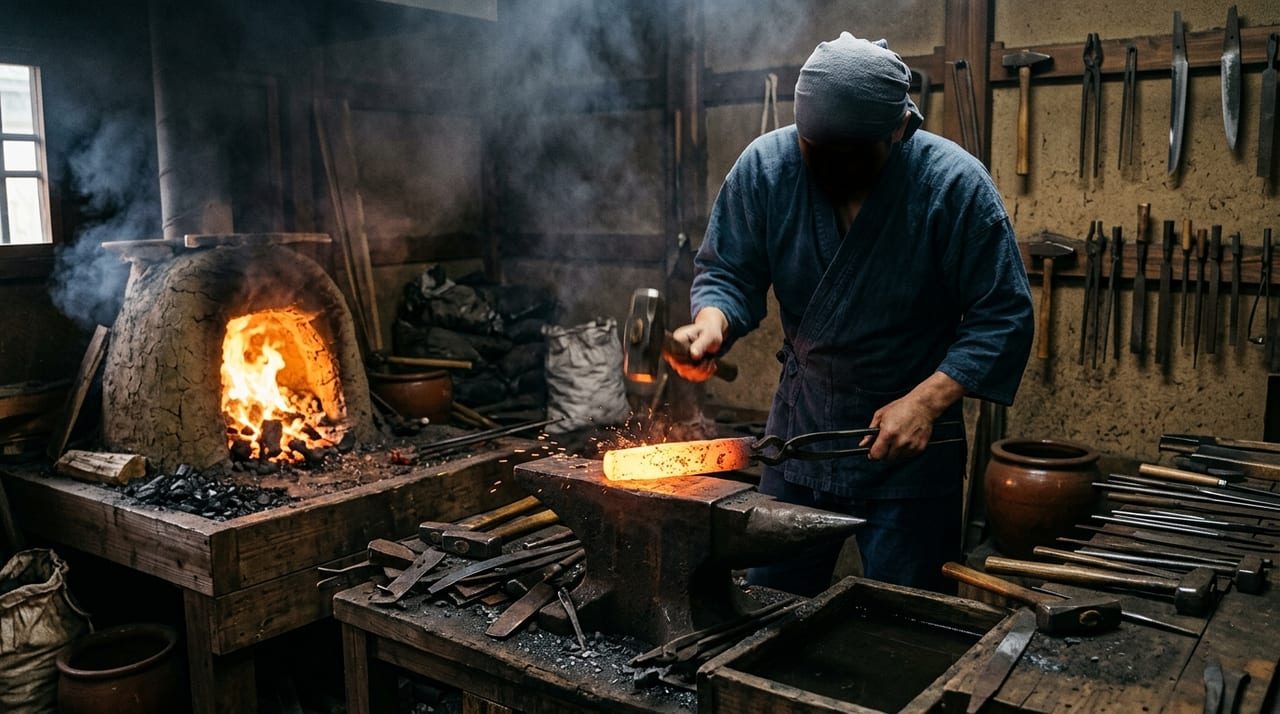
 * Image is for illustrative purposes only.
Tegai Kanenaga I
手掻包永(初代)
Description
Tegai Kanenaga——Founder of the Tegai School, One of the Five Yamato Schools
Tegai Kanenaga (first generation) was a swordsmith of the late Kamakura period who set up his workshop in front of the Tengai-mon gate of Tōdai-ji in Yamato Province. He is the founder of the Tegai school, one of the five Yamato schools. His common name was Heizaburō, and there is a record of his activity during the Shōō era (1288–1293). Among the five Yamato-den lineages (Senjuin, Taima, Shikkake, Tegai, and Hōshō), the Tegai school has left the largest number of extant works and is also the largest as a lineage.
Among items designated or certified by the state, there are one National Treasure sword, six Important Cultural Properties, and nine Important Art Objects.
Characteristics of Style
Shape is a chū-zori curve with a slight koshi-zori tendency (also called kyō-zori), and the chūkissaki point is the standard. The kasane is thick, the hiraniku is well developed, and the shinogi is high. A broad shinogi-haba and a sturdy overall construction are its hallmarks, embodying the austere aesthetic of Yamato-den.
Jigane (base steel) is masame-hada with itame mixed in, which is the common characteristic of the entire Tegai school. In the first-generation Kanenaga, however, the ko-itame is well refined, and compared with other Yamato smiths, the masame is less conspicuous. Jibuie appears evenly, forming the compact ground texture peculiar to the Tegai school.
Hamon (temper line) is based on "chū-suguha" and includes hataraki such as kuichigai, hotsure, and nijūba. These hataraki are a design consistent across the entire Tegai school and were passed down as a tradition since Kanenaga.
Bōshi (tip temper) has a shallow kaeri and takes the form of yaki-tsume or kaen (flame).
Representative Works——The National Treasure Tachi and the Meibutsu "Konotegashiwa"
Tachi, signed "Kanenaga" (National Treasure; in the collection of Seikado Bunko Art Museum) is the most highly regarded of Kanenaga's signed works. It passed from the Iwasaki family into Seikado Bunko and is a central piece of the sword and metalwork collection of Seikado Bunko Art Museum.
Meibutsu "Konotegashiwa Kanenaga" is a tachi named by Hosokawa Yūsai, transmitted as the foremost famous blade of the Mito Tokugawa family, and it is also recorded in the Kyōhō Meibutsuchō. The origin of the name is said to be that the haki-omote has midare-ba while the haki-ura has a suguha, so the hamon differs between the two sides. It was damaged and burned in the Great Kantō Earthquake of 1923 (Taishō 12), and it is now held by the Tokugawa Museum.
Combining the six Important Cultural Properties and nine Important Art Objects, fifteen swords have received designations at the intermediate level or above, and these numbers make clear how representative Kanenaga is as a smith of Yamato-den.
Evaluation and the Historical Significance of the Tegai School
Among the Five Yamato Schools, the Tegai school left the largest number of successors and extant works and is the largest school. The skill and formative influence of the first-generation Kanenaga, who laid its foundation, are immeasurable. As the school that most richly developed the aesthetics of the suguha lineage of Yamato-den, the Tegai school continued to bear the core of Yamato swords from the late Kamakura period through the Nanboku-chō and Muromachi periods. Kanenaga holds a firm place in the history of Japanese swords as one of the representative smiths of Yamato-den.
Famous Works
- tachi “signed Kanenaga” (National Treasure, held by Seikado Bunko Art Museum)
- named Konotegashiwa Kanenaga (fire-damaged in the Great Kantō Earthquake, kept at the Tokugawa Museum)
- Important Cultural Property tachi, 6 pieces
- Important Art Object, 9 pieces