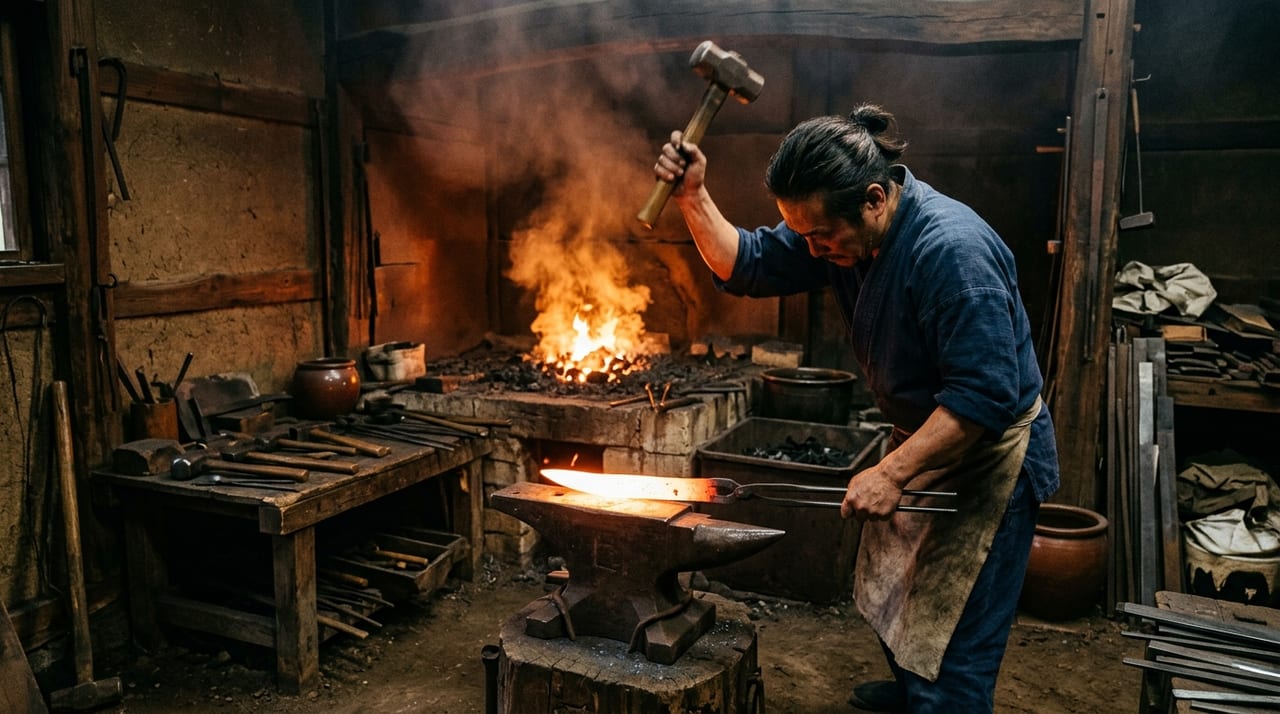
 * Image is for illustrative purposes only.
Takada Tomoyuki
高田友行
Description
Takada Tomoyuki and the Establishment of the Bungo Takada School
Takada Tomoyuki was a swordsmith who was active in Takada in Bungo Province (present-day Ōita Prefecture) from the Nanbokuchō period into the early Muromachi period. He is regarded as the restorer of the Bungo Takada school or, in effect, a figure of founding-patriarch status. In Takada in Bungo, Tomoyuki established a sword-making tradition that was later called “Ko-Takada.”
As a sword-producing region of Kyushu, Bungo nurtured a distinctive style of its own alongside the Naminohira school of Satsuma. Bungo swords have generally been described as having little aesthetic beauty for appreciation, yet excelling in practicality: they do not break, do not bend, and cut well. Swords of the Takada school were also made with an emphasis on practicality, and in an age of warfare they were sought for their sharpness and sturdiness.
Characteristics of Ko-Takada Works
The blades of Ko-Takada (Nanbokuchō to early Muromachi), as represented by Tomoyuki, are distinctive works that display the jigane peculiar to Bungo. The jigane tends to have large itame grain that flows, and its iron color is slightly tinged with black. Ji-nie is present, but the quality of its nie differs from that of Bizen works and Yamashiro works.
The hamon is mainly gunome or ko-gunome, and shows a bright hamon edge in which ashi and yō appear frequently. Some works mix in chōji-midare, but overall there are many orderly hamon with little variation. The bōshi often turns into a small round (komaru) shape after a shallow midare runs in from the yokote.
The kasane is relatively thick, a construction that emphasizes practical strength as a sword. This corresponds to the point that Bungo swords have long been valued for their high practicality.
Evaluation and the Development of the Takada School
The techniques of the Takada school established by Tomoyuki were thereafter divided into periods as “Ko-Takada” and “Hira-Takada,” and developed through the Sengoku and Edo periods into one of Kyushu's leading sword-making centers. Among Japanese swords, Bungo swords tended to place greater emphasis on practicality than on appreciative beauty.