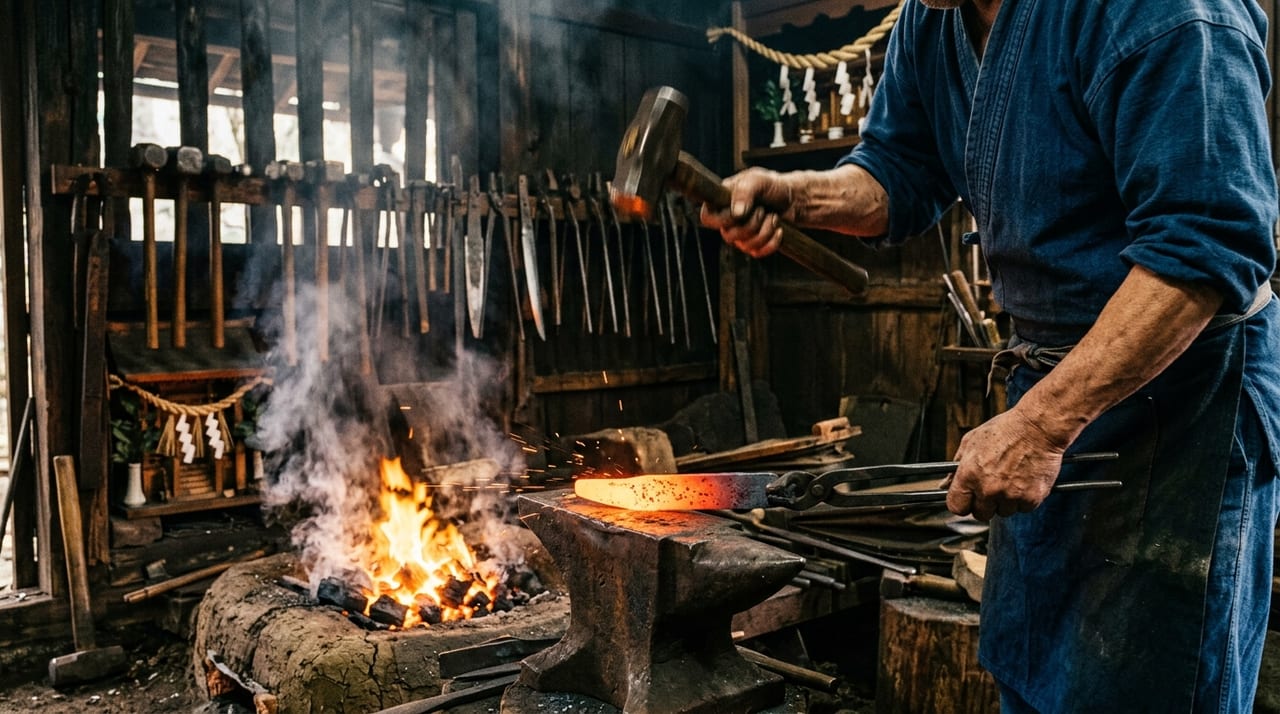
 * Image is for illustrative purposes only.
Shikkake Norinaga
尻懸則長
Description
Shikkake Norinaga was a swordsmith active in Yamato Province (present-day Nara Prefecture) from the late Kamakura period through the Nanboku-chō period, and is a representative maker of the Shikkake school, one of the five Yamato schools. Since ancient times, Yamato has had groups of swordsmiths who worked under large temples, including Tōdai-ji and Kōfuku-ji. The five schools, namely the Senjuin school, the Taima school, the Shikkake school, the Tegai school, and the Hoshō school, are collectively called the five Yamato schools. The founder of the Shikkake school is traditionally said to be Norihiro, but no extant work by Norihiro is known with certainty, so the accepted view treats Norinaga, said to be his son, as the de facto founder of the school and its representative smith. The name "Shikkake" is said to derive from the name of the place in Yamato where the family lived. Furthermore, the name Norinaga was not limited to a single generation. It was passed down over several generations from the late Kamakura period into the Muromachi period, and most extant signed works are judged to be by the first generation of the late Kamakura period or by a generation close to it.
The style clearly shows the characteristics of the Yamato tradition, and the jigane is itame with masame flowing through it. In particular, the ground pattern in which the area near the shinogi flows as mokume-hada and the area near the cutting edge flows as masame-hada is called Shikkake-hada, and it is regarded as a highlight that characterizes the steel of the school. The hamon is based on suguha, with ko-gunome and ko-midare mixed in. Within the hamon, hotsure and nijūba workings are seen, along with tamagaki-ba that run in regular succession. The bōshi is mostly hakikake. Overall, the nie workings are rich. The style is said to share features with the works of the Tegai school and of Kanenaga, both of the same five Yamato schools, but Norinaga's works are evaluated as having nie that is thicker than Kanenaga's. These features, namely the masame-mixed ground steel, the suguha-based hamon, and the nie-based workmanship, rest on the tsukurikomi common to the Yamato tradition.
Smiths of Yamato, because of their affiliation with temples, left many works that have been transmitted unsigned, and in many cases the school and maker were determined by later attributions (kiwame). Among them, Norinaga left signed works, which makes him a valuable figure, since the style of the school can be known through reliable reference works. Among signed tachi, there are examples inscribed 大和則長作 (Yamato Norinaga saku) and examples inscribed 大和尻懸住 (Yamato Shikkake jū), which prefixes the place of residence.
As a representative work, the tachi signed 大和則長作 (Yamato Norinaga saku) is designated an Important Cultural Property (designated Shōwa 27 (1952); owned by the Kurokawa Institute of Ancient Cultures). It measures 73.3 centimeters in blade length and 2.0 centimeters in curvature, and shows the form of a tachi with medium curvature and a chū-kissaki. The tsukurikomi, with its wide and high shinogi, clearly displays the features of Yamato works. This single piece vividly shows Norinaga's highlights, namely the hamon mixing gunome with suguha, and from its form it is judged to be a work of Norinaga from the late Kamakura period. Norinaga is highly evaluated as a jōsaku-ranked smith representative of the Yamato tradition.
Famous Works
- Tachi signed Yamato Norinaga saku (Important Cultural Property, Kurokawa Institute of Ancient Cultures)