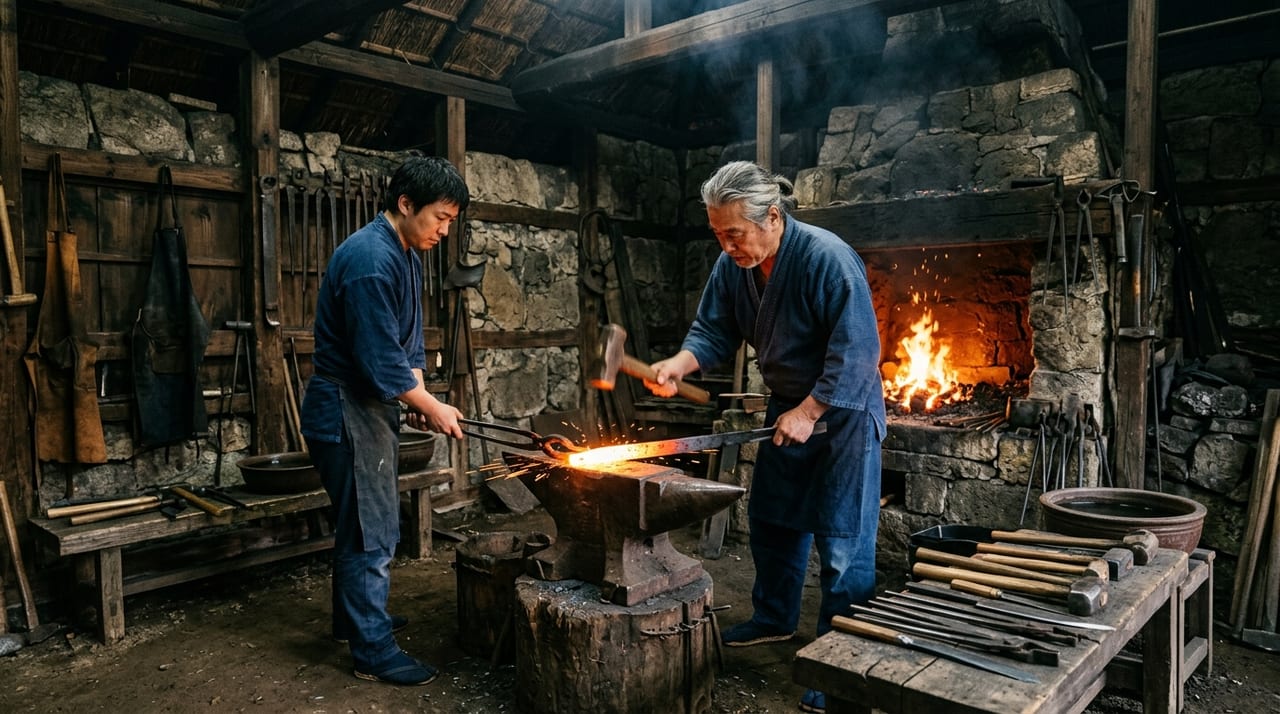
 * Image is for illustrative purposes only.
Senjuin Yukinobu
千手院行信
Description
Senjuin Yukinobu's Background and the Founding of the Senjuin School
Senjuin Yukinobu was a swordsmith active in Yamato Province (present-day Nara Prefecture) in the late Heian period. He is traditionally regarded as the founder of the Senjuin school, one of the Five Yamato Schools. Yukinobu is said to have served as a jōji hōshi (temple attendant monk) at Senjuin, a subtemple of Tōdai-ji. A jōji hōshi was responsible for the miscellaneous duties and service of a temple. It is said that from this position he became the house smith of Senjuin and thereby founded a school. His period of activity is generally placed in the Chōshō era (1132–1135), and he is considered the earliest known name among the swordsmiths of the Yamato tradition.
The Five Yamato Schools are the Senjuin school, together with the Taima, Shikkake, Tegai and Hōshō schools. Collectively they refer to groups of Yamato-tradition swordsmiths with bases in various parts of Nara Prefecture. The Senjuin school is known as the school with the oldest history among the Five Yamato Schools, and it has a forging tradition that continues unbroken from Yukinobu's time.
The Rarity of Signed Works and Historical Background
No signed works by Senjuin Yukinobu or the other smiths of Ko-Senjuin survive. The school's patrons were mainly temples such as Senjuin and Tōdai-ji. Its swords were used by sōhei (warrior monks) during each period of warfare, and many are said to have been worn out or lost in fires. For this reason, individual swords made by Senjuin Yukinobu cannot be identified. However, an unsigned tachi attributed to Ko-Senjuin has been designated as a Tokubetsu Jūyō Tōken (Special Important Sword), and it conveys the school's skill to the present day.
Characteristics of the Work and the Yamato Tradition
Swords made by Ko-Senjuin, represented by Senjuin Yukinobu, are mostly tachi that combine the elegance of Heian-period swords with functional beauty. The blade is slender, with a pronounced funbari and high koshizori. It faithfully embodies the style of the late Heian period. The kissaki is small, giving a classical impression that contrasts with the larger kissaki of the Kamakura period and later.
The jigane shows masame-hada mixed into an itame flow, with fine ji-nie. The masame jigane common to the Yamato tradition is one of the most distinctive features of the Senjuin school. The hamon is mainly suguha with nie-hon'i, mixed with ko-midare, nijūba and kuichigaiba. The bōshi is yakizume or kaen. This Yamato-specific combination of masame jigane and suguha with nie is clearly different from the nioi-de chōji-midare of the Bizen tradition and the intense nie of the Sōshū tradition.
The Development of the Senjuin School and Its Place in the Yamato Tradition
The Senjuin school founded by Yukinobu later produced Rikiō, Sadashige and Nagayoshi, and during the Kamakura and Nanboku-chō periods it formed the core of the sword-making culture of Yamato Province. Among the Five Yamato Schools, the Senjuin school holds a special position as the school with the oldest lineage. Its establishment of the Yamato tradition as an independent style alongside other traditions such as Bizen and Sōshū played an important role in the history of Japanese swords.
Although Senjuin Yukinobu is an ancient swordsmith whose signed works are difficult to confirm, his school is still valued in historical research today. In this respect, he is remembered in later generations as a figure who laid the foundation of the Yamato tradition.
Famous Works
- Tachi, unsigned (mumei) Ko-Senjuin (Tokubetsu Jūyō Tōken, attributed to the Senjuin school)