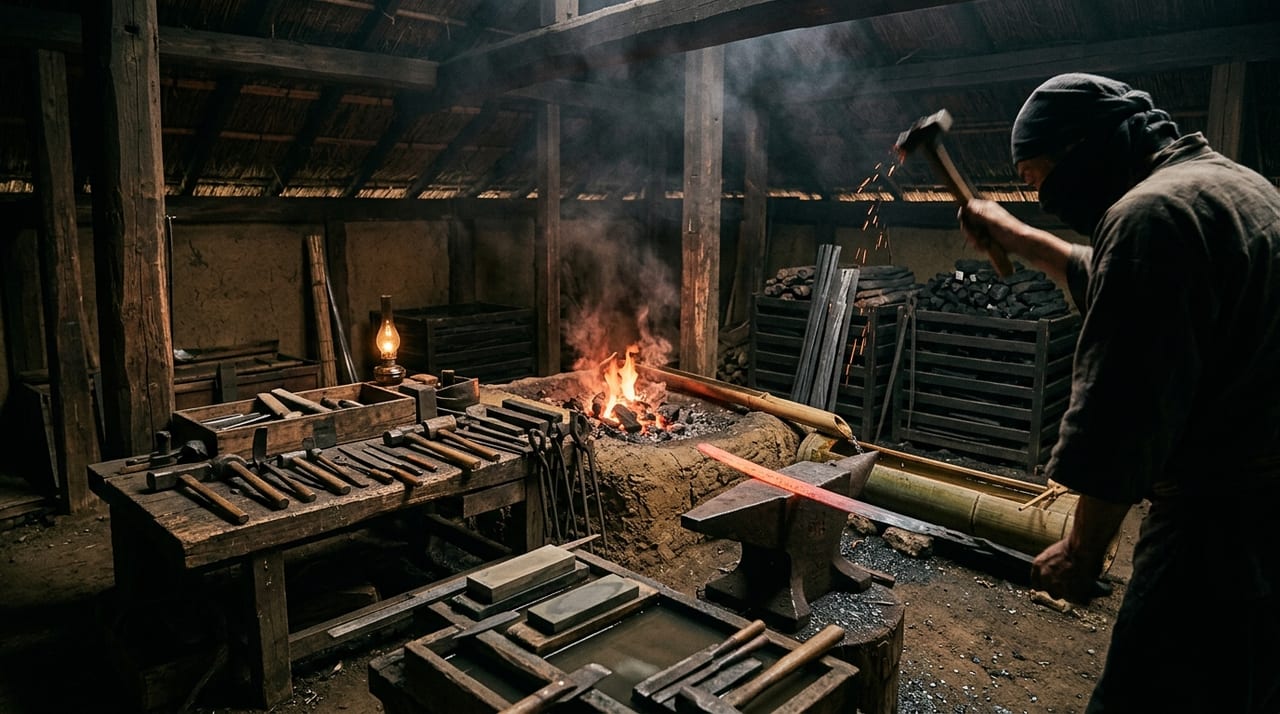
 * Image is for illustrative purposes only.
Sekishū Naotsuna
石州直綱
Description
Sekishū Naotsuna was a swordsmith active in Iwami Province (present-day western Shimane Prefecture). Several generations bore the same name: the first is said to have worked around the Kenmu era (1334-1336), the second around the Eiwa era (1375-1379), and the third around the Ōei era (1394-1428).
Relationship to the "Ten Great Disciples of Masamune"
As Masamune's Sōshū tradition spread across the provinces, Naotsuna of Iwami came to be counted among the "Masamune Jittetsu" (Ten Great Disciples of Masamune), alongside Rai Kunitsugu and Hasebe Kunishige of Yamashiro, Kaneuji and Kanashige of Mino, Gō Yoshihiro and Norishige of Etchū, Kanemitsu and Chōgi of Bizen, and Samonji of Chikuzen. However, few of Naotsuna's surviving works can be called top-tier Sōshū-style pieces, and the chronology makes a direct master-disciple relationship with Masamune difficult to confirm as historical fact; some scholars regard the association as a later embellishment.
Style
The steel (jigane) shows itame mixed with mokume patterns. The hamon combines angular gunome with pointed elements. Vigorous activities such as kinsuji, sunagashi, yubashiri, and tobiyaki appear prominently, and the blades show the wide, large-kissaki, robust shape typical of the Nanbokuchō period.
Reputation
Some surviving Naotsuna blades, judged sound in both the steel and the edge and well preserved, have been designated Important Swords (Jūyō Tōken). While the direct discipleship under Masamune remains disputed, Naotsuna is recognized as a smith who embodied the Sōshū style in the outlying province of Iwami.