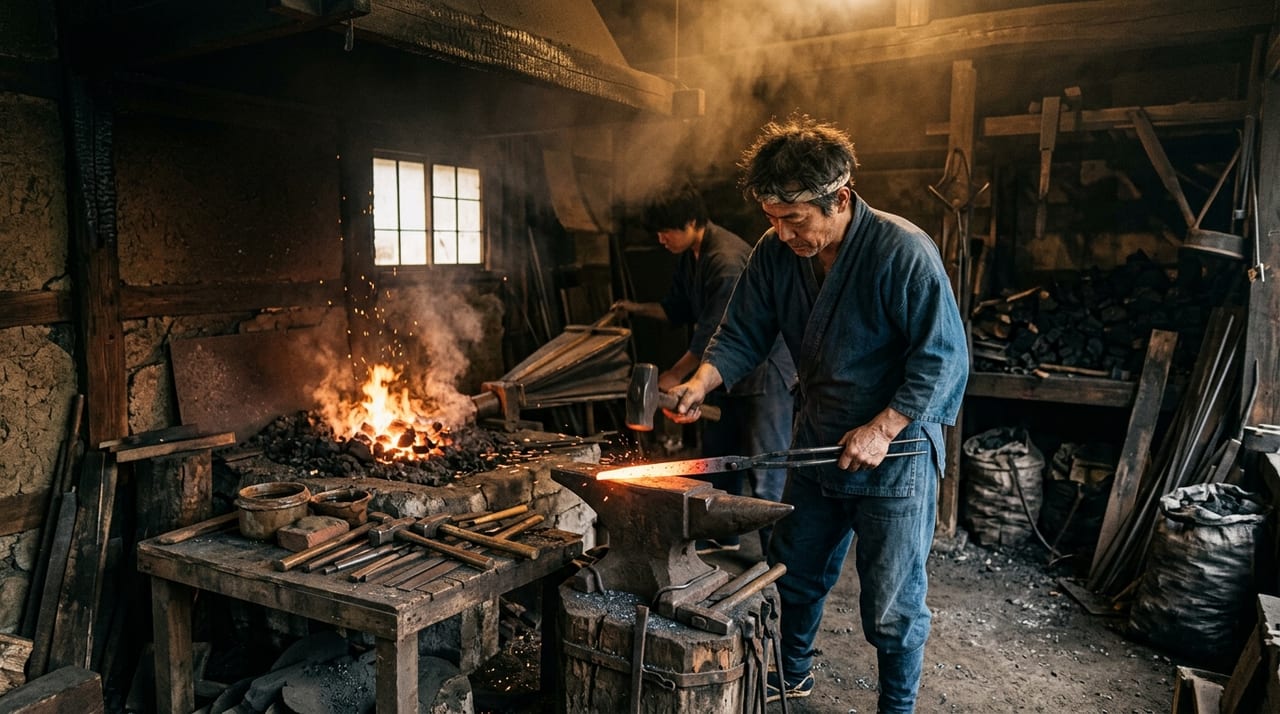
 * Image is for illustrative purposes only.
Seki Kanetsune
関兼常
- Period
- Muromachi Period
- School
- Nara School of the Seven Schools of Seki
- Active Years
- early Muromachi period onward
- Tradition
- Mino Tradition (Seki)
Description
Seki Kanetsune was a swordsmith active in Seki, Mino Province (present-day Seki City, Gifu Prefecture) during the Muromachi period, known as the founder of the Nara school, one of the "Seven Schools of Seki" that made up the guild organization of the Seki swordsmiths.
The Seven Schools of Seki and the Nara School
The Seven Schools of Seki were seven schools formed by the smiths of Seki. They comprised the Zenjō school of Kaneyoshi, said to be the chief house, the San'ami school of Kanenori, the Muroya school of Kaneari, the Ryōken school of Kanemune, the Tokunaga school of Kanehiro, the Tokuin school of Kaneyasu, and the Nara school of Kanetsune. With Kasuga Shrine as its seat, the Seki smiths formed the kajiza, a self-governing guild that was run by consensus among representatives of the seven schools, a system called the "Shichitō-sei" (seven-head system). As founder of the Nara school, Kanetsune is counted among the representative Seki smiths of the early Muromachi period.
Style
The smiths of Seki drew on the Yamato tradition while developing their own forging methods, giving rise to the Mino tradition, one of the Gokaden or five great schools of Japanese swordmaking. Its defining character lies in thoroughly practical swordmaking that pursued cutting ability and sturdiness above all. Kanetsune belonged to this formative current of the Mino tradition and helped establish Seki's standing as a production center for battle-ready blades, demand for which surged during the Sengoku period.
Reputation
Each of the seven schools produced numerous smiths over successive generations, providing the ground from which such leading masters of the Mino tradition as Magoroku Kanemoto and Izumi no Kami Kanesada emerged. The name Kanetsune too was passed down by later generations, continuing as a lineage of Seki swordsmiths. As one of the founders who underpinned the rise of Seki as a major production center, he remains an essential figure in the history of the Mino tradition.