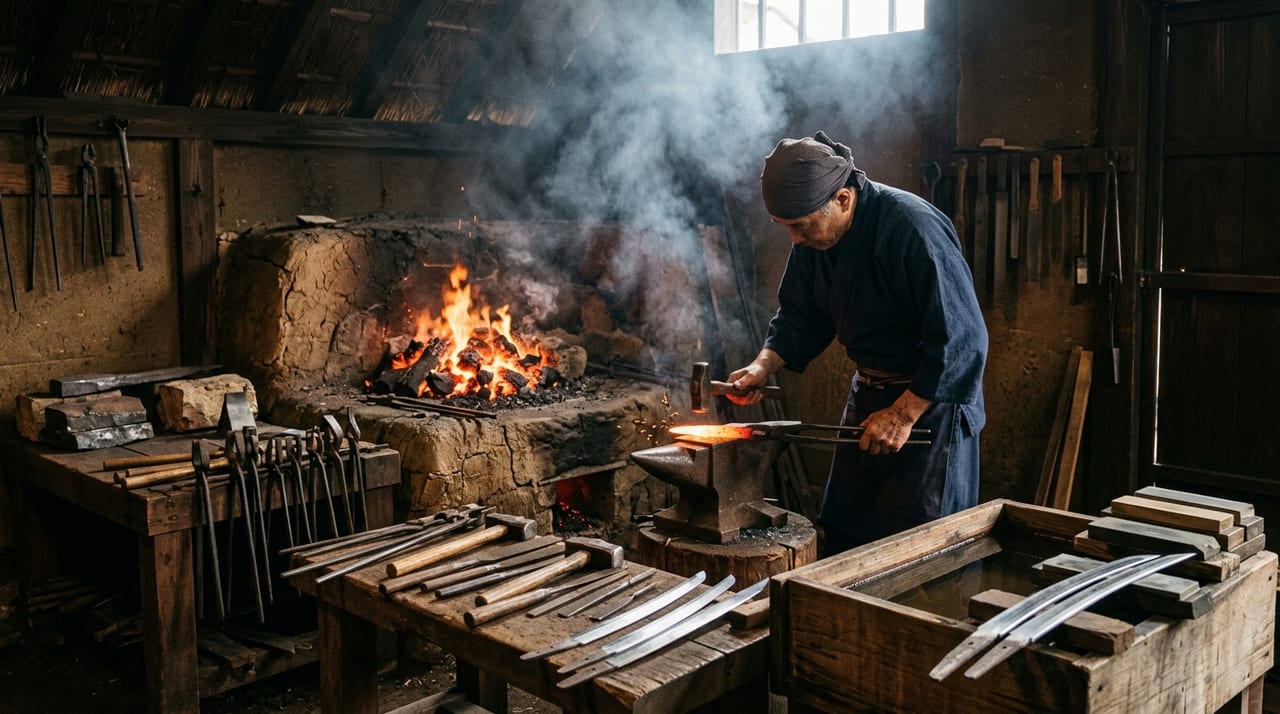
 * Image is for illustrative purposes only.
Rai Kunitsuna
来国綱
Description
The Raikai School of Swordsmiths—Rai Kunitsuna
Rai Kunitsuna was a swordsmith of the Raikai school who was active in Yamashiro Province (present-day Kyoto Prefecture) during the Kamakura period. The Raikai school was a prestigious lineage representative of the Yamashiro tradition, with Rai Kuniyuki considered its de facto founder, followed by smiths such as Rai Kuniton, Rai Kunimatsu, and Rai Kunitsugu, who established the school's golden age from the late Kamakura period through the Nanbokucho period. Rai Kunitsuna was part of this Raikai lineage, positioned as a later generation after Rai Kuniyuki, though few signed works by his hand survive and much of his biographical record remains unclear.
The Raikai Style
Blades of the Raikai school are characterized by tightly packed small mokume grain with uniformly distributed hardness throughout the jigane, creating brightly lustrous and refined steel surfaces. The hamon is primarily straight interspersed with small irregular patterns and small gunome-style wave formations, with bright and crisp nioi. In contrast to the robust and dramatic nie formations of the Soshu tradition, the Raikai school is distinguished by intellectually refined and delicate craftsmanship—a shared aesthetic among the lineage. Blades attributed to Rai Kunitsuna similarly display this characteristic Yamashiro tradition elegance.
Caution Against Name Confusion
The name 'Kunitsuna' appears among multiple swordsmiths, so care must be taken to avoid confusion. The famous 'Onimaru Kunitsuna,' one of the Tenka Gotetsu (Five Swords Under Heaven), was forged by Awataguchi Kunitsuna of the Awataguchi school, a different smith from Rai Kunitsuna of the Raikai school. Similarly, the tachi 'Sohaya no Tsuruki,' which was venerated by Tokugawa Ieyasu and is preserved at Kunozan Tosho-gu Shrine, is attributed to Miike Tentaro Mitsuyo, not to Rai Kunitsuna. The founder of the Raikai school was Rai Kuniyuki, not Rai Kunitsuna. These distinctions are frequently confused with one another.
The Origin of the Name 'Rai'
Regarding the character 'Rai' (来) of the Raikai school, several theories have long been transmitted: one suggests it derives from the school's founder being a lineage that came from the continent, while another traces it to the single character 'Rai' that became the prefix to the school's signatures. What is certain is that from Rai Kuniyuki onward, the lineage customarily inscribed signatures prefixed with the character 'Rai' on the tang of their tachi, establishing this as the school's distinctive name. Rai Kunitsuna, too, was a smith of this lineage characterized by the 'Rai' prefix.
The Genealogical Significance of the Raikai School
Beginning with Rai Kuniyuki, the Raikai school left a substantial legacy as the core of the Yamashiro tradition. Rai Kuniton in particular left numerous dated works that provide a chronological framework for studying the late Kamakura period. Rai Kunitsuna is counted among the smiths who upheld the Kyoto forging tradition as a member of this lineage.
Touken-za and Rai Kunitsuna
Touken-za presents Rai Kunitsuna as a swordsmith of Yamashiro connected to the prestigious Raikai school. Though often confused with the same-named Awataguchi Kunitsuna or with Rai Kuniyuki, the founder of the Raikai school, each is a distinct historical figure. Rai Kunitsuna's name has been transmitted as a smith who bore a significant role in the vast genealogical lineage of the Raikai school.
Famous Works
- ソハヤノツルキ(重要文化財・久能山東照宮)
- 太刀(東京国立博物館蔵・重要文化財)