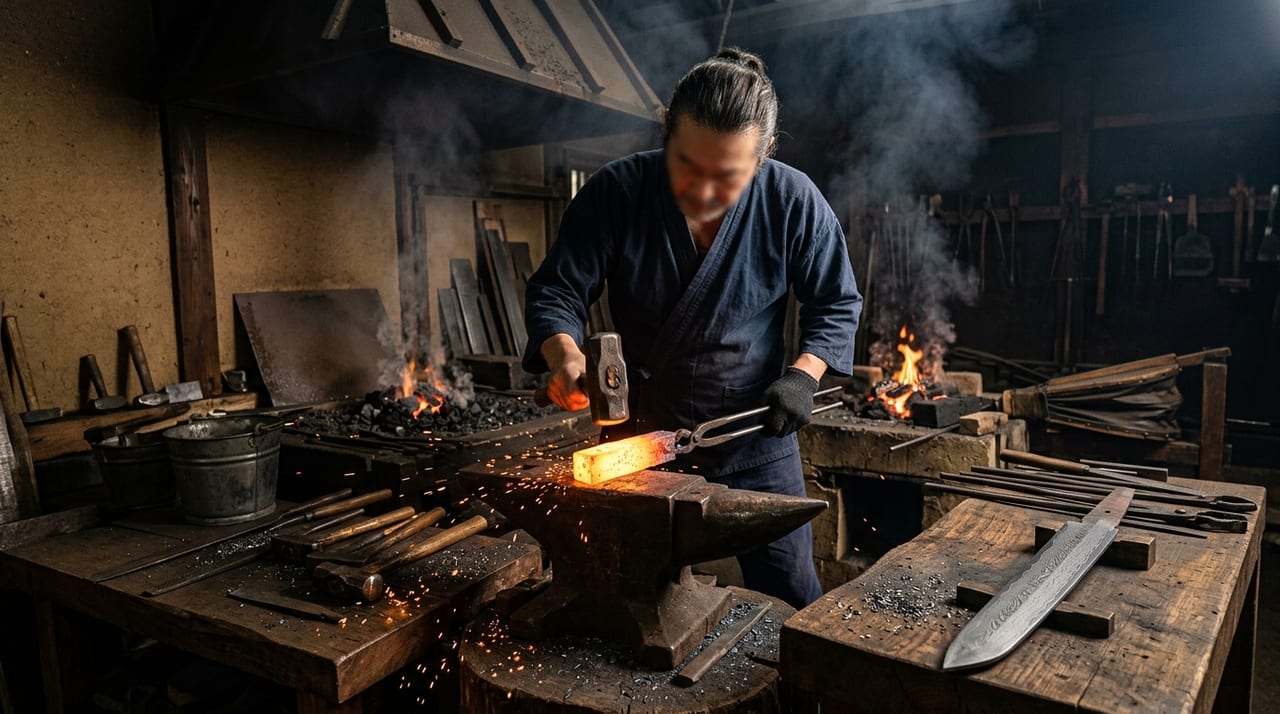
 * Image is for illustrative purposes only.
Osafune Tomonari
長船友成
Description
Osafune Tomonari was a Bizen Province swordsmith active from the late Heian to early Kamakura period, recorded in history as a representative of Ko-Bizen, known as Japan's largest sword-producing area.
Tomonari's era represents the most important transitional period as the Japanese sword's form evolved toward completion. During the transition from the elegant, slender, high-curvature blades of the Heian period to the powerful, functional forms of the Kamakura period, it is said that Tomonari left works embodying the characteristics of both eras. His jigane displays the fundamental qualities of the Bizen tradition, with tightly packed ko-itame and abundant ji-nie, exhibiting a bright, clear quality. His hamon is fundamentally based on chōji-midare, with variations such as kawazuko-chōji and kenuki-gata-chōji visible within the pattern, and the genesis of the brilliance characteristic of Bizen swords can be discerned here.
Before Tomonari, Bizen swords belonged to the stream known as "Ko-Bizen," represented by smiths such as Masatsune and Kanehira. Tomonari was a representative swordsmith of the Ko-Bizen era, and his style became the source of later Bizen swords. The actual founder of the Bizen Osafune school was Mitsutada of the mid-Kamakura period, approximately 250 years later. This lineage subsequently produced many of the greatest names in Japanese sword history—Mitsutada, Nagamitsu, Kagemitsu, Kanemitsu, Morimitsu—functioning as the center of Japanese sword culture through the Kamakura and Muromachi periods.
Extant blades bearing Tomonari's signature are extremely rare, and signed examples are evaluated at the level of National Treasure or Important Cultural Property, the highest rank of ancient swords. This rarity reflects the fact that Tomonari lived approximately 900 years ago (in the 12th century), the small number of swords produced at that time, and the loss of many over the long passage of centuries. Yet the high technical standard demonstrated by the small number of surviving works testifies that Tomonari was not merely a nominal "founder" but a truly outstanding master craftsman.
In Japanese sword history, Tomonari holds great historical significance as a representative master of Ko-Bizen who left some of the oldest signed works in Japanese sword history. His lineage is positioned as a distant source stream in the prosperity of later Bizen swordsmith communities. As a figure who helped form the very foundation of Japanese sword culture, Tomonari remains an object of eternal reverence.
Famous Works
- 太刀 銘 友成(国宝候補)
- 太刀 銘 友成(重要文化財)